Revisiting Brussels' de-risking policy







Mitigating risks in EU-China relationships has become a prominent focus in contemporary policy discussions. The concept of "de-risking", a widely recognized strategy in financial and business domains aimed at diversifying risks to enhance the management of opportunities and challenges, proves equally valuable in the realm of international relations.
Re-examining this strategy is imperative, signifying a deliberate and repeated assessment to guarantee that the risk reduction process does not inadvertently result in significant losses of the substantial benefits derived from fostering deeper international collaborations.
The China-EU Summit, held in Beijing on Thursday, signifies the first in-person summit in four years. The event presents a pivotal occasion to explore the expansive collaboration prospects between China and the European Union, with special focus on key areas such as climate change and trade. And to make it productive, the EU expects China to take on increased responsibility in addressing global challenges within the framework of a rules-based international system, thereby fostering peace and security.
China is pursuing the ratification of the Comprehensive Agreement on Investment (CAI), a proposed deal between China and the EU. The agreement, already endorsed in principle by EU leaders in December 2020, still awaits ratification by the European Parliament.
For the EU, the CAI seeks to enhance market access for EU companies in China, addressing issues of asymmetry in market openness. It also seeks to establish explicit regulations on Chinese State-owned enterprises, "subsidy transparency", and prohibits practices such as "forced technology transfers", aiming to create a fairer and more balanced economic relationship. As such, the CAI can help stabilize the interest of EU business leaders to invest in China and to further develop trade relationships.
The concerns surrounding the signing of the CAI and its potential impact on the EU's strategy of de-risking its relations with China are multifaceted, with a predominant emphasis on the political implications of economic considerations. The ultimate outcome, however, remains contingent on the precise terms of the agreement and the manner in which it is executed.
Opponents of the CAI raise the specter of interference in market mechanisms and a departure from established rules governing market economies. This apprehension is rooted in the fear that such deviations could undermine globalization efforts and erode the integrity of market mechanisms. Furthermore, there are valid concerns that the agreement may inadvertently exacerbate existing trade imbalances, posing challenges to the EU's efforts to foster equitable economic relationships.
A recurring argument against the CAI revolves around the potential misuse of China's rising economic prowess. Critics posit that China might leverage its economic strength to exert economic and political pressure on other countries, thereby compromising their independence. This fear is grounded in the belief that the EU, by entering into such agreements, may find itself vulnerable to undue influence, undermining its autonomy on the global stage.
However, it is important to recognize that the realization of such dire scenarios is contingent on the EU's inability to navigate and safeguard its interests within the framework of these collaborations. A potential failure on the part of the EU to uphold its economic standing and profile within these partnerships might indeed lead to unwarranted dependencies.
The key lies in approaching this agreement as an opportunity for both sides to develop a mutually beneficial situation — a win-win scenario. By diligently addressing challenges, fostering transparency, and adhering to agreed-upon terms, the EU and China can establish a partnership that enhances economic cooperation without compromising the autonomy and strategic interests of either party. As these concerns are navigated and partnerships are developed on solid foundations, the EU can strive to maintain a delicate balance between collaboration and autonomy in its global relationships.
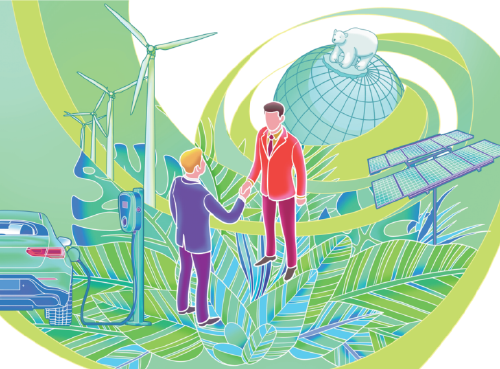
Addressing climate change represents a significant area of potential international collaboration between the European Union and China. This shared challenge is recognized as a key priority by EU policymakers, who acknowledge the necessity of China's substantial capacities and resources to effectively meet climate goals. Both the EU and China understand the complex challenges posed by climate change, desertification, pollution and biodiversity loss, viewing them as threats to humanity and the planet.
The EU and China have a history of cooperation on climate change through the EU-China Partnership on Climate Change. Committed to the goals of the Paris Agreement, they emphasize the importance of intensifying collaboration on climate change and clean energy. This commitment extends to joint research initiatives, including the food, agriculture, and biotechnology initiative and the recently introduced Climate Change and Biodiversity Project.
While recognizing the potential benefits of collaboration, it's essential to navigate the complexities involved, and make collaborative efforts to ensure mutual benefits and address the concerns of both parties. As the EU and China continue their cooperation on climate-related issues, maintaining a nuanced approach is crucial to fostering sustainable solutions and achieving a harmonious balance between environmental goals and national interests.
The author is a professor at the Free University of Berlin and the president of the Global Labor Organization, a Germany-based worldwide network of researchers investigating the path of globalization.
The views don't necessarily reflect those of China Daily.