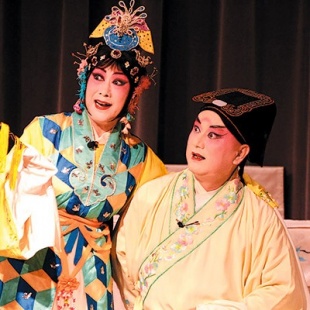



Kunqu Opera takes a bite of Big Apple







Decades of commitment
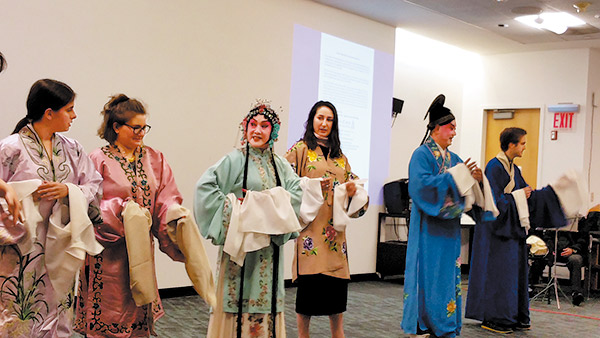
Kunqu Society of New York resident artists have maintained this commitment for 34 years, dedicating to teaching students on weekends. They didn't stop even during the COVID-19 pandemic, when they continued their workshops online, and now, on-site workshops are being conducted again at Flushing High School.
"Honestly, learning Kunqu is difficult. If you want to excel, you need a touch of talent and daily dedication," says senior instructor Cai Qinlin, in his 70s, who was a former member of the Shanghai Kunqu Opera Troupe.
Cai, clad in a black suit, is crouching on the floor of the high school, demonstrating to students how to portray a scared character in a scene from The Gorgeous Cloud Pavilion of the Qing Dynasty (1644-1911).
Cai instructs his students to pay attention to every detail, from the speed at which he crawls and the sound produced, then, to the tone of their voices, eye movements, and how their hands guide their eyes, making precise adjustments to perfect the scene.
"Kunqu is not just about singing; you also must act to make it understandable to the audience. Every movement and expression originates in these fundamental skills," Cai says. "It's like a child taking its first steps into the world — you have to learn to open your eyes, to lift your head, to roll over, to walk, to learn different steps, and to stretch your muscles."
Cai says that these fundamental skills constitute the performance. When he was a child, he recalls, he spent an entire semester learning nothing but how to walk, practicing, for four hours a day, steps that remain etched in his memory.
"These fundamentals are the lifeblood of Kunqu performers," says Cheng Min, artistic director and instructor of Kunqu fundaments in the Society. "Teaching and learning Kunqu requires a calm and steady mindset."
Learning Kunqu is akin to going to a karaoke bar for younger generations, Cheng says. While learning today may not demand the same training as in a professional troupe, it still requires undivided focus and dedication to properly combine singing, speaking, acting and fighting.
Guo Haichen, 20, has been learning Kunqu for the last four years. When Guo began learning Kunqu, she often skipped classes to go out and play. However, as time passed, she gradually realized her deep love for Kunqu, and started to learn in earnest, Cheng recalls.
Guo's progress helped her secure an opportunity to perform onstage in November. This was a new form of recognition for her, and also a positive challenge, as, even for amateur actors, securing a spot in the Society's performances is highly competitive.
Ye Zitao, 24, another enthusiast who has been learning Kunqu for a year, describes it as "difficult", but that performing Kunqu as a hobby is fortunate for him. "When I watched a performance, there were many tiny little details that I didn't notice at all. In addition to the fundamental moves, I have also learned how to express the emotions of the characters and portray their personalities. This involves pausing at specific moments, engaging with the audience, and coordinating with the musicians," Ye explains.
Ye says that Kunqu's complexity and difficulty are what attracted him the most, but these factors have become a challenge, as the audience is sometimes deterred by the form's intricacy.
Zhou Ming, the Society's music director and instructor, says that music also plays an important role, helping to pace the performance and provide the audience with a scene. A former musician at the Lincoln Center for the Performing Arts, Zhou oversaw the music for the production of The Peony Pavilion.
"Kunqu is a part of East Asian culture, and the cultural gap between China and the West runs deep. People may attend our shows just because it seems exotic, but they might not fully understand it. That's why we need to promote knowledge of Kunqu, especially its music, musical formats and different tunes," he says.