Traditional art form maintained by dedicated practitioners begins to attract greater interest, reports Mingmei Li in New York.
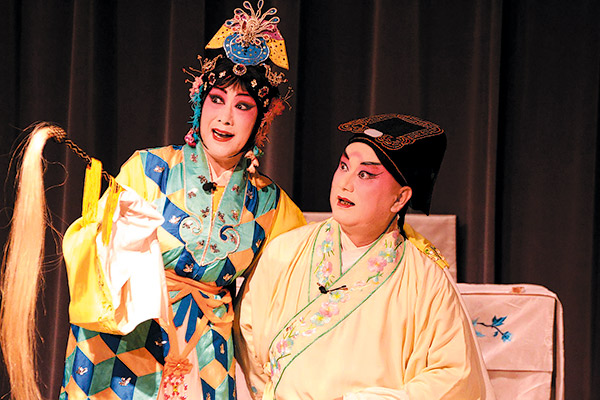
Aglance, a facial expression, a posture or a gesture, a spoken word, a tone accompanied by the melody of a flute and the resounding tap of a gong and drums, these are the fundamental elements of Kunqu Opera.
However, the direction of the gaze, the depth of the emotion expressed, the precise placement of hands and feet, the transition from stillness to movement, the repetition of lines dozens upon dozens of times during practice, the variation in tone and inflection, and the different characters, all meld with musical instruments of different frequencies. Add to this the rhythm and intensity of percussion and all these intricacies are repeatedly scrutinized and refined by Kunqu performers before they put on their costumes and makeup.
In New York, longtime Kunqu artists and students are working together to pass down the ancient traditional form from generation to generation, and Kunqu societies have been active in the city for over 30 years. And recently, these Kunqu Opera practitioners young and old staged a performance at the Big Apple to commemorate the 35th anniversary of the Kunqu Society of New York, a nonprofit culture and arts organization.
"My home is actually the birthplace of Kunqu, but I only began to systematically study it in the United States," says Daisy Huang, who comes from Jiangsu province, and has been studying Kunqu Opera for around 20 years.
"The show by Kunqu professionals and students maintains the same level of quality as an official production. The dedication to teaching is exceptional, and we faithfully preserved the essence of Kunqu," she adds.
For the last 30-odd years, the Kunqu Society of New York has been nurturing this cultural legacy, to preserve its splendor, and the Society has organized 300 public programs, including around 40 Kunqu performances.
"When Mei Lanfang (1894-1961) toured the US in 1930 to great international success, he included Kunqu as part of his performances. Today, Kunqu Opera touring the US may not cause a sensation quite as profound as Mei's tour, but all the performances bring together Chinese communities in the US, allowing overseas Chinese students and students of Chinese heritage to connect with a beautiful part of their culture. Kunqu serves as a kind of cultural ambassador, promoting mutual appreciation and respect," says Xu Peng, an associate professor at ShanghaiTech University, and who previously taught Kunqu stage production at the University of Hawaii in Manoa.
"Kunqu relies on being passed down from person to person," says Yin Jifang, former artistic director of the Kunqu Society of New York. Yin emphasizes that the Kunqu society's mission is to preserve and promote Kunqu, to ensure that it endures, whether in China or overseas.
As one of the oldest forms of Chinese opera still performed today, Kunqu was recognized as one of the Masterpieces of the Oral and Intangible Heritage of Humanity by UNESCO in 2001.
However, presenting this art form overseas is challenging, even today.
In the 1980s, there were Kunqu enthusiasts in the greater New York area, along with a few Kunqu clubs, according to Teng Chung-teh, vice-president of the Kunqu Society of New York. "Despite their (scattered) locations, they would often gather in small groups to casually perform scenes. However, there were no formal, professional Kunqu performances in New York at the time," Teng adds.
Kunqu Opera has managed to attract a significant American audience over the decades, and has served as a form of cultural exchange between China and the US, with regular troupes traveling from China to the US to perform, according to Teng. Many of today's leading artists at the Shanghai Kunqu Opera Troupe also performed in the US, not only reaching US audiences, but also bringing together Kunqu enthusiasts and Chinese culture scholars on the East Coast.
"Their presence seemed to ignite a fire that kindled our enthusiasm, and the Kunqu Society was later formed," Teng says, adding that, afterward, the gatherings of enthusiasts and professionals were no longer unorganized, but managed by the officially registered organization.
According to Yin, the Kunqu Society of New York is composed of three main forces: Chinese literature and history scholars, amateur enthusiasts and professional actors. "Each of these three groups is indispensable," Yin says. "Professional actors lead weekly workshops and stage two types of performances. One is annual, and of the highest quality; the other is a progressive 'report-back' performance by students."
The Society's performances are not to entertain themselves or to cater to the audiences. Their objective is to preserve this cultural heritage and pass on its most authentic form.
"Even though we are based overseas, we maintain strict performance standards for our actors, and adhere to the highest levels of professionalism," Yin says, adding that, as an artistic director, it had been her responsibility to ensure professionalism.
The establishment of the Kunqu Society of New York also depended on the efforts of non-performers, such as Hans Frankel, a professor at Yale University who specialized in Chinese poetry and literature, who also searched for old Kunqu scores.
Frankel once wrote in an introduction to Kunqu Opera that it's "more than just a drama. It is a combination of a play, an opera, a ballet, a poetry recital, and a music recital". He further wrote: "In the performance of Kunqu, three media work simultaneously and in harmony: words, music and dance."
Through the generational transmission of culture and insisting on the authenticity of each show, the purest form of Kunqu has endured, according to Yin.
"If we aim to deliver a stellar performance, every one of us must strive for the utmost professionalism. Our Kunqu Society maintains very close exchange and interactions with actors based in Shanghai and Suzhou of Jiangsu province," she says. "It's not only about our passion for Kunqu or promoting it overseas, but also an unwavering commitment to traditional Chinese culture."