Experts show steadfast confidence in economy







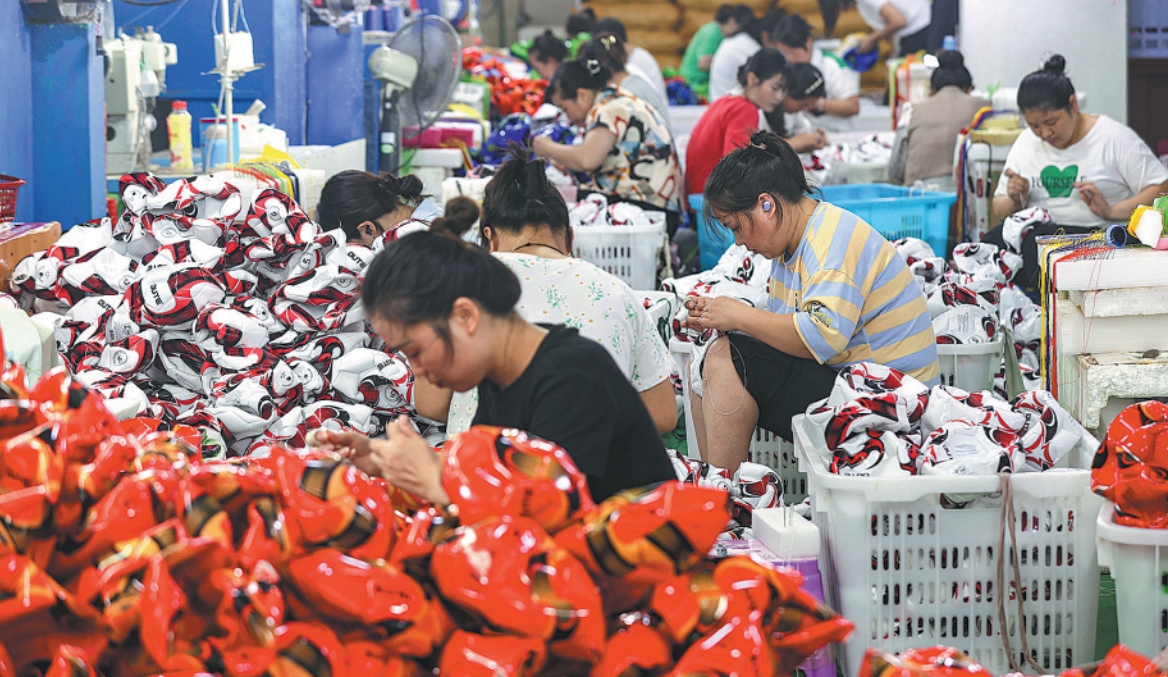
Despite temporary market woes, data indicates China on road to recovery
Amid the dynamic changes occurring within China's economic landscape, the nation is currently grappling with short-term challenges primarily arising from a weakening domestic property market and the looming risk of deflation. Nevertheless, experts have maintained an unwavering faith in the nation's promising long-term economic trajectory.
In August, China reported economic data that exceeded expectations, demonstrating the ongoing recovery of the world's second-largest economy. The report comes on the heels of a set of robust yet focused measures undertaken by policymakers to address various challenges and downward pressures. China's value-added industrial output surged in August, registering a year-on-year increase of 4.5 percent. This was a notable uptick from the 3.7 percent growth observed in July.
According to the most recent data by the National Bureau of Statistics, China's official manufacturing and nonmanufacturing purchasing managers indexes both improved in September to 50.2 and 51.7, respectively, from 49.7 and 51 in August. The figures were above the 50-point mark that separates contraction from growth.
Ben Cavender, managing director of the China Market Research Group, said the Chinese economy is moving toward stabilization and is starting to show some signs of recovery.
He emphasized that China's enduring strengths lie in its substantial infrastructure and manufacturing ecosystems, which are not susceptible to rapid decline. "The government's emphasis on fostering development of new high-tech industries should also help to create avenues of growth for the economy in the coming decade," he said.
Nevertheless, Cavender pointed out that the country faces significant demographic challenges, necessitating ongoing efforts to address issues related to local government and corporate debt management. "Right now, the name of the game is stability and doing whatever possible to assure consumers and private businesses that spending and investment are not too risky now, as this would unlock the spending we need to see to get back to normal," he said.
John Beirne, vice-chair of research at the Asian Development Bank Institute, paints a cautious outlook for the rest of this year and into the next year. However, he remained optimistic about China's long-term economic prospects.
"China's income per capita ratio and urbanization rate are indicative of spare capacity in the economy over the longer term. There is ample room for additional reforms within the household registration system to help support sustainable consumption growth," he said.
Beirne underscored the adverse impact of declining property values and the increasing costs of servicing local government debt on the consumption recovery that commenced this year. Consequently, he emphasized the critical necessity of implementing targeted policies to alleviate the challenges plaguing the property market, including the relaxation of bank lending restrictions and the provision of fiscal support.
"Stabilizing the property sector will be a key determining factor," he said. "While recent policy measures have helped to mitigate economic uncertainty, more stimulus may be needed to trigger consumption and investment growth, and avert deflation concerns."
While comparisons with Japan's "lost decades" have surfaced due to shared challenges such as an aging population, property market downturn and potential deflation risks, Beirne highlighted key distinctions.
"While parallels exist, China's lower urbanization rate implies higher productive capacity and growth potential," he explained. "Additionally, China's property and asset price bubble appears less severe, potentially leading to a softer correction."
Stephen Roach, senior fellow at the Paul Tsai China Center at Yale University in the United States, downplayed concerns over underlying structural imbalances and mounting debt.
Some experts have discussed the possibility of a sudden market collapse due to reckless speculation — known as a Minsky moment — or a Lehman Brothers-like crisis. But Roach argued that China's mixed economy, featuring both state and private enterprises, coupled with substantial savings and foreign exchange reserves, offer a measure of resilience.
Chris Bovis, a professor of International Business at the University of Hull in the United Kingdom, echoed this sentiment, saying: "The long-term prospects for the Chinese economy have not changed. The global economic system looks at the Chinese economy as a telltale of growth. This implies national economies will be gearing their economic forecasts to China as a bench mark."
Bovis emphasized that China's economic growth is underpinned by its strong international focus and domestic reforms geared toward bolstering exports and encouraging foreign outward investment. "These distinguishing characteristics represent the biggest difference between the Chinese economy in its current configuration and the economy of Japan before the millennium and the early '90s," he said. "Internationalization and outward investment are valid measures to balance temporary market imbalances and corrections and combat deflationary patterns."
However, China faces a higher public debt burden than Japan in the 1990s, raising concerns about a "balance sheet recession", as some experts have noted. To avoid a prolonged period of deflationary expectations, Beirne of the banking institute said that China must implement growth-enhancing policies that boost aggregate demand, support domestic consumption and encourage investment in productive sectors.