Boosting the global energy transition







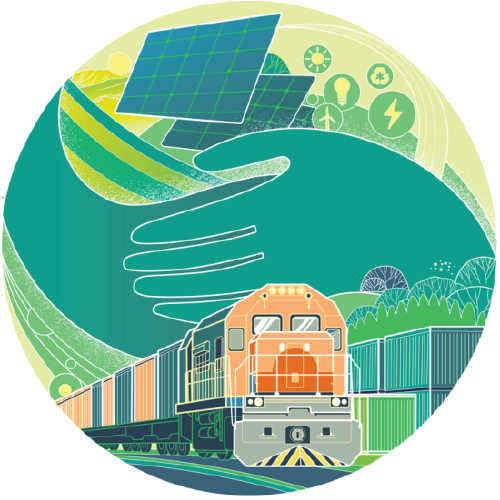
Through the Belt and Road Initiative, China can provide a much-needed boost to global climate action, benefiting billions of women, men and children around the world
Over the past 10 years, the Belt and Road Initiative has made sizeable contributions to global development. In the coming years, it is poised to become a major force in advancing the global energy transition. With the effects of climate change really starting to hit every continent on earth, countries around the world should work together to accelerate this transition. The third BRI Forum for International Cooperation, set to take place in Beijing in the coming days, is a major opportunity to advance this agenda.
In September 2021, President Xi Jinping pledged to the United Nations that "China will step up support for other developing countries in developing green and low-carbon energy, and will not build new coal-fired power plants abroad". Environmental law organization ClientEarth cooperated with the Belt and Road International Green Development Coalition (BRIGC) and other partners on recommending this policy, as well as supporting the development of an environmental project classification system known as the Green Development Guidance for BRI Projects.
These policies have led to a transformative greening of the BRI.According to the report from the Green Finance and Development Centre at Fudan University in Shanghai, 10 years after the launch, cumulative BRI engagement (in the forms of construction and investment) breached $1 trillion mark. China's energy-related engagement in the first half of 2023 was the greenest in any six-month period since the BRI's inception in 2013. In the first six months of 2023, almost half of energy engagement went into solar and wind. An important growth area of strategic importance is China's engagement in metals and mining, which are particularly relevant to the green transition (e.g., lithium, nickel etc).
And this is set to continue. Renewable energy industries in China are growing at astonishing rates. In 2020, China set a target to reach 1,200 gigawatts on solar and wind capacity by 2030. This target is set to be achieved well within 2025. This year alone, China is expected to deploy 60 GW of wind and 100 GW of solar, and these figures are projected to continue to rise quickly year-on-year. The International Energy Agency data shows that China produced more than 80 percent of global solar panels, and accounts for half of the global wind power capacity additions in 2022.Costs continue to fall, and in many cases they are already lower than fossil fuel power. And it's a similar story for other technologies required for energy transition, such as batteries and electric vehicles.
China's progress in renewable energy technologies couldn't be more timely. The world has already warmed 1.2 C above pre-industrial averages, and in July this year, we briefly crossed the important threshold of 1.5 C of global average warming. The ramifications were felt all around the world, with disastrous heat waves, forest fires, hurricanes, floods and droughts all well beyond historical levels. At a recent Climate Summit in New York, UN Secretary-General Antonio Guterres remarked that "humanity has opened the gates to hell". And this warming is forecast to increase in the coming decades. Mitigating further climate change, by urgently transitioning away from the burning of fossil fuels, remains the safest, lowest cost and most important response to the climate crisis.
However, there remain serious challenges to translating China's technological and manufacturing capabilities into a faster global energy transition. Debt levels in many developing countries are very high following the COVID-19 pandemic, and economic pressures are severe. Renewable energy projects also have variable output, and are harder to integrate in the power grid, requiring storage solutions as well as more advanced grid planning and management. In addition, for reasons which are probably based on outdated assumptions, renewable energy projects are typically considered more risky than traditional fossil power, and therefore often subject to higher costs of financing. This is further compounded by exchange rate risk, which is particularly high for developing countries. On top of that, businesses in the fossil fuel sector tend to be entrenched and well connected, and often have long-term contracts to sell their power.
Therefore, dedicated efforts are required to speed up this process. China, countries involved in the BRI, and other developed countries all have a role to play in this regard.
First of all, ambitious and clear top-level policy signals are needed. China already has clarified its vision of supporting developing countries in their energy transition, and it can further clarify this by setting time-bound targets such as total overseas investment, or total overseas installed capacity of solar and wind power by 2030. All countries should set clear policies and time-bound targets for their own energy transition. Importantly, China and countries involved in the BRI can engage in bilateral dialogues to develop a joint vision of cooperation, again ideally with time-bound targets. Having such a clear joint vision will allow companies and institutions to understand the opportunities and develop proposals. We have worked with BRIGC to start such a dialogue between China and Indonesia, which is making great progress.
In addition, there is a need for specialized institutional capacity and support. China may develop a special facility for green BRI partnership and project development. This is needed to provide technical support, accelerate project development, and significantly reduce risk by ensuring that projects fit into a comprehensive and technically sound design for a low-carbon power grid. China has some of the world's most advanced renewable energy engineering and planning institutes. They can play a key role in working with countries involved in the BRI to develop mutually recognized medium- and long-term plans. Chinese financial institutions and export credit agencies may be able to develop special instruments to support renewable energy investments, and incentivize much greater private sector investments by de-risking renewable energy projects, and possibly exchange rate risk. Chinese companies can also partner with local companies to develop joint manufacturing capacity.
Finally, the Chinese government and companies can take several steps to further build trust and reduce the risk of political pushback. The energy sector is considered highly strategic in all countries, and therefore trust is essential for in-depth cooperation. Environmental and social safeguards should be fully implemented, including those specified in the Green Development Guidance for BRI Projects, and the Green Investment Principles. This includes active stakeholder engagement and disclosure of environmental information through the entire project cycle, starting from the planning stage. Active coordination and dialogue with other development partners is also essential, for example, to develop joint plans and projects, reduce the risk of geopolitical rivalry, maintain sustainable debt levels, and ensure the smooth phasing down of coal power in countries involved in the BRI.Developed country actors who are serious about climate action should stop treating the BRI as a threat, and actively engage with China on the global energy transition.
Through the BRI, China can make unparalleled contributions to accelerating the global energy transition. This will be a great and much-needed boost to global climate action, benefiting billions of women, men and children around the world, especially the poorest and most vulnerable ones by maintaining a livable planet for us and generations to come.
James Thornton is president and founder of environmental law organization ClientEarth. Dimitri de Boer is regional director for Asia at ClientEarth and special adviser of the China Council for International Cooperation on Environment and Development.
The authors contributed this article to China Watch, a think tank powered by China Daily.
The views do not necessarily reflect those of China Daily.