



Railway can drive Central Asia's development faster







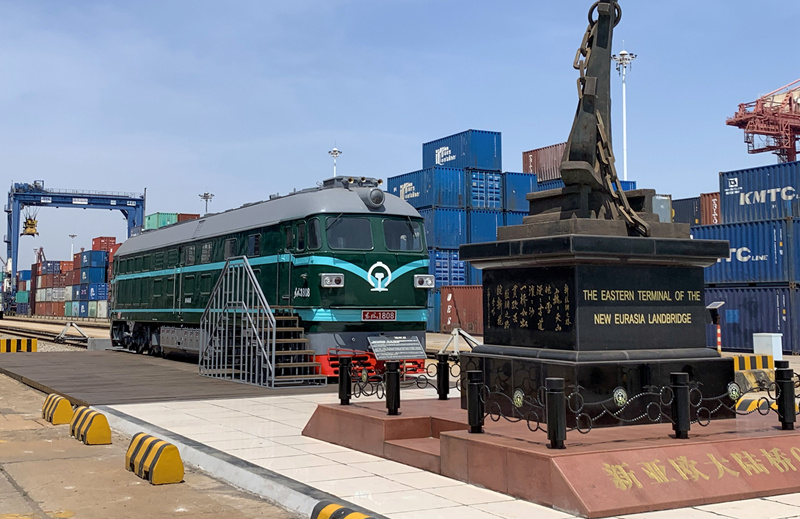
The Belt and Road Initiative has built remarkably efficient railways connecting China and Europe via Central Asia. These rail routes did not exist even a decade ago. Within a short period, they have boosted local and national economies thanks to their solid infrastructure, smooth operation and socioeconomic impacts.
Between January and August in 2023 alone freight trains made 11,638 trips and transported 1.26 million twenty-foot equivalent units (TEUs) of cargo between Asia and Europe. The trains have an average speed of 120 kilometers an hour, and connect 86 routes that cover 217 cities in 25 European countries and more than 100 cities in 11 countries and regions in Asia.
Over the past 10 years, China-Europe freight trains have made a total of 77,000 trips, carrying 7.31 million TEUs of goods worth more than $340 billion.
At present, most cargo between China and Europe is transported along the so-called northern route that passes through Central Asia, Russia and Belarus. However, the shortest and most efficient southern route from Central Asia to China, and then through the South Caucasus to Europe, is gaining more attention. In this regard, the China-Kyrgyzstan-Uzbekistan section will be a promising inclusion to these routes.
In September 2022, an agreement was signed at the Shanghai Cooperation Organization Summit in Samarkand, Uzbekistan, to promote construction of a railway connecting China, Kyrgyzstan and Uzbekistan. Additional documents were signed during the China-Central Asia Summit in Xi'an, Shaanxi province, in May this year to conduct a feasibility study and work out a financing model.
The Kyrgyz section of the railway will start from the Torugart Pass, from where the railway line will extend northwest through Arpa and Makmal to Jalal-Abad, where it will connect with Uzbekistan's railway network. To facilitate that, the railway gauge will be changed from the standard gauge (1.43 meters) used in China and Europe to the standard gauge (1.52 m) found in Central Asia, probably in Makmal, which is home to a gold processing plant.
The Kyrgyz section of the railway will span 280 km, crossing rugged mountainous terrain and require the construction of at least 90 tunnels. The total cost of the project is estimated to be between $3 billion and $5 billion. Also, China will need to build about 160 km of access roads within its territory to connect to the new railway line.
After the completion of this section, the railway can be extended to the West, passing through Turkmenistan and Kazakhstan, the South Caucasian countries and Turkiye to ultimately reach Europe. This extension is expected to reduce the distance from China to Turkiye by about 900 km.
As for the return on the investment, the parties can recover their amount by collecting road toll, primarily for cargo being transported from China to Europe — estimated at 5 million tons of freight per year.
Central Asia is set to become a critical transport hub for the whole of Eurasia. The East-West transport corridor in this region will soon connect with the North-South corridor, linking the northern countries through Iran and Afghanistan with South Asian countries and the ports around the Indian Ocean. This will make Central Asia a vital transportation hub in the foreseeable future.
Some experts initially had doubts about the feasibility of building a railway in the challenging terrain of the Kyrgyz mountains. However, these doubts disappeared, considering the features of the newly built China-Laos railway. The China-Laos railway covers 1,035 km from Kunming in Southwest China's Yunnan province to the Laotian capital of Vientiane. The railway runs through high mountainous terrain with complex geology, high seismic risk and high geo-stress.
Moreover, the China-Laos railway crosses 218 faults and fractures as well as the Mekong River, with an altitude difference of 2,900 m. Despite these challenges, the railway has been built and newly features 301 bridges and 167 tunnels.
That China has paid special attention to the environment and the fragile ecology of the mountains during the construction of the railroad goes without saying. The railway bypasses multiple national nature reserve forests, including Xishuangbanna and Luang Prabang, as well as tourist attractions and national forest parks. The project was, therefore, designed to blend harmoniously with the environment along the route. The China-Laos railway has already started bearing economic fruit, especially for the tourist spots along the way.
Similarly, the railway connecting Asia and Europe through Central Asia will be a prime example of transportation infrastructure having a positive impact on the economy, promoting development in a region, and bringing different countries closer. With the latest transportation technologies, trade will be simplified and expedited, distances will be reduced, and people and cultures will come closer, leading to increased exchanges of knowledge and experiences.
The caravans of the ancient Silk Road facilitated intercultural and intellectual dialogue between people from different countries, shaping modern civilizations and promoting development.
In the same way, every train passing through Eurasia will bring economic prosperity through partnership and strengthen trust between peoples. The railway, when completed, has the potential of transforming Central Asia from a land-locked region to a land-connected hub for the whole of Eurasia. By channeling collective energy toward revitalizing new routes, the Belt and Road Initiative has been reviving the great spirit of the ancient Silk Road as a trade corridor and opening-up passages connecting people, cultures and civilizations.

The views don't necessarily reflect those of China Daily.





