



Unwanted attention
NATO's pivot to the Asia-Pacific will force countries to side with either China or the US and upset the region's 'balanced diplomacy' if countries hold joint military drills







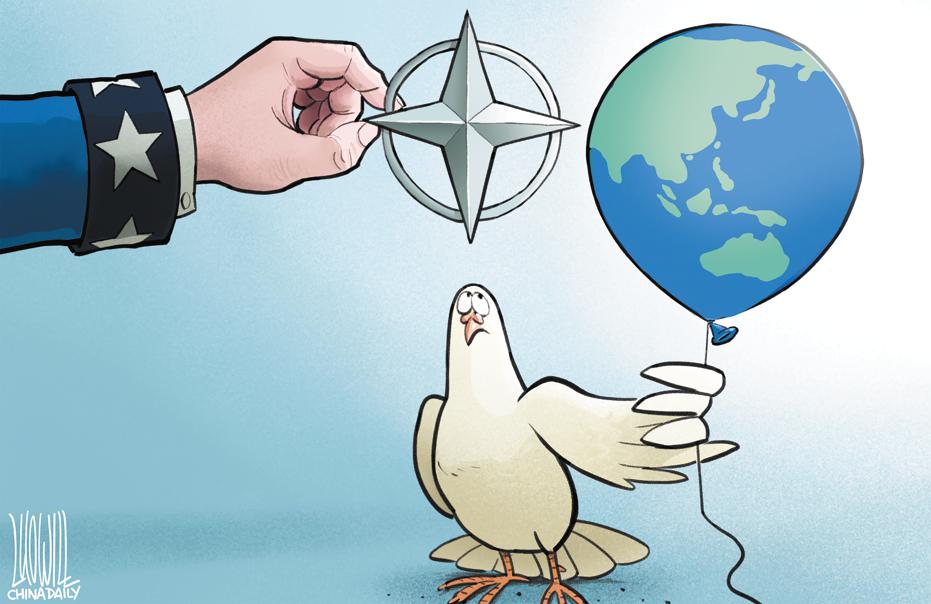
NATO's pivot to the Asia-Pacific will force countries to side with either China or the US and upset the region's 'balanced diplomacy' if countries hold joint military drills
In recent years, the North Atlantic Treaty Organization has been increasingly turning its attention to the Asia-Pacific region. Against the backdrop of the Ukraine crisis, NATO is, on the one hand, ramping up efforts to confront Russia, and on the other hand, rallying support from Japan, the Republic of Korea, Australia and New Zealand to build strategic fulcrums in the Asia-Pacific. In July, NATO invited the four nations to attend its summit, signaling its accelerated steps to extend tentacles to the Asia-Pacific.
As for the United States, the Joe Biden administration is shifting its strategic center of gravity eastward while tackling the Ukraine crisis. In this context, the US is actively seeking to integrate its strategies for the two geopolitical zones of the Pacific Ocean and the Atlantic Ocean.
In the meantime, even Europe is increasingly looking to the Asia-Pacific. NATO, a bloc mainly composed of the US and European countries, is adopting a changed perception of global security. As the most important security alliance between the US and Europe, NATO is moving to the Asia-Pacific.
Since taking office, US President Joe Biden has regarded China as the biggest competitor of the United States. Tackling the "China challenge" is the main impetus behind the US pushing for NATO's pivot to the Asia-Pacific. A review of the alliance's documents released in recent years shows that its perception of China has been changing, with its China policy now increasingly defined by challenges and competition.
In early 2017, then US defense secretary James Mattis first proposed that China was a problem that NATO should deal with. In April 2019, a conference of foreign ministers of NATO members first called for a collective stance targeting China. In December 2019 in its London Summit Declaration, the alliance for the first time recognized "opportunities and challenges" posed by China's increasing global role.
In the NATO 2030 report and the Brussels Summit Communique, the alliance once against mentioned "China challenges".In its strategic concept document released in 2022, NATO listed China as one of its strategic priorities for the first time, saying China posed challenges to the Western bloc's interests, security and values, a narrative that was repeated at the Vilnius Summit held in July.
Since the escalation of the Ukraine crisis, the US' "Two Oceans Strategy", which bundles China with Russia, has added new connotations to NATO's response to the "China challenges". The alliance's pivot to the Asia-Pacific has not slowed down despite Europe's geopolitical crisis. Rather, it has lent new "legitimacy" to the eastward shift. Some elites of the US and Europe believe that China, a non-Western nation, is posing "challenges" to Europe in politics, economy, technology and culture, and NATO should not ignore Asia's expanding influence in the Atlantic and Europe's neighboring regions, as well as the implications in military security caused by the development of China-Russia relations.
NATO's negative perception of China has also expanded to more areas. The US has spread its growing anxiety about China to other NATO members. This means NATO's pivot to the Asia-Pacific also sees the alliance increasingly including issues related to China and the Asia-Pacific into its agenda.
With the continuous evolution of the Asia-Pacific's strategic landscape, various factors such as politics, technology and economy are driving changes in the strength and policy of regional countries.NATO is trying to portray China as a "systemic challenge" to the regional and international orders.
Since NATO's eastward movement is meant to serve the major-power competition strategy of the US, it faces limits in viability and sustainability. In the short run, with the Ukraine crisis dragging on, NATO's strategic priority will remain in Eurasia, and it will strengthen security cooperation with Ukraine to contain Russia.
NATO's pivot to the Asia-Pacific is a strategic adjustment made with an eye on the future, and at the moment, issues related to the region are not likely to be included in the core agenda of the alliance. Moreover, NATO's military structure is not able to support war on two fronts.
In the medium and long run, it will be impossible for NATO to sustain its outreach in the Far East. Once regional countries join NATO, the memberships may turn out to be a burden instead of an asset for the alliance. Therefore, NATO may imitate the model of the "Indo-Pacific Economic Framework for Prosperity" launched by the US to build a "NATO+" framework, which in essence is another US-led alliance, and establishes security partnerships that feature flexible agendas.
As for action, NATO is unlikely to take part in major naval operations in the Asia-Pacific, and its role will be limited to intelligence sharing and interoperability training.However, the alliance may pay more attention to some specific areas targeting China, and push beyond the limits of geography in its bid to shape a consensus on competition against China in fields such as digital technology, aerospace and technical standards among allied countries from both the Atlantic and the Pacific.
More importantly, most Asian countries are cautious about, if not opposed to, NATO's pivot to the region. Asia-Pacific countries are concerned about the security regimes the US has initiated in the region, such as the US' security alliance with Australia and the United Kingdom, known as AUKUS, and the Quadrilateral Security Dialogue of Australia, India, Japan and the US — or Quad. They worry that NATO's movements in the region might intensify China-US competition, thus damaging peace and stability in the region.
NATO has not yet deployed military forces in the Asia-Pacific. But the Association of Southeast Asian Nations members' attitude toward AUKUS and Quad is a telling clue to regional countries' concern that US-led security alliances may turn into a "mini — NATO" in the Asia-Pacific, and impact the regional security landscape with ASEAN at the center.
In a word, NATO's pivot to the Asia-Pacific will force regional countries to pick sides between China and the US. Once these countries start cooperation with NATO, AUKUS or Quad in the form of joint military drills, it will cause negative influence on the "balanced diplomacy" pursued by most countries in the region and undermine regional peace and development.
The author is a fellow and head of US-EU program at the Center for International Security and Strategy at Tsinghua University. The author contributed this article to China Watch, a think tank powered by China Daily. The views do not necessarily reflect those of China Daily.
Contact the editor at editor@chinawatch.cn.





