



US, Chinese economies shouldn't abruptly divorce







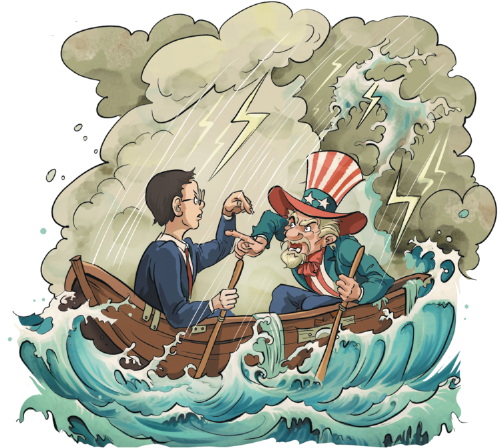
The economies of the United States and China together constituted 43 percent of the global economy before the COVID-19 pandemic. The world's two largest economies' stability and growth are co-dependent. Neither the US nor the Chinese economy can be stable or coexist peacefully if one or both relentlessly play zero-sum games and launch economic attacks on the other.
The US and China are engaged in a destabilizing trade war while trying to deal with the economic problems caused by the pandemic, The Russia-Ukraine conflict, worldwide instability caused by the sudden 5 percent increase in US Federal Reserve interest rates, and China's slowing economic growth, which is a key driver of US and global economic growth, are some of the most prominent problems facing the global economy and the international community.
The pandemic exposed vulnerabilities in the global supply chains, prompting both the US and China to either "decouple" or "de-risk" from the other or create localized industries and new supply chains. Proponents of "decoupling" think it will allow the US and China to become more self-sufficient and less vulnerable to external shocks.
"Decoupling" appeals to US fears of China's economic growth and "Made in China 2025" goals. However, instead of using aggressive "decoupling" policies, the US' policy toward China should be more balanced, and designed to protect the economic and national security interests of both the US and China and enable them to coexist peacefully. Peaceful coexistence is essential for the economic and national security of both countries.
Viewed from China's perspective, many US policies are confrontational, contradictory, delusional and self-defeating because they seek to undermine China's goals and interests while requiring China's support for meeting the US' interests and goals.
In a speech she delivered on April 20 this year, US Treasury Secretary Janet Yellen said the US seeks a "constructive and fair economic relationship with China. We do not seek to decouple our economy from China's. A full separation of our economies would be disastrous." She added that "the US does not seek winner-take-all competition with China".
But, from China's perspective, US policies seem designed to prevent its development. The US' "decoupling", "de-risking" and "small yard and high fence" policies elicit a somewhat similar response from China.
Aggressive and rapid "decoupling" is counterproductive to both the US' and China's economic recovery and growth. US political leaders are under the delusion that aggressive policies can force China to change its behavior to suit US demands. But the reality is, China is responding by accelerating its focus on achieving its "Made in China 2025" goals.
Previous US president Donald Trump's aggressive protectionist policies have in many ways harmed US businesses. For example, US policies seeking to withhold high-end chips from China have led to chip shortages, which are hurting many industries in the US and the rest of the world. Incumbent US President Joe Biden has continued Trump's policies and added the "small yard and high fence" policy to ostensibly make the US policies seem less damaging to US businesses.
Such US policies are counterproductive because, as in the chip industry example, they assume that, despite the US restricting the sale of high-end chips to China, Washington can get Beijing to buy lower-quality chips from US companies, which depend on access to China's market for the revenue and profits they need to fund US high-end chip research, development and production.
It is prudent for the US and China to diversify the supply chains their economies rely upon in the medium to long term. But, in the short to medium term, the two largest economies will remain co-dependent on fragile worldwide networks of production, trade and investment.
Political leaders should also understand that ending US-China financial and economic co-dependence will require massive economic and financial restructuring, which can and probably will trigger catastrophic mistakes that will hurt both countries' economies.
Aggressive US "decoupling" policies are creating a frightening future for the entire world. The Financial Times' economics expert Martin Wolf warned earlier this year that the US is moving toward an all-round military conflict with China, because it views China as an enemy that must be suppressed. But since its economy is about 10 times larger than Russia's, China cannot be suppressed, and trying to harm China will put the US on the path to economic and military conflict with China.
It will be catastrophic if US or Chinese policymakers try to aggressively and rapidly restructure the global economy and financial system. American and Chinese policymakers need to work together to understand and implement how the economic growth and national security of the world's two largest economies and military powers can be gradually aligned to peacefully coexist.
Both countries' policymakers need to pursue "mutually assured prosperity" (MAP) rather than unleashing "mutually assured destruction" (MAD) in managing US-China economic competition. Pursuing MAP is necessary to protect the world's fragile financial and economic systems. The economic and national security of both the developed and developing countries depend on the American and Chinese policymakers pursuing MAP instead of following MAD policies.
The author is chairman of the America China Partnership Foundation. The opinions expressed here are those of the writer and do not necessarily represent the views of China Daily and China Daily website.
If you have a specific expertise, or would like to share your thought about our stories, then send us your writings at opinion@chinadaily.com.cn or comment@chinadaily.com.cn.





