Ample room for growth of realty sector







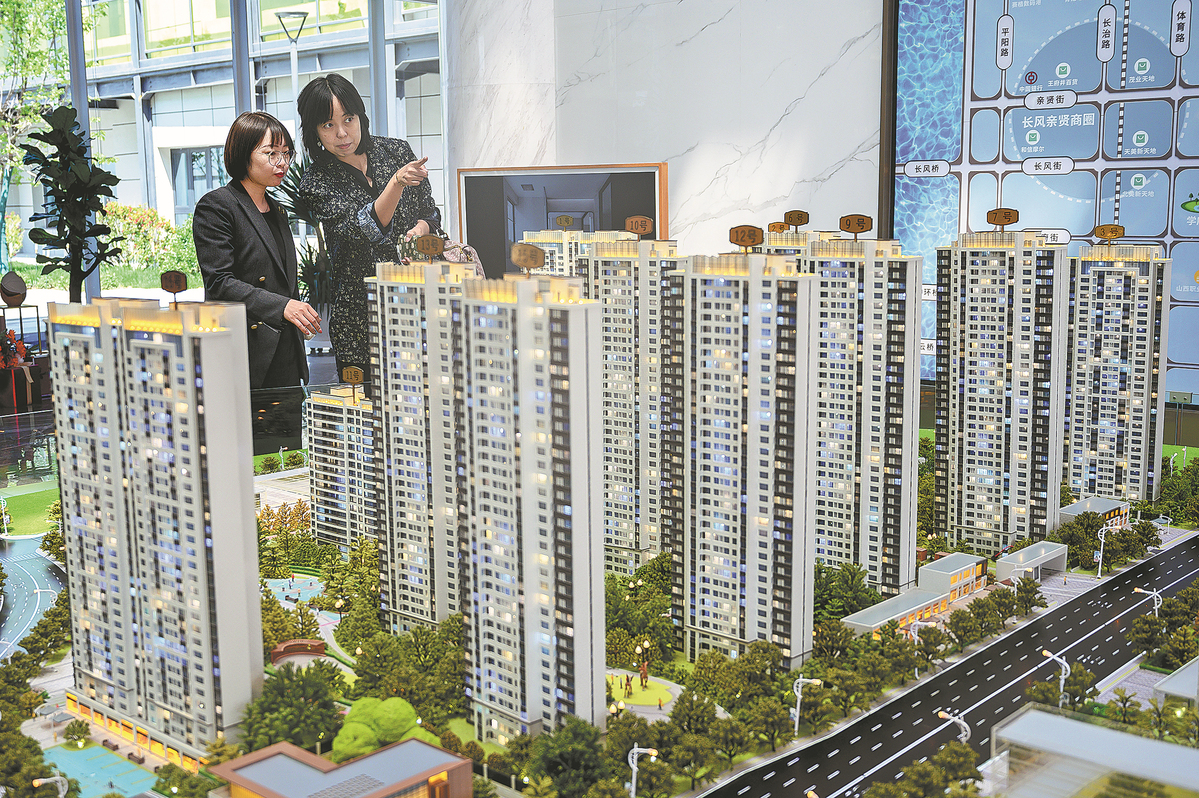
National Statistics Bureau data for the first half of this year, which were released on July 17, show the sales of new residential houses further declined by 2.8 percent, following the significant drop of 26.8 percent in 2022.
The declining housing sales have triggered widespread concern over the future of housing demand. After the per capita built-up urban housing space exceeded 38 square meters, the shortage of housing in urban areas all but disappeared. Combined with that, the rapidly aging population and the declining fertility rate could seriously constrain the demand for newly-built housing.
However, the Chinese real estate industry still has ample room for development, because there are three groups of "200-million people" each with substantial demand for improved housing, meaning there are three structural opportunities for increasing investment, which in turn could become a key driver for the development of the real estate industry. Nonetheless, proper policy innovations are needed to meet that demand.
The first group of the "200-million people" refers to new urban residents, mainly comprising people migrating from rural to urban areas and new graduates. According to the Monitoring Report of Rural-Urban Workers (2022) released by the National Bureau of Statistics in April, about 171.9 million workers with rural hukou (household registration) are working in urban areas, and their per capita housing space is only 22.6 square meters, far less than the national average. In particular, per capita housing space for workers with rural hukou in cities with more than 5 million people is only 17.6 square meters.
Besides, for the first time more than 10 million youths graduated from college in 2022, and the total number of youths who graduated from universities in the past three years is estimated to be more than 28 million. And since most of the new graduates are living in overcrowded, low-standard accommodations, they have a strong demand for improved housing.
To bridge the gap between rural people who have migrated to urban areas and the average urban resident in terms of per capita housing space, the real estate industry needs to build at least 3.2 billion sq m of new housing space in the next few years. Assuming an investment of 10,000 yuan ($1,401.40) per sq m is needed for building new housing, it would require an investment of at least 3 trillion yuan, which is three times the total investment in housing construction in 2022.
But the new urban residents' housing demand is constrained by their low affordability, as housing prices in cities are very high. So the government is seeking to develop a new investment model for housing that will attract more capital and make housing affordable for most new urban residents.
The second group of "200-million people" comprises urban residents living in dilapidated neighborhoods. According to the seventh national census conducted in 2020, about 31 percent of urban households, or 270 million urban residents, were living in buildings built before 2000. These old buildings are often poorly designed, equipped with outdated facilities and require frequent repairs and renovation.
The neighborhoods this group lives in are usually poorly maintained, lack good public facilities and are functionally inadequate to meet the requirements for decent living. In March, the Ministry of Housing and Urban-Rural Development announced that 167,000 old neighborhoods have been renovated at a cost of 660 billion yuan over the past five years, benefiting 29 million households and 80 million people.
But despite the government spending huge amounts on repairs and renovation, the old neighborhoods still cannot meet residents' decent housing demands.
Additionally, in most cases, the old neighborhoods need more than repairs and renovation; they require comprehensive reconstruction. Many buildings need to be demolished and built anew. This means substantial investment opportunities for the real estate and related sectors. As the total built-up housing space in the country was estimated to be about 35 billion sq m in 2020 according to the seventh national census, one can assume the built-up space area of residential buildings constructed before 2000 is more than 10 billion sq m. And considering that the renovation cost would be 1,500 yuan per sq m, it would require an investment of 1.5 trillion yuan.
Moreover, a significant number of these buildings and neighborhoods may need to be demolished and built anew. But most households in such neighborhoods cannot, on their own, afford the high cost of renovation or reconstruction.
The third group of "200-million people "is that of senior citizens who need accommodation that can cater to their special needs. According to the National Bureau of Statistics, the population of people aged above 65 at the end of 2022 was 212 million, accounting for 14.9 percent of China's total population. And their population is expected to exceed 327 million by 2035.
The elderly people have special and specific needs. So developing elderly-friendly communities and modifying housing to meet elderly people's special needs can allow them and their family members to live in a safe and healthy environment, reducing the elderly people's stress and risk of physical injury, and alleviating their anxiety.
Such housing communities and housing modifications would also help increase the elderly people's access to surrounding environments and public facilities, and make them feel self-sufficient, giving them a sense of satisfaction. Elderly-friendly neighborhoods and housing modifications also require huge amounts of investment. Assuming the cost of housing modification to meet the elderly people's needs is 1,000 yuan per sq m, it would require at least 8 trillion yuan to modify the houses for 212 million people.
However, financing for elderly-friendly modification projects is not easy to come by, as most elderly people can neither afford the cost nor are likely to pay, if they could, for such modifications.
Yet there is a significant demand for new housing and housing improvement. In most cases, however, the requirements to meet such a demand should be included in the overall plan for socioeconomic development. For example, in the 2023 Government Work Report, the State Council, China's Cabinet, said that policy support would be provided for strengthening community home-based eldercare services which would include policies on taxes, housing, and water and electricity charges.
On July 18, the Ministry of Housing and Urban-Rural Development and six other departments jointly issued a document to promote the renovation of old urban residential areas, putting emphasis on three key renovation points — "corridor revolution", "environmental revolution" and "management revolution" — and stressing that such renovation is crucial to meet people's rising demand for a decent life.
Furthermore, high-quality renovation of old residential areas will not only improve people's livelihoods but also help promote economic growth. But there are also some challenges when it comes to implementing these projects: the narrow profit margin in building affordable housing, renovating neighborhoods, and modifying housing for the elderly people.
It is thus necessary to develop a new model for sustainable financing for these projects while creating a favorable environment to attract more capital to the sector. And the government should take measures to leverage the role of communities, incorporate grassroots organizations into the housing renovation and development plan, set up consultation and discussion platforms, in order to improve neighborhoods, develop beautiful cities, and promote the growth of the real estate sector.
Chen Jie is a professor at the School of International and Public Affairs, Shanghai Jiao Tong University. Guo Xiaoxin is an assistant researcher at the Institute of Applied Economics, Shanghai Academy of Social Sciences. The views don't necessarily represent those of China Daily.