



UN chief launches 3 policy briefs on Our Common Agenda







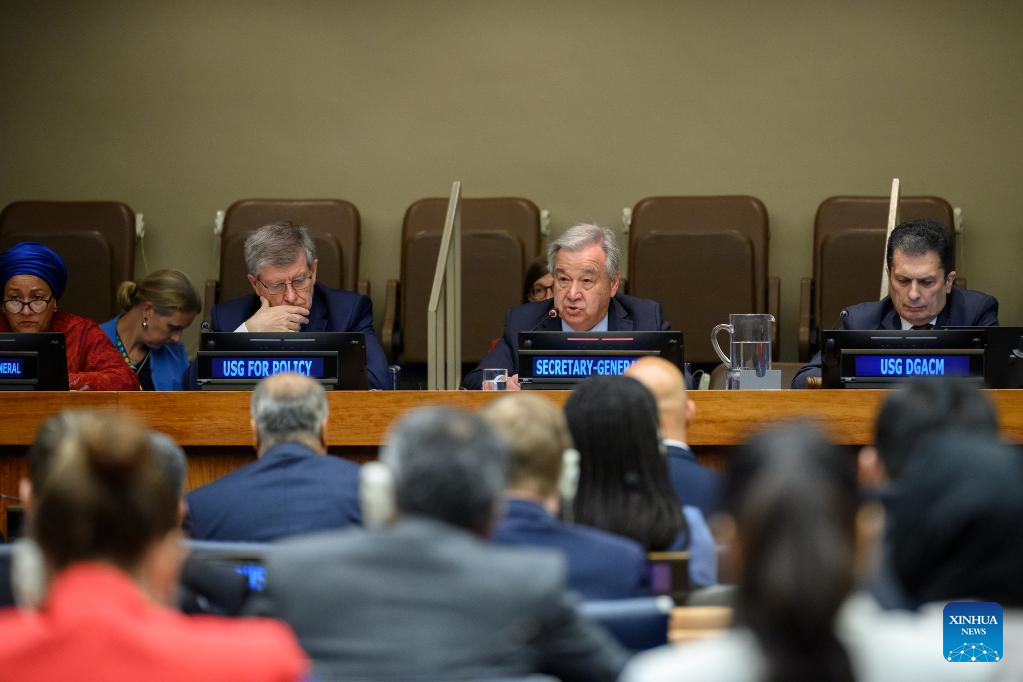
UNITED NATIONS - UN Secretary-General Antonio Guterres on Monday launched three policy briefs on Our Common Agenda -- on reforming the international financial architecture, on looking beyond gross domestic product (GDP) as a metric for economic progress, and on forming a Global Digital Compact.
The three documents bring the total number of policy briefs to seven under Our Common Agenda. Four other briefs will follow.
In his policy brief on reforming the international financial architecture, Guterres stressed the need for structural reforms in addition to immediate measures to relieve the burden on developing and emerging economies.
The Bretton Woods system was established in 1945, when many of today's developing and emerging economies were under colonial rule. It is supposed to serve the world but does not represent the world, he said.
The COVID-19 pandemic and its aftermath were a stress test for that system, but it largely failed and did not fulfill its core mandate as a financial global safety net. It did not provide enough of the financing needed to support a recovery in developing countries, many of which are now in the throes of a deep financial crisis, said Guterres.
Fifty-two developing countries are in, or near, debt distress, while debt relief is at a standstill. Inflation and rising interest rates are adding to the unsustainable financial pressure on developing countries. Some governments are being forced to choose between making debt repayments or defaulting in order to pay public sector workers -- possibly ruining their credit rating for years to come. Africa now spends more on debt service costs than on health care, he noted.
In the short term, the international community needs to take urgent steps under current arrangements to relieve the burden on developing and emerging economies, said Guterres. "But beyond emergency measures, we need a structural response. The international community must reform the international financial architecture to make it resilient, equitable, and accessible to all."
The policy brief sets out ambitious, concrete proposals in six areas to address historic injustices and systemic bias: global economic governance, debt relief and the cost of sovereign borrowing, international public finance, the global financial safety net, addressing short-termism in capital markets and sustainable finance, and a global tax architecture.
The brief proposes strengthening the voice and representation of developing countries on the boards of the World Bank and the International Monetary Fund (IMF); proposes reforms to IMF quotas, which should be delinked from access to resources; suggests changes to IMF voting rights and decision-making rules; and proposes a representative apex body overseeing the entire system, to enhance its coherence and align its priorities with the 2030 Agenda.
Overall, the proposals in the brief are aimed at moving away from a system that benefits the rich and prioritizes short-term gains, toward one that is equitable, and invests up-front in the Sustainable Development Goals (SDGs), climate action, and future generations, said Guterres.
In the policy brief concerning GDP, he urged member states to move toward universal and comprehensive measurements to complement GDP as a metric for economic progress.
GDP "will continue to be an important metric. But there is a growing recognition that GDP overlooks human activities that sustain life and contribute to well-being, while placing disproportionate value on those that damage us and deplete our planet," said the UN chief.
According to Guterres, GDP ignores or obscures the complexity of sustainable development, as deforestation, overfishing and the mining and burning of fossil fuels all increase GDP, while GDP takes no account of environmental sustainability, unpaid care work, and the negative impact on people and societies of many economic activities.
Some countries may have a relatively high GDP, but due to special circumstances, they may be at increased risk from economic shocks. Conversely, some countries with lower GDP may be more resilient to shocks because of a strong social contract, or a geographic location that protects them from the worst impacts of climate chaos, he said.
This policy brief proposes a path toward complementary metrics that more accurately reflect what humans value, said Guterres.
First, it proposes that member states make a political commitment to a conceptual framework that accurately values what matters for people, the planet, and the future.
Second, the brief calls for a technical process to develop metrics to inform this framework. It proposes that an independent high-level expert group should produce a dashboard of key alternative indicators by March 2024.
Third, the brief calls for a massive upgrading of support to countries so that they can develop the data capacity needed to make new metrics operational.
In the policy brief on the Global Digital Compact, Guterres said there is an urgent need for governments to come together in such a compact to mitigate the risks of digital technologies and identify ways to harness their benefits for the good of humanity.
Artificial intelligence (AI), deep fakes, and bio-engineering are just three areas of latest technological progress that are testing governance capacities beyond their limits. This exponential acceleration makes cooperation on technology even more important, he said.
Generative AI will have a huge impact on education, communication, the world of work and far more. But the future of that impact is not clear to anyone. Jobs will be both created and lost, and the world of work will change, he said.
While AI has the potential to turbocharge development and productivity, accelerating progress toward the SDGs, it also presents serious ethical challenges. The weaponization of AI is a huge concern, he warned.
The policy brief proposes a vision for digital cooperation that puts humanity at the core, with no one left behind: a digital future that is anchored in universal human rights; global cooperation that harnesses technology for human development and turbocharges progress on the SDGs; digital technologies that are governed by humans, for humans, said Guterres.
The Global Digital Compact is a unique opportunity to bring together governments, regional organizations, the private sector and civil society in a global approach to digital governance, he said. "The compact would provide a framework to align national, regional and industry approaches around global priorities, principles and objectives."
The policy brief identifies areas for urgent action, from scaling up efforts to connect the unconnected, to building digital public infrastructure and supporting public administrations to regulate technology for everyone's benefit.
The brief proposes steps to address gaps in the governance of AI. It reiterates Guterres' proposal for a high-level advisory body for AI, which could meet regularly to review AI governance arrangements and offer recommendations on how they can be aligned with human rights, the rule of law and the common good.
"We will start work on this body by the end of this year, and task it to present options for the international governance of AI. This could include an AI Accord, connected to the Global Digital Compact process," said Guterres.
The brief also proposes a Digital Cooperation Forum that would evaluate progress on digital governance and highlight gaps.
The series of policy briefs on Our Common Agenda provide insights for member states as they prepare for this year's SDG Summit and next year's Summit of the Future.










