



Maker and breaker







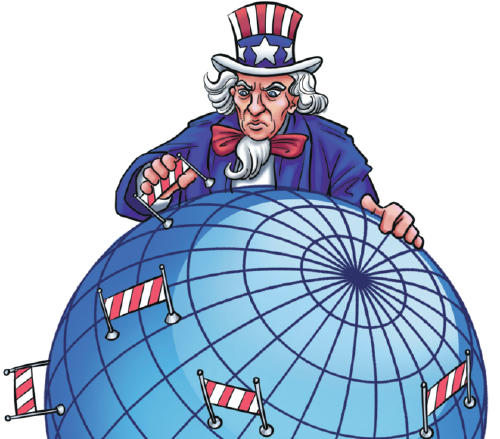
For the US, a double-standard international economic order is one where it gets to make and abuse the rules
The G7 issued a separate statement on economic security during its Hiroshima summit, hyping up the so-called economic coercion from China. During the press conference after attending the G7 summit, US President Joe Biden also mentioned that the G7 will "resist economic coercion together" from China. This is a manifestation of how some countries are obsessed with economic confrontation and vying for rule-making powers, even at the expense of the economic development rights of other countries.
Some politicians, led by US Secretary of State Anthony Blinken, have repeatedly accused China of using "economic coercion". In May 2021, Blinken said the United States would not leave Australia alone in the face of coercion from China. During the Japan-US Economic Policy Consultative Committee in July 2022, Blinken said that the two countries "addressed the People's Republic of China and how its coercive economic practices go against an open, inclusive rules-based international economic order that gives all countries a chance to participate, to compete, and to grow".
While these statements directly endorsed the anti-China policies of certain countries and politicians, they were also intended to promote the economic standards dominated by the US and its allies. The "economic coercion" accusation is a double standard targeting China. In fact, it is the US that frequently practices "economic coercion".
First, the US has a long-standing practice of exerting long-arm jurisdiction over international economic activities based on its domestic laws. Since the enactment of the Sherman Antitrust Act in 1890, the US Congress and government have repeatedly enforced certain domestic laws on non-US economic activities beyond its territories.
Since the Donald Trump administration initiated trade conflicts in 2018, a large number of foreign technology companies and individuals have fallen victim to the long-arm jurisdiction imposed by the US.
The abuse has even provoked opposition from the US' long-time political allies, such as Canada and the European Union, which in 1996 passed targeted regulations to counter US long-arm jurisdiction within the EU.
Second, the US frequently imposes economic sanctions to suppress foreign companies and interfere in other countries' policies, which is typical coercive behavior. In recent years, the US abuse of sanctions has become increasingly rampant. Data from the Center for a New American Security showed that in 2021 alone, the US implemented a total of 1,552 sanctions actions. Since the Russia-Ukraine conflict in 2022, the US and its allies have further expanded their abuse of economic sanctions, openly seizing the overseas assets of foreign governments, companies and individuals.
Third, the US not only abuses sanctions and other economic means to exert "maximum pressure" in bilateral trade, but also seeks to disrupt the external environment of other countries, effectively infringing upon their rights to development.
The US has introduced a wide range of laws, such as the Helms-Burton Act against Cuba in 1996, that allow it to sanction countries, individuals and entities engaged in economic, trade and technological cooperation with specific countries. These sanctions lack grounds in international law and are based solely on US interests and political arbitrariness.
The double standards employed by the US in terms of economic coercion are all about the contest for rule-making authority. Some in the West claim that economic coercion is the result of corruption and rent-seeking, thereby implying that Chinese investments are "opaque", "high risk" and "unsustainable", while US investments are of "high standard".
However, in reality, the "high standard" for the US investments has not been recognized by the majority of countries worldwide. Standards for economic and trade cooperation should be negotiated by the parties involved based on internationally accepted norms and should align with the socioeconomic conditions and development needs of the parties involved.
China's cooperation with its partners is based on the principles of voluntariness and mutual benefit, and should not be labeled as "low standard". Moreover, the anti-corruption and transparency standards proposed by the US are primarily determined by Western NGOs, or even by US institutions alone, to largely serve the overseas expansion of US companies.
In fact, the US-centric standards do not even align with the interests of its allies. Take the Trans-Pacific Partnership as an example. Many provisions of the agreement, such as intellectual property rights and the Investor-State Dispute Settlement mechanism which allowed US companies to sue host governments, complicated the negotiations and ultimately led to the failure of the TPP. After freezing certain US-centric provisions, many TPP participating countries successfully established the Comprehensive and Progressive Agreement for Trans-Pacific Partnership.
In 2022, the Regional Comprehensive Economic Partnership officially came into effect. Based on the principles of equal consultation and respect for sovereignty, the success of the RCEP further proves that US-style rules do not align with the interests of the majority of countries and that economic cooperation with China is a voluntary choice that conforms to market principles and national interests. Should the US persist in promoting its economic rules through vilifying China, it will ultimately end up with few supporters.
The reason behind the US' "economic coercion" rallying cry is the belief that certain countries have refused to stand by the US side due to their economic ties with China, preventing the US from creating a Cold War-style, ideologically clearcut anti-China alliance.
At the same time, certain interest groups in Japan and some European countries believe that they have gained little benefit from trade with China and choose to back the US narrative with an anti-China agenda. Some even advocate "decoupling" from China due to "ideological conflicts" and participate in joint statements that support the US.
However, in the middle of an economic downturn, forcibly reducing trade with China using ideological differences as an excuse will only harm domestic consumers, give no help to solving the economic problems, and hinder the creation of a diverse and equitable international trade and development framework.
In the face of high international economic risks and development deficits, countries around the world should overcome political and ideological differences and prioritize the global economic recovery.
The US has been using the "economic coercion" accusations to exert long-arm jurisdiction, divide the world into friends and foes, and impose economic sanctions and political pressure under double standards. Its intention to create an anti-China economic system has significantly increased uncertainty in the world economy.
The author is an assistant research fellow at the Institute of World Economics and Politics at the Chinese Academy of Social Sciences, and the National Institute for Global Strategy at the CASS. The author contributed this article to China Watch, a think tank powered by China Daily.The views do not necessarily reflect those of China Daily.
Contact the editor at editor@chinawatch.cn





