China-Central Asia ties help region stability








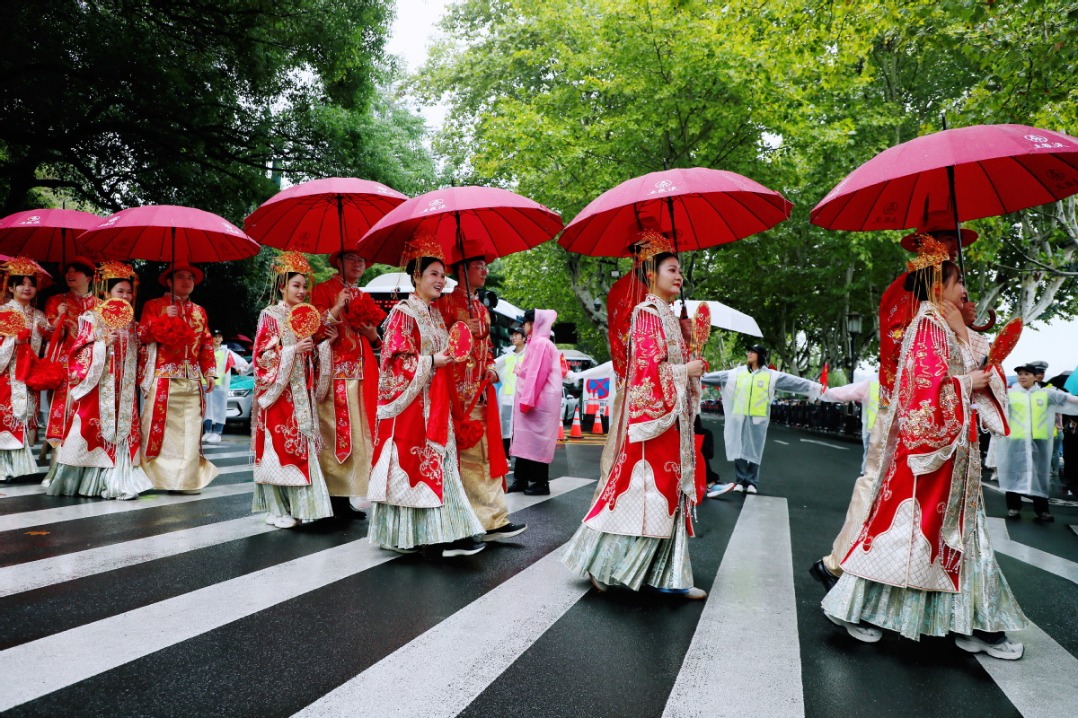
May is the month when pomegranate and peony flowers bloom and lush greenery covers the city of Xi'an, the starting point of the Silk Road. And it's on May 18-19 that Xi'an, Shaanxi province, will host the China-Central Asia Summit, which will add a new chapter in the development of China and the five Central Asian countries (Kazakhstan, Kyrgyzstan, Tajikistan, Turkmenistan and Uzbekistan).
China and the five Central Asian countries are friendly neighbors connected by mountains and rivers. They are connected also by the stories and legends of the ancient Silk Road, which bridged Asia and Europe. And it was the ancient Silk Road through which the inventions and creations of China traveled to Central and South Asia, the Middle East and Europe and left the people there mesmerized.
According to the "heartland theory" of British geographer and politician Halford John Mackinder, Central Asia, as part of Eurasia, has been the "geographical pivot of history" and would remain the pivot of global politics. In a paper, The Geographical Pivot of History, he wrote in 1904, Mackinder said: Who rules Eurasia commands the "heartland", who rules the heartland commands the "world island", who rules the world island commands the world. Mackinder also referred to the "heartland" as the "pivot area" and the core of Eurasia, and considered Europe and Asia to be the world island.
Mackinder's theory is reflected in major powers' foreign policies and strategies even today. His argument that "who rules the heartland… commands the world" has, in some ways, become the driving force behind major powers' foreign policies, resulting in power competitions between them to expand their sphere of influence, thus changing the historical context of Central Asia.
Major powers have tried to meddle in the region many times. Empires have risen and collapsed, but their desperation to expand their influence to or control foreign regions have led to instability in Central Asia. Afghanistan (a country in South-Central Asia) is an apt example of the political instability and economic ruin that major powers' interference can cause in a country. Even more than one year after the withdrawal of US forces from the country following almost two decades of occupation, Afghanistan has been struggling to get a foothold on all fronts.
And although China and Russia are not involved in any power game over Central Asia, the Western media have been spreading lies that the two countries are trying to control the region. Perhaps the Western media are in cahoots with Western politicians' geopolitical game of divide and conquer.
But lies and rumors will always be exposed. In recent years, the Western media have hyped up the non-existent "Xinjiang forced labor" and "Xinjiang concentration camp" issues to deter the five Central Asian countries which, like China's Xinjiang Uygur autonomous region, are Muslim-majority societies, from deepening trade and economic relations with China and Russia.
The China-Central Asia Summit will demonstrate that China and the five Central Asian countries are friendly neighbors and close trading partners. Besides, the Sino-Russian strategic partnership has strengthened, thanks to their deepening mutual trust and good understanding about regional development and security.
But some countries, to fulfill their narrow geopolitical ends, have been creating trouble and trying to trigger disputes among the countries in the region. But the win-win cooperation between China and the Central Asian countries, the strategic partnership between China and Russia, and good relationships between China and other countries in the region will not allow the Western powers to succeed in their design.
Working together, especially over the past 10 years, and driven by the Belt and Road Initiative, China and the Central Asian countries have built solid cooperation platforms, which have benefited all sides.
After years of discussions and exchanges, China, Kyrgyzstan and Uzbekistan have reached an agreement on a railway connecting the three countries, and construction on the project is about to start. The Belt and Road Initiative will help upgrade the infrastructure in the two Central Asian countries, increasing their pace of development, and turn Xinjiang into a bridgehead for the economic hub of Central Asia, which connects East Asia with Europe, the Middle East and Africa.
The China-Kyrgyzstan-Uzbekistan Railway and other Belt and Road projects will also transform Central Asia from a landlocked region to land-linked region. And the proposed communication networks including roads, railways and flight routes, and infrastructure such as oil and gas pipelines will bring the Central Asian countries much closer to the sea, thus boosting their trade with the outside world.
Apart from becoming a core region of Belt and Road projects and part of a community with a shared future, Central Asia will also become a prosperous region. And soon people in the region will realize that China's call to help build a community with a shared future for mankind is not an empty slogan but a sincere project for the benefit of all.
The global situation has been changing rapidly, with two distinct trends. One is that of China promoting mutual benefit with countries like those in Central Asia and making efforts to unite all countries so they can achieve peace, stability and development. The other trend is that of Western powers forming alliances, forcing other countries to take sides and using sanctions and threats to force China to accept their repressive demands, causing instability and raising tensions across the world.
But despite the Western powers' evil design, peace and development will remain the overriding themes of the times. The voices of peace-loving and development-oriented forces, such as those likely to emanate from Xi'an on May 18-19, will echo throughout the world.
The author is deputy secretary-general of the Center for One Belt One Road, Chinese Academy of Social Sciences. The views don't necessarily reflect those of China Daily.
If you have a specific expertise, or would like to share your thought about our stories, then send us your writings at opinion@chinadaily.com.cn, and comment@chinadaily.com.cn.