China a growing player in Middle East







Editor's note: The Global Security Initiative aims to eliminate the root causes of international conflicts, improve global security governance, and encourage joint international efforts to bring more stability. The initiative has helped Saudi Arabia and Iran open a path for peace and stability in the Middle East. Three experts share their views on the issue with China Daily.
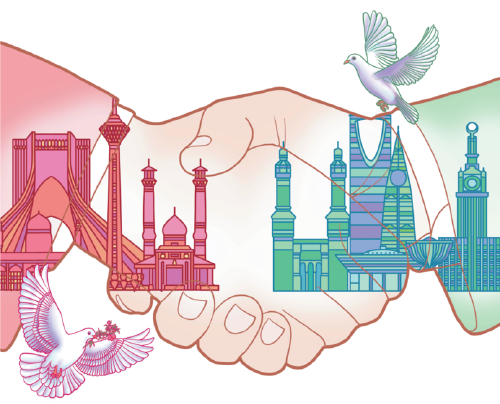
That China has brokered a historic diplomatic deal between Saudi Arabia and Iran — the two countries have decided to resume diplomatic ties after seven years — may come as a surprise to many, especially because China was not seen as a major player in the Middle East. But the fact is that for more than a decade, China has steadily expanded its influence across the Middle East.
China has not only increased investments in the Middle East through its Belt and Road Initiative and grown to become the region's largest trading partner, but also avoided, in most cases, entangling itself in the messy politics and sectarian rivalries in the region. This reflects China's new diplomatic strategy, characterized by a more active foreign policy that suits its own interests and creates more space for it to play a bigger role on the global stage.
This raises two questions: Does China hope to supplant the United States' role as the diplomatic heavyweight in the region? And what is driving China's evolving interests?
The short answer to the first question is "no". China plays, and will continue to play, a fundamentally different role in the Middle East than the US. It has no will to be the primary security guarantor for the region, nor can it offer the military resources provided by the US. The arms trade between China and the Arab region, for example, is a small fraction of what is traded with the US.
But China's interests in the region are indeed shifting. The country's relationship with the Arab world has long been based on trade and economy. Increasingly, it is likely to be animated by geopolitical and strategic concerns. And while it may not seek to supplant or replicate the US' role in the region, China may use its growing political and strategic clout in ways that are likely to aggravate tensions with the US.
China's new diplomatic strategy is less about a seismic shift in the world order than a shift in its own vision of its international role.
In the 1980s, the Arab order was challenged by the Iran-Iraq War. Plus, the geopolitical order was overturned by the end of the Cold War in 1991. And between 1984 and 1990, China established diplomatic relations with the United Arab Emirates, Qatar, Bahrain and Saudi Arabia.
The global order is shifting again, creating new dynamics between the Arab world and the two major global powers. While the US is widely perceived to be retreating from the Middle East with its new focus on the "Indo-Pacific", China is rapidly strengthening its ties with Arab nations. In 1990, China's bilateral trade with Saudi Arabia amounted to only $417 million. In 2022, it had grown to more than $116 billion. China's trade with Saudi Arabia in 2020 was more than three times that of US-Saudi Arabia trade.
The growing economic ties between the countries, however, are underpinned by strategic imperatives. China's economy relies heavily on imported oil and gas. And China sees the energy-rich Arab region as a crucial energy supplier at a time when demand for oil is expected to bounce back after nearly three years of COVID-19-related restrictions. China also sees significant potential to export more of its technologies and invest in critical infrastructure.
For China, the Middle East is an attractive market, one without the regulatory and political restrictions that Chinese technology firms face in Europe and the US.
At the same time, China has been expanding its political relations with the region. A 2019 report by the Atlantic Council says that China has signed comprehensive strategic partnerships with Saudi Arabia, the UAE, Iran, Egypt and Algeria. This level of partnership maintains "full pursuit of cooperation and development on regional and international affairs". China also maintains "lower-level" partnerships with eight other countries in the Middle East.
China's expansive foreign policy goes well beyond the Middle East. In addition to its recent efforts to play a significant diplomatic role in the Russia-Ukraine crisis, China has engaged in a more activist foreign policy, concluding security and defense agreements with Djibouti and pledging $100 million in military aid to the African Union.
On the other hand, the Joe Biden administration's ties with traditional allies and partners — Egypt, the UAE and Saudi Arabia — are strained. When Washington pushed for sanctions to punish Moscow for the Russia-Ukraine conflict, not one of these three countries supported it.
China's transition from foreign policy observer to active diplomatic player should not come as a surprise. As China's economic interests have grown significantly overseas, it has used this economic might to promote its own diplomatic agenda. This new Chinese strategy is less about a seismic shift in the world and more about a shift in China's vision of its international role.
What does this mean for China's future in the Middle East? Beijing has much to gain, economically and geopolitically, especially if the US continues to deprioritize the region. The Middle East countries have gained an important economic partner, but increasingly they are becoming the competitive playing field for growing US-China competition. How the region balances its economic interests with its foreign policy and national security priorities will remain a challenge in the foreseeable future.
The views don't necessarily reflect those of China Daily.