



A good year for Chinese economy







In March 2022, the Chinese government set a target of 5-5.5 percent GDP growth for the year. At the time, such growth levels appeared perfectly attainable. But within a month, the Omicron variant arrived, triggering strict lockdowns that, while stemming the spread of the coronavirus, caused serious damage to the supply and demand sides of the economy. China's growth rate for 2022 was just 3 percent.
Today, however, things are looking up for China's economy. Following the government's rapid shift away from its zero-COVID policy in December — and especially since the middle of last month — the economy has sprung back to life. This renewed vitality was on display during the Spring Festival holiday in late January, when more than 300 million Chinese hit the road, up 23 percent from last year.
There are good reasons to expect significantly higher growth in 2023. For starters, the headline rate will reflect the low base in 2022. Given 4.8 percent average GDP growth in 2019-22, a back-of-the-envelope calculation suggests that China should be able to achieve GDP growth of around 6 percent in 2023.
Moreover, China still has ample room for expansionary monetary and fiscal policy. In the monetary realm, there is space to lower both the reserve requirement for banks and policy interest rates, such as the seven-day reverse repo rate and the medium-term lending facility.
As for fiscal policy, there are widespread — and legitimate — concerns about China's high leverage ratio. But the government's debt-to-GDP ratio remains significantly lower than that of most advanced economies. Add to that China's faster GDP growth and high savings rate, and it is clear that China's fiscal position is much stronger than it is for most developed countries.
The question is how to direct the available policy support. Given the grim global outlook, exports cannot be expected to be a major driver of growth this year, despite making an important contribution to growth in 2022. Consumer demand can support growth, if it recovers strongly: in 2022, final consumption in China contributed just 32.8 percent to GDP growth, despite accounting for some 55 percent of GDP. But the likely impacts of direct measures to stimulate consumer demand remain unclear.
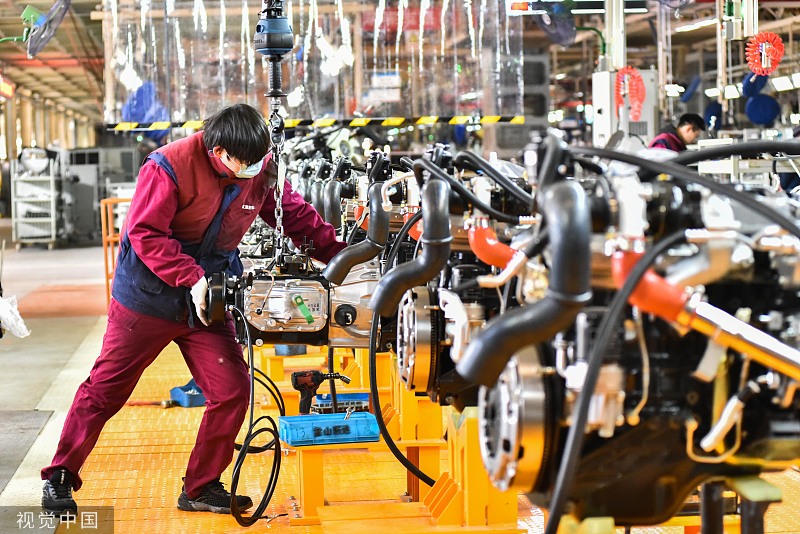
Where expansionary fiscal policy would be useful is in supporting investment. While investment's contribution to GDP growth has decreased significantly since 2010, it was the main engine for growth in 2022. Yes, real-estate investment declined by 10 percent. But investment in manufacturing and infrastructure rose by 9.1 percent and 9.4 percent, respectively.
China's best hope for the real-estate sector in 2023 is that investment stabilizes, while manufacturing investment will be decided mainly by market forces related to industrial and technological development. But infrastructure investment merits fiscal support.
Some economists have argued that China already suffers from excessive infrastructure investment, citing massive waste and white elephants. But while they are right that China has made inefficient investments, the country's infrastructure needs have not been met. For example, the pandemic highlighted weaknesses in China's public-health infrastructure. More broadly, compared to developed countries, China's (per capita) infrastructure gap is huge. So, infrastructure investment is still badly needed; it simply must be better targeted.
Of course, another black swan event like the pandemic could thwart China's aspirations for growth in 2023. A more likely impediment is an increase in inflation, as has occurred in much of the rest of the world.
Over the last decade, China's inflation rate has been very low, with the consumer price index averaging less than 2 percent. But the pandemic has dealt a major blow to China's production capacity, and repairing supply chains and eliminating production bottlenecks may take time. As a result, supply may not be able to keep up with the surge in demand that accompanies reopening. The resulting imbalance will cause inflation to rise this year, at least for a while.
Higher inflation will hamper the government's ability to implement expansionary fiscal and monetary policy. But the policy priority must be to stabilize growth, so China may well need to tolerate an inflation rate higher than 2-3 percent. Striking the right balance between growth and price stability may well prove to be a key challenge for China's government this year.
Fiscal and monetary expansion cannot fix China's structural problems. What it can do is create space for China to implement the comprehensive reform program set forth at the 18th National Congress of the Communist Party of China in 2012. That program called on the government to "encourage, support, and guide the development of the non-public sector"; "improve the property-rights protection system"; establish the basis "for the market to play a decisive role in the allocation of resources"; "put in place a modern market system in which enterprises enjoy independent management and fair competition"; and "build a law-based and service-oriented government."
The government must act fast, given the possibility that its space for macroeconomic expansion will shrink as CPI inflation rises and other potential constraints take hold. If China's leaders make optimal use of fiscal and monetary policy, and unswervingly pursue reform and opening up, they can ensure that 2023 is a very good year.
Project Syndicate
The views don't necessarily represent those of China Daily.
The author is a former president of the China Society of World Economics and director of the Institute of World Economics and Politics at the Chinese Academy of Social Sciences, and served on the Monetary Policy Committee of the People's Bank of China from 2004 to 2006.





