China building a better future through reforms








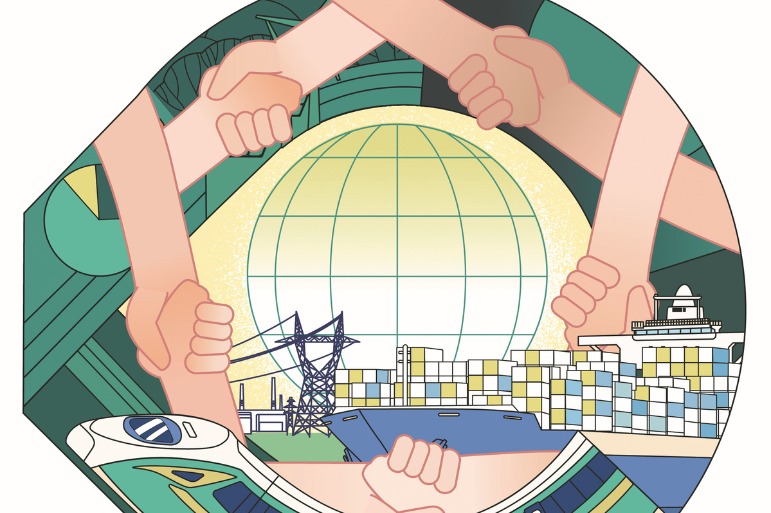
As China's economy faces many challenges, in his speech at the opening session of the 20th National Congress of the Communist Party of China President Xi Jinping launched an agenda that will guide the country for the next five years. In its quest to be a modern socialist state by 2035, the concept of a "New development pattern" is expected to create economic opportunities for the world during an era of low growth, high inflation, post-pandemic consequences and uncertainties due to increasing trends of deglobalization, the war in Europe and climate change.
One of the main challenges that faces the Chinese economy is the increasing pressure the United Sates is leveraging through technological competition. Most recently, the US government has ordered the halt of sales of semiconductors used to produce supercomputers and artificial intelligence and have forbidden any citizen of the US to work in Chinese companies involved in this business.
That is why the Chinese government is increasing its efforts to be technologically self-sufficient and independent of foreign technology. For this end, China will redouble its efforts to invest in R&D and implement strategies to develop a high-quality workforce. In this scenario the "Made in China 2025" policy was a good strategy because it seeks to reach 70 percent sufficiency in basic materials for 10 advanced industries including semiconductors, autonomous vehicles, AI, aerospace and digital development. China spends around 2.5 percent of its GDP in R&D and this must increase for these goals to be achieved.
China's development of indigenous technology in these industries will bring a needed alternative to developed countries which now must rely on the US. This will also create more competition, thus reducing the costs of these advanced products.
Another challenge China faces are the consequences of climate change via environmental contamination, land degradation, droughts and floods. Xi mentioned China needs to accelerate its transition to a green economy and consumption by developing low-carbon industries and using more clean energies. This represents an opportunity for Latin American countries because they can supply clean materials to build wind farms, solar panels, electric cars, batteries and other necessary infrastructure because they are big suppliers of minerals like copper, iron and lithium.
China must also work to create a larger middle class. This has to do with common prosperity, a key principle Xi has mentioned on several occasions.
Lastly, another opportunity for the world is China is willing to keep opening its economy. For example, China announced it wants to be part of the Comprehensive and Progressive Agreement for Trans-Pacific Partnership. This is a more advanced and wide trade agreement, and will not only open China's market more but will also make rules for investment and government purchases more transparent.
In the CPTPP there are also Latin American countries like Peru, Chile and Mexico. The first two have Free Trade Agreements with China but the CPTPP offers more market liberalization. China's willingness to enter this agreement is in contrast with countries like the US that are forming rival blocs and working for a decoupling from the Chinese economy.
Finally, Xi noted China cannot develop in isolation from the world and the world needs China for its development, which summarizes what the world needs in this era of challenges.
Maria Osterloh Mejia is a researcher and professor at the Center for Asian Studies at San Marcos National University in Peru.
The opinions expressed here are those of the writer and do not necessarily represent the views of China Daily and China Daily website.
If you have a specific expertise, or would like to share your thought about our stories, then send us your writings at opinion@chinadaily.com.cn, and comment@chinadaily.com.cn.