



Paving an open sci-tech innovation path







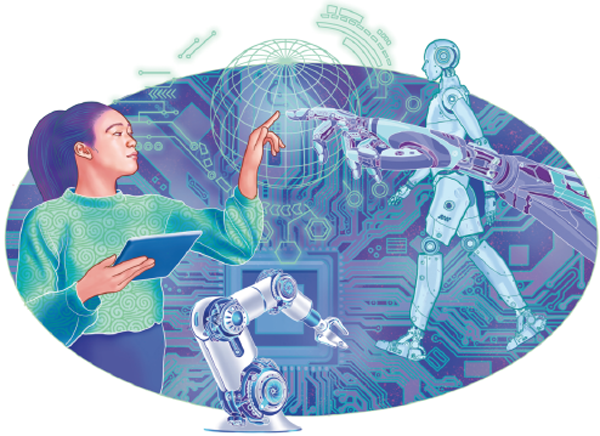
The past 10 years have seen China make rapid and remarkable progress in the field of science and technology, and rigorously promote innovation. No wonder China is now one of the leading nations in the field of innovations.
According to the Global Innovation Index of the World Intellectual Property Organization, China moved up from the 34th position in 2012 to the 12th position in 2021 based on innovation capability. Thanks to its strong innovation capability, China has been helping the world overcome many global challenges.
The past decade has also seen China substantially raise investment in the science and technology sector. Overall, its research and development expenditure has increased from 1.03 trillion yuan ($0.14 trillion) to 2.79 trillion yuan, the second-highest in the world, with its R&D intensity increasing from 1.91 percent to 2.44 percent, close to the average of OECD nations.
With the rapid growth of investment in R&D, China has produced more impressive results in science and technology. In 2021, for example, 42,920 Chinese papers were among the highly cited ones, the second-highest in the world, accounting for 24.8 percent of the world, with its applications for patents to the Patent Cooperation Treaty increasing from 19,000 in 2012 to 69,500 in 2021, the highest in the world.
China has made a number of breakthrough achievements in areas such as quantum information, and the R&D capability of its universities, institutes and science and technology companies has significantly improved.
Chinese papers in 4 disciplines including materials science, chemistry, computer science, and engineering, which are major contributors to scientific achievements, ranked first in the world in terms of citations in 2021.
China has completed many major science and technology projects, attracting worldwide attention. Tianwen-1 explored Mars, Chang'e landed on the moon, Shenzhou XIII and Tianhe core modules were successfully docked, and China's deep space exploration has been progressing smoothly. China has also built and put into use major scientific and technological infrastructure such as the Large High Altitude Air Shower Observatory.
Besides, the Five-Hundred-Meter Aperture Spherical Telescope (or FAST) has discovered millisecond pulsars, the first such discovery, and a new generation "artificial sun" has made its first discharge. China's scientific and technological progress has helped elevate its science and technology industries to the mid to high end of the global value chains.
The transformation of China's industrial system has accelerated thanks to the advances it has made in R&D in the science and technology sector, and the use of a large number of advanced equipment and systems have promoted its industrial upgrading. For example, China has accelerated R&D to find new, more efficient and eco-friendly use of coal.
More important, the expedited application of emerging technologies such as artificial intelligence, big data, and blockchain has given birth to new products and formats in China including smart terminals and telemedicine. And the scale of China's digital economy tops the world, with the country increasing investment in new energy vehicles.
China has been the world's leading electric vehicle (EV) manufacturer and consumer for seven consecutive years. It also leads the world in areas such as solar photovoltaic panel production, wind power generation and advanced energy storage.
China's achievements in science and technology are inseparable from global cooperation in the field. Yet global economic development is no longer possible without China's contributions. In fact, China has been carrying out extensive bilateral and multilateral cooperation with 161 countries for years.
Among the Chinese papers included in Science Citation Index in 2020, those co-authored in cooperation with researchers in 190 countries and regions numbered 144,500, and joint research conducted by China and other countries has yielded results that have helped fight climate change, and improve human life and health.
China has also been participating in major global science projects such as the International Thermonuclear Experimental Reactor program and the Square Kilometre Array, and cooperating with many major science and technology powers to try and find solutions to global problems. But despite carrying out research in some important industries — a strategic choice to boost economic development and industrial security — it has always believed that self-reliance in the field of science and technology and cooperation are not exclusive, but mutually enhancing.
In recent years, China has adopted a variety of policy tools to promote global science and technology cooperation, opened up large-scale scientific infrastructure, jointly established R&D platforms, and expanded the scope, field and scale of open innovation.
In 2021, China's intellectual property imports reached $46.8 billion. From the technological development and economic globalization points of view, collaboration and integration are the only options to take forward scientific and technological development. This means isolation from the global trend of cooperation and collaboration will only hurt humankind's development and undermine common welfare.
In the 14th Five-Year Plan (2021-25), the government has proposed to further integrate into the global innovation network and adopt a more open, inclusive and mutually beneficial international science and technology cooperation policy.
As such, China will establish an innovation policy system that conforms to international rules, strengthen intellectual property rights protection, and create an open innovation ecosystem. Moreover, it will further open its science and technology sector and always strive to make more contributions to global scientific and technological and socioeconomic development.
The author is director of and a researcher with the Institute of Innovation and Development, Chinese Academy of Science and Technology for Development. The views don't necessarily represent those of China Daily.
If you have a specific expertise, or would like to share your thought about our stories, then send us your writings at opinion@chinadaily.com.cn, and comment@chinadaily.com.cn.








