Country can continue to keep a lid on inflation







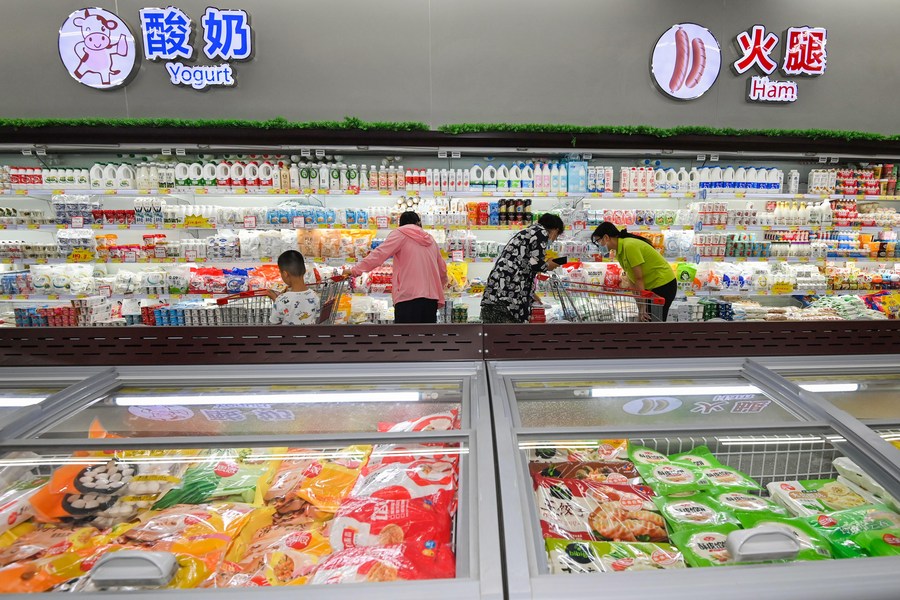
When high levels of capital investment spending fueled a sustained increase in Chinese inflation from 1991 to 2011, the authorities quickly brought the situation under control.
Over the past decade, the rise in China's consumer price index has rarely exceeded 2 percent, compared with 5.4 percent in 2011. With policymakers in most major economies now losing their grip on price stability, can China continue to keep a lid on inflation this year and next?
To answer this question, it is worth considering how China succeeded in curbing inflation for the past decade. Notably, the government refrained from new rounds of large fiscal and monetary stimulus, and thanks to the central bank's increased autonomy, money creation and credit growth stopped passively catering to investment projects from below.
After 2015, the People's Bank of China, the nation's central bank, adopted a prudent tone and adjusted credit allocation to support sectors with excessive debt ratios.
Highly polluting industries and the real estate sector-both of which had driven rapid GDP growth in the past-faced financial repression. At the same time, the central government has tolerated the minimum growth rates that could accommodate steady employment growth.
Today, that tolerance is being tested. COVID-19 pandemic lockdowns, especially in Shenzhen, Guangdong province, and in Shanghai have taken a heavy toll on China's economy. In the second quarter of 2022, Shanghai's GDP fell by almost 14 percent. In addition, the real estate sector-traditionally a major contributor to aggregate demand-is becoming a drag on the economy.
In 2020, Chinese government introduced "three red lines" to constrain the sector's access to credit: developers' liabilities should not exceed 70 percent of assets, their net debt should not exceed equity, and their cash holdings must be equal to short-term borrowing.
The new debt metrics, together with the pandemic, have put intense pressure on the sector. Once-thriving developers are now facing serious debt crises.
With some residential projects having been delayed or halted, homebuyers in several cities have had to stop making monthly mortgage payments since the second half of last year.
The good news is that China has indeed kept inflation under control. In the first half of the year, the consumer price index rose by 1.7 percent, and the government's inflation forecast for 2022 is about 3 percent.
The bad news is that, while China's economy has been spared from overheating, this has clearly come at the cost of a sustained slowdown in GDP growth, and even a recession in some areas.
Given this, official forecasts of 5.5 percent economic growth this year will not be achieved. In the second quarter of this year, China's growth was barely positive. Though GDP still grew by 2.5 percent year-on-year in the first half of 2022, thanks to relatively strong exports, real GDP growth would have to reach at least 8 percent in the second half of the year to achieve the 5.5 percent target for 2022, which is unlikely to happen.
Therefore, the central government would most likely need to revise the lower limit of its growth forecast for July-December downward to 6 percent, rather than 8 percent, implying an annual growth rate of 4 to 4.5 percent for the entire year.
Therefore, China's government is planning to launch a new round of stimulus for the rest of the year. With unemployment rising-the rate for 16- to 24-year-olds reached 19.3 percent in June, up 4 percentage points year-on-year-stimulus is urgently needed. But Premier Li Keqiang has been very wise to highlight the importance of not overdoing it.
In the past, stimulus has taken the form of excessive infrastructure investment. But China now has limited room for maneuver. One key constraint is the huge debt overhang from the massive round of stimulus in 2009-11, which poses a serious risk to the financial system.
Most of the liquidity that could be used to invest in additional infrastructure projects will still have to be financed by local financing vehicles and local government bonds.
While the authorities recently asked China's policy and development banks to add a total of 1.1 trillion yuan ($162 billion) in new credit lines to support infrastructure projects, new budget outlays-and new debt-might still be required.
Another constraint on stimulus is the threat of imported inflation. The effects of the pandemic, together with the fallout of the Russia-Ukraine conflict, are raising inflation expectations in most Western countries, which are already experiencing rapid increases in consumer prices. For example, the consumer price index in both the United States and the United Kingdom exceeded 9 percent in June, while the eurozone's CPI exceeded 8 percent.
Likewise, in Asia, South Korea's CPI rose 6 percent year-on-year in June, the largest such increase since November 1998. The increase in Japan's CPI-2.4 percent-exceeded the central bank's target for a third consecutive month.
As a major energy and food importer, China will find it difficult to insulate itself from the global trend. Two factors explain why the CPI in China has not already surged.
First, China's energy and food importers are all giant, State-owned enterprises whose pricing decisions are tightly regulated.
Until inflation expectations are formed, the increase in import costs is not passed on to consumers. This is reflected in China's producer price index, which has been less stable than the CPI over the years.
Second, even as China imports many critical goods, those that are included in the CPI are largely supplied domestically. And, as with importers, the prices charged by State-owned producers in the upper reaches of China's economy do not fully reflect changes in their costs, due to government controls.
Consider pork, which is the single most important item affecting the CPI in China-accounting for 2.5 percent of the index.
The countercyclical regulation of hog raising and State subsidies to pork producers have gone a long way toward keeping pork prices-and, thus, the CPI-relatively stable.
However, while such regulation can help to cushion external supply shocks, reducing revenues or increasing subsidies will add to the government's fiscal burden, especially amid global inflation.
In this context, it is understandable that China's government chose to adopt a modest stimulus package. An overly strong stimulus, experience has made clear, would almost inevitably entail excessive monetary expansion, leading to a surge in inflation that would create further challenges for China's economy in the coming years.
The author is dean of the School of Economics at Fudan University and director of the China Center for Economic Studies, a Shanghai-based think tank.