Escaping the Thucydides' Trap







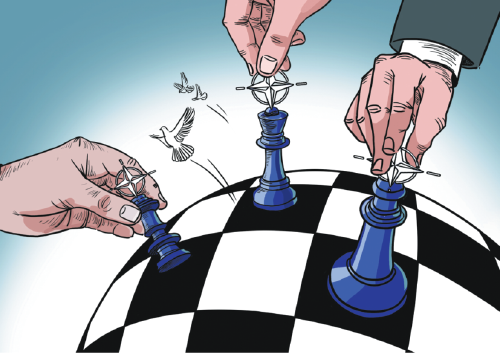
The Thucydides' Trap is a term first used by US political scientist Graham T. Allison to describe an apparent tendency toward war when an emerging power threatens to displace an existing great power. The term is based on a quote by ancient Athenian historian and military general Thucydides, who in his 'History of the Peloponnesian War' wrote, "it was the rise of Athens and the fear that this instilled in Sparta that made war inevitable". The term was coined, and primarily used, to describe a potential conflict between the United States and the People's Republic of China. Is it likely then that war will be the consequence of the currently changing global order?
One would of course hope not, given the potency of modern weaponry, including nuclear weaponry. The reality of mutually assured destruction, bearing the apt acronym MAD, is understood to make such an event unlikely and thus far since the Soviet Union copied the US in having "the bomb" in 1949, nuclear conflagration has not occurred. The danger under MAD, however, is that though both nations know they cannot win a nuclear war, each must demonstrate a willingness to risk losing one, for without such they will lose out in the geopolitical powerplay. The clearest example was in the Cuban Missile crisis where then-US president John F. Kennedy made it clear to the Soviets that he would use nuclear weapons unless they withdrew their missiles from Cuba. In that high-stake game of poker lies the risk.
It is unlikely that the rising power China will start a war. As the world's major trading nation it would make no sense for China to wage war. Trade works best is a stable international environment. War is disruptive to trade, especially when Chinese trade embraces the whole world.
Indeed, China has never been an aggressive military power over the nearly 5,000 years of its civilization, even when it was by far the predominant global power. During times in the Song, Tang, and Ming dynasties, it is estimated that Chinese GDP made up as much as 60-70 percent of the global total. In the early Ming Dynasty, under the Yongle Emperor (1402-24), China developed a vast navy, which under admiral Zheng He, made seven great journeys to distant shores as far as Africa and the Middle East. These ships were up to 100 metres in length weighing some 500 tonnes. Those of Portugal, the leading European naval power, were no more than 20 metres and weighed in at just 50 tonnes. Yet, even with these military means the Chinese never sought to project their military power as colonialists. That was primarily because they believed that all that was really needed was to be found in the "Middle Kingdom", an idea that would later cause them to be undone. The genesis of modern colonization would come in the West.
China seems also to understand identifying power as being better projected by other means. Chinese power is exercised far more through trade, particularly through the Belt and Road Initiative now involving over 140 countries. The US response to this has been late and half-hearted with Build Back Better.
The limitations of war as means of projecting power are also found in it being asymmetrical, something we are currently seeing in Ukraine. Massively expensive US aircraft carriers in the South China Sea are vulnerable to much cheaper Chinese hypersonic missiles.
The danger of conflict comes, I believe, from the US, where high-level mistrust of the government has led to a heightening instability, most vividly seen in the attacks on the Capitol on January 6, 2021, by forces aligned to Trump. Indeed, the election of Trump in 2016 was a sign of a breakdown in the US social fabric. Only in the US, among economically developed nations, have those at the bottom 50 percent of the economy gone backwards during the past 30 years. Alienated, having lost trust in the system, they are susceptible to demagogic appeal. The riots at the Capitol are unlikely to be the last, and with the midterm elections soon due, there is fertile ground for extremism. This mistrust contrasts sharply with the high-level trust of government and institutions in China, various studies putting that at over 90 percent.
Despite this loss of trust, the US government and its populace share an ideological commitment built around the idea of "American exceptionalism," often seen as having divine sanction. That this ideological commitment is often deeply genuine is what makes it especially dangerous.
Then there is the danger of the US "military industrial complex", first identified by Dwight D. Eisenhower, both a general and later president. It was he who said, "We must guard against the acquisition of unwarranted influence, whether sought or unsought, by the military industrial complex". His words have been little heeded with its power in US politics having become inordinate. Having a powerful financial interest in war and conflict these interests have not been backward in promoting conflict.
All this leads me to think that any US-China conflict is far more likely to be initiated by a United States under threat of the loss of its top status. With growing internal instability there is a growing chance of a reactive lashing out. Further, restraints have been removed with the US unilateral withdrawal from treaties designed to preclude nuclear war, the Anti-Ballistic Missile Treaty (2002) and the Immediate-Range Nuclear Forces Treaty (2019).
With a massive military complex, including 800 overseas military bases, any reactive lashing out will be highly destructive, perhaps terminal for civilisation. One hopes we avoid the Thucydides Trap.
John Queripel is a Newcastle-based author and historian and social commentator.
The opinions expressed here are those of the writer and do not necessarily represent the views of China Daily and China Daily website.
If you have a specific expertise, or would like to share your thought about our stories, then send us your writings at opinion@chinadaily.com.cn, and comment@chinadaily.com.cn.