G7 makes a joke of itself by countering China with PGII







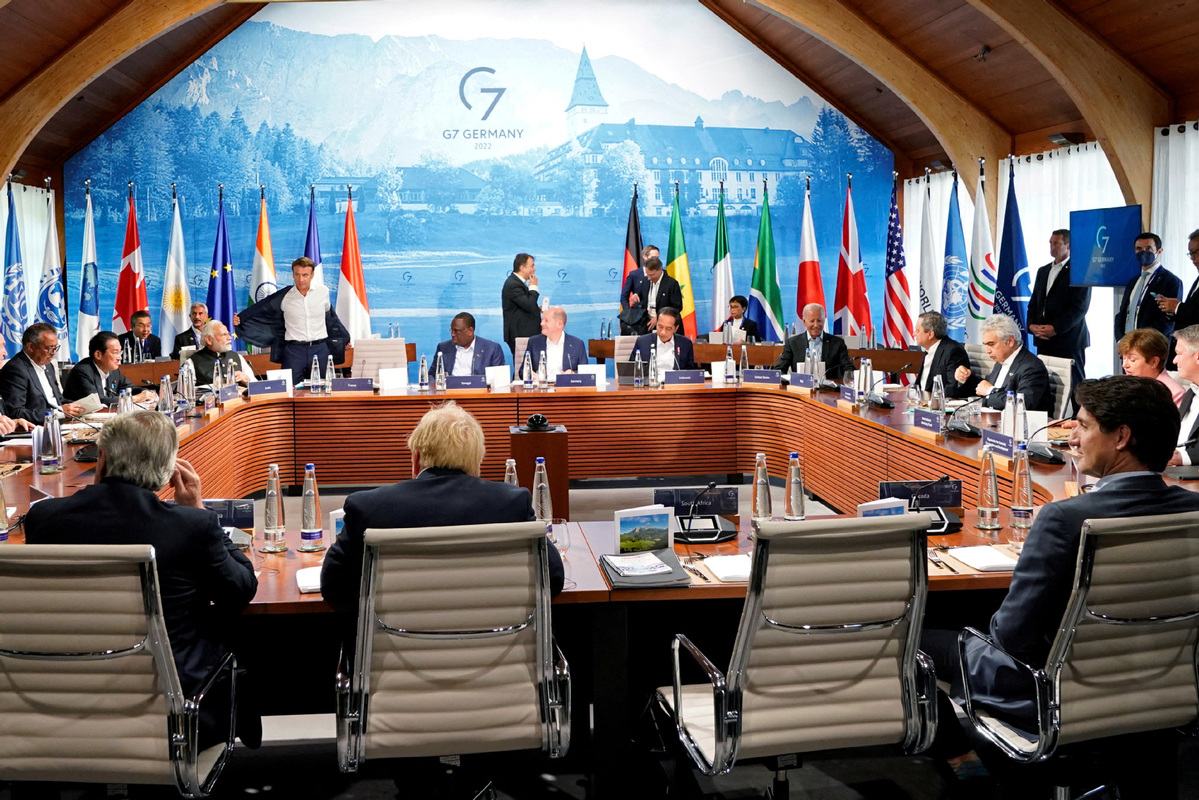
The Partnership for Global Infrastructure and Investment launched by G7 leaders during their just-concluded summit in the Bavarian Alps, Germany, has become an instant laughing stock for its empty rhetoric and its bid to "counter" the China-led Belt and Road Initiative.
To begin with, the PGII is nothing new but a rebranding of the "Build Back Better World" or "B3W" plan the G7 leaders led by US President Joe Biden unveiled during their summit in Cornwall, England, last year. In the past year, no progress on the B3W has been reported.
At their Bavaria summit, the G7 leaders said they aim to leverage $600 billion of public and private funds by 2027 for PGII, with Biden pledging $200 billion. But no one seems to have any clue where the money will come from.
For Biden, getting any public funds approved by the US Congress for the PGII is unthinkable given that he has failed to get the Senate to pass his ambitious domestic Build Back Better plan.
Even Wendy Cutler, who served as acting deputy US trade representative in the Barack Obama administration, could not help saying that "the more concrete, affirmative actions the G7 can take instead of just words in a final statement, the more impactful and relevant the group will be going forward".
Observers will notice that the PGII does not include the most common infrastructure projects such as roads, bridges, railways and power plants despite the fact that they are the most needed facilities in the developing world. The PGII is limited to health and health security, digital connectivity, gender equality and equity, and climate and energy security.
So how can the US and other G7 member states provide "an alternative to what the Chinese are offering", as US National Security Advisor Jake Sullivan said last week, if they don't intend to build any roads and bridges?
China will be eagerly waiting to see if the G7 can actually set a good example in building such infrastructure facilities. Also waiting will be developing nations from Asia, Africa, Latin America and the Middle East. The sad truth is that the G7 will skip those real infrastructure projects.
Developing countries need more infrastructure projects, the more the better. So infrastructure initiatives should never be a zero-sum competition between big powers. That was why European countries joined China in launching the Asian Infrastructure Investment Bank in 2015 despite strong US opposition.
I hope the G7 fulfills its $600 billion target by 2027. But it will still be dwarfed by the expansive Belt and Road Initiative that has been building connectivity around the world since 2013.
That's why John Berthelsen, editor-in-chief of the Asia Sentinel and a long-time China watcher, wrote on Wednesday that the PGII is "too little, too late", lamenting that the "smattering of projects pales in the face of Beijing's vast infrastructure investment".
It's not just the PGII that has been disappointing — like old wine in a new bottle. The G7 Summit this week, too, was a forum of just empty talks.
Politico, a news website which tends to be pro-Democrats, made a rare criticism of the summit for making no progress on key issues, from fighting climate change, helping end the Russia-Ukraine conflict and easing the food crisis to curbing the rise in energy prices, and lowering high inflation.
China and the G7 could learn a lot from each other in terms of their respective strength in infrastructure construction to the benefit the developing world. But if the G7's sole purpose is to counter China, to undermine the Belt and Road Initiative and to sabotage China's infrastructure projects in developing countries, then the G7 will simply end up working against the interests of both China, and developing countries it promises to help.
The author is chief of China Daily EU Bureau Chief based in Brussels. chenweihua@chinadaily.com.cn