G7's China obsession won't pay off








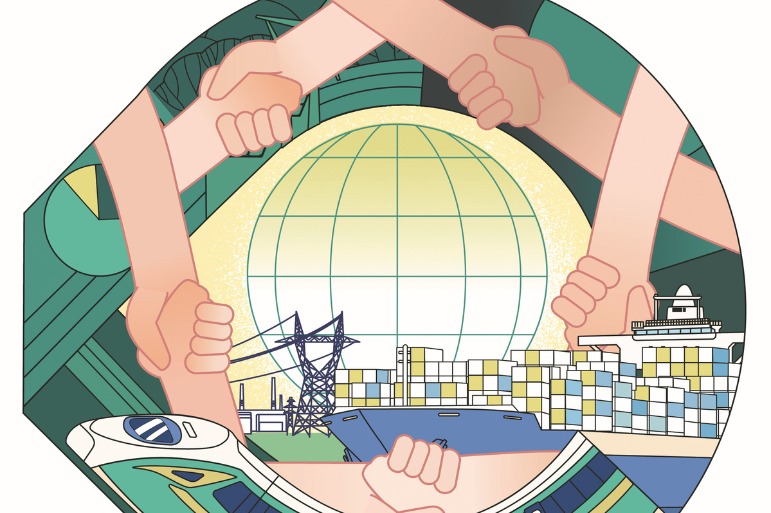
On June 26, leaders of the Group of Seven economies pledged to raise $600 billion in private and public funds over five years with the futile aim of countering China's Belt and Road Initiative. By re-emphasizing the "values-driven, high-impact, and transparent" nature of the Partnership for Global Infrastructure and Investment, the group ends up treating infrastructure financing as an exercise in influence, not peaceful development. It is highly unlikely this Cold War view of contending China will attract many takers in a highly globalized world.
The BRI stands for much of what the G7 doesn't on the international stage: there is a demonstrated focus on win-win cooperation, no ideological baggage and traction with nearly 150 countries and 32 international organizations. On the contrary, the G7's sustained campaign to offer an "alternative" is riddled with ambiguity and the group continues to react to China's peaceful rise, as opposed to coexisting with it. That warrants skepticism among the scores of low- and middle-income economies the G7 infrastructure partnership – with no prior memory of long-term success – aims to speak for. Make no mistake: the $600 billion pledge is a move with some positive optics, but defeats its own global appeal by tethering engagement drivers to "like-minded partners."
The G7's agenda to target China isn't new. Last June, countries sought to portray China's Belt and Road engagement as a risk to Western standards of doing business on infrastructure. There were no immediate takers for this line of argument last year, and little suggests that would change now. After all, the G7 – led by US President Joe Biden – is using infrastructure development as a weapon to prove countries will reap concrete development benefits if they partner with "democracies." What the G7 doesn't mention is these same democracies have increased exposure to recession risks and have yet to muster the hundreds and billions of infrastructure investment they wish to commit in opposition to the Belt and Road.
Another setback for the G7's "Partnership for Global Infrastructure and Investment" is the big discord between countries' domestic economic challenges at home and the "enormous infrastructure needs" it claims to meet on the world stage. Downgraded growth forecasts bring into question the group's ability to scale heavy investments long-term. Moreover, the fact the partnership is only being announced now confirms the focus on low- and middle-income economies is seasonal. That is a marked departure from the BRI, given its long-term role in cultivating trade connectivity, stepping up engagements from Africa to the Middle East and ensuring recipient nations build the necessary capacity to develop in sync with a highly globalized world.
As the G7 commits to its anti-China agenda, serious questions surround the degree of infrastructure transparency it is actually committing to the developing world. After all, G7 leaders have characterized their China-focused infrastructure plan as one that will "support the United States' and its allies' economic and national security interests." Where is the evidence that scores of countries share the G7's spin on infrastructure financing as a national security imperative? For now, that is largely the G7's own narrative, one devoid of broad-based support from the rest of the world. It is all talk and little action.
The fact remains the BRI's ability to deliver dwarfs the G7's infrastructure pivot. Leveraging developing economies to serve a futile anti-China agenda is nothing more than exploitation.
The author is a foreign affairs commentator and author.
The opinions expressed here are those of the writer and do not necessarily represent the views of China Daily and China Daily website.
If you have a specific expertise, or would like to share your thought about our stories, then send us your writings at opinion@chinadaily.com.cn, and comment@chinadaily.com.cn.