



Veteran diplomat: Steady ties essential







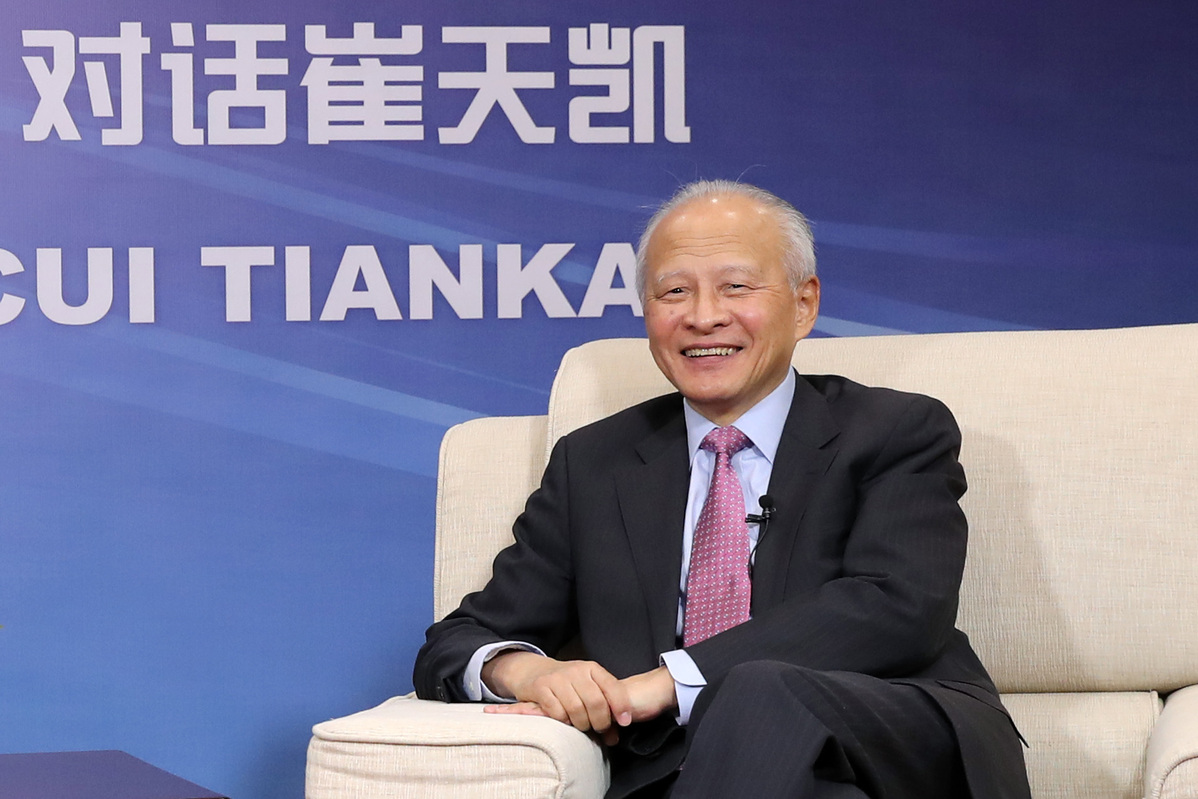
Q: So often we hear from the US, the "rules-based international order". What are your thoughts on that? What characterizes China differently in the way it conducts itself internationally?
Cui: First of all, about the so-called rules-based international system, people have to ask, what are the rules? Who made these rules?
They should be based on the United Nations Charter, the purposes and principles of the charter. And the first principle set by the United Nations Charter is sovereign equality of all member states. These are the real internationally accepted rules, and who are abiding by the rules and who are violating these rules is quite clear.
Then as for an initiative like the Belt and Road Initiative, I think the best judges are the countries participating in such an initiative. People can just go to some of the African countries, Asian countries that are taking an active part. They will tell you the true story of how they have benefited from it, how such an initiative is helping all of us.
We are helping others to build up the infrastructure. If they have a good infrastructure, they have the conditions for further development. And if they are connected to other countries by trade, by mutual investment, if they are connected to the global market, then their people have the opportunity to achieve prosperity, to get rid of poverty.
Q: In your time as ambassador you were interviewed frequently and almost always on very specific sets of topics. I'd like to know about your experiences interacting with the media.
Cui: I have had so many interviews when I was the ambassador in Washington, DC, and I have also made many friends in the American media.
I certainly understand the need to do a good job, to outperform some of their colleagues. Sometimes I have disagreements with them, and I have to say it.
I would offer some advice for them to consider. You see human beings, all of us, including you and me, we have our own limitations. We should not believe that just because we are journalists, we are always right. We have the right to criticize others, but we can refuse to listen to others' criticism. I think they should get rid of this kind of mindset.
You see on the top corner of The New York Times, there's a phrase, "All the news that's fit to print". But who is there to decide what is fit, what is not? It's determined by the editors, maybe by the reporters, it's determined by human beings.
Human beings all have our own weaknesses. Sometimes we are misguided and sometimes we have misunderstandings. So I think people working in the media should recognize this.
They should be more open. They should be more ready to listen to others, to tolerate different views.
Q: So what they tended to focus on are made into these hot-button topics such as Xinjiang, Hong Kong, Tibet, the South China Sea, these things in the early months of the COVID-19 pandemic. I'm curious if there was anything you'd like to clarify, maybe there's any kind of misunderstanding or misrepresentation.
Cui: The problem is sometimes they just don't tell the true story. The media is there to help other people to have access to the true stories, to the realities. But sometimes they got a message of their own and they're so obsessed sending their messages or even imposing their messages on others at the expense of truth.
For instance, I have visited Xinjiang more than once in the last few years. I tried my best to share what I saw in Xinjiang on the ground talking to the real people there.
I tried to share all this with some of my friends in the American media. But they just didn't report on all these things. They are so obsessed with the bias or their perception.
You have the question of Taiwan, you have the question in Xinjiang, Hong Kong, and the South China Sea. We are very much on the defensive side and others, some people who have never visited these places, know very little about these places, are trying to criticize China on what we are doing there.
And what we are doing there is very simple. First to defend our sovereignty and territorial integrity. Number two, to develop these places, to develop the entire country. So people in China could enjoy a better life.
Q: What story would you like to share? What aspect of this do you think they could look into and find something that is closer to the truth?
Cui: For instance, what is happening in Xinjiang, some of the people in America, politicians and media people, they are always talking about so-called forced labor.
But if you go there and have a look there is such development in Xinjiang, actually people are using a lot of machines, a lot of high technology to grow plants, like cotton and other things, and people are having new jobs, have new opportunities to make themselves richer and better off.
Q: You mentioned Taiwan and that is obviously foundational for the US-China relationship. There is a lot of misunderstanding about Taiwan.
Cui: As you said, this is a question about the very political foundation of the relations between China and the US. For China, this is really a matter of core interest, a matter of life and death importance for China, because it concerns China's territorial integrity and its sovereignty. So there's no room for compromise or for concession for China.
So I think American policymakers should have a better understanding of the importance and sensitivity of this Taiwan question.
Actually, we talk about the three China-US Joint Communiques. All these joint communiques focused on the Taiwan question. And that is the core issue of all these agreements between the two governments and the US government has committed to implementing the one-China policy.
What they are doing is a clear violation of this one-China policy and the three joint communiques. So if things go on like this, it's going to be very serious and dangerous.
And also China will have to defend our own territorial integrity and will do whatsoever to defend our sovereignty and territorial integrity. But we are not just doing this for our self-interest. In a sense we are doing this for the shared interest of the entire international community.
If China's sovereignty and territorial integrity is violated then that would set a very bad precedent. Today you could violate China's territorial integrity. Tomorrow you could violate another country's territorial integrity.
Q: What are some of the things that have been done that have aggravated this relationship?
Cui: There are so many of them, for instance, American arms sales to Taiwan.
You see this year 2022 would mark the 40th anniversary of the third communique between China and the US, the joint communique on Aug 17 in 1982, which is basically about how to stop American arms sales to Taiwan.
The US made the commitment that it will gradually reduce its arms sale to Taiwan, and eventually it will stop. And it also promised that the remaining sales will not exceed, in quality and quantity, previous levels.
But all these commitments, all such promises were not honored, were not implemented. The US is selling more and more and more advanced, more sophisticated arms to Taiwan.
And also in recent years, there is a clear attempt to upgrade official relations between the US and the Taiwan authorities. They are still telling us this is an unofficial relationship. I don't know how people could be so hypocritical.










