First Chinese curator in America: How cultural communication bridges East and West







The Asian Art Museum in San Francisco is dedicated to spreading Asian culture and art, with a collection of nearly 20,000 Asian cultural relics spanning 6,000 years. The Chinese collection is the most abundant. How does the museum act as a bridge in cross-cultural communication? Xu Jie (Jay Xu), the museum's director and CEO, said in a recent exclusive interview with the China News Service's "East-West Quest" that the key to setting cultural free from political limits is finding the greatest common divisor. Museums can transcend politics and emphasize the communication between people and between cultures.
Xu graduated in 1983 and started his career as a curator secretary at the Shanghai Museum. Seven years later, he chose to further his study in the United States at Princeton University. After graduation, he worked at the Seattle Art Museum and Chicago Art Museum. In 2008, Xu joined the Asian Art Museum in San Francisco, becoming the first Chinese curator at a large American museum. In 2015, he was elected an academician of the American Academy of Humanities and Sciences.
China News Service:Since you have work experience in both Eastern and Western museums, what differences impressed you most when you first entered Western museum?
Xu Jie: I officially began to work for American museums in 1996 as a curator in the Chinese art department at the Seattle Art Museum. At that time, what impressed me most was that China and the United States were different in their management. Chinese museums work in teams, while American museums emphasize individuals. In comprehensive museums in the United States, it is often impossible for every cultural category to have many employees; one person must undertake many aspects of work. This mechanism has great advantages. If you are alone, you will have many opportunities to give full play to your talents. But the challenge is that no one can do everything, so they must cooperate with Chinese experts and Chinese art experts outside the museum.
China News Service:As a Chinese-American, what advantages do you have, and what challenges have you faced when working in American museums?
Xu Jie: My identity gives me great advantages when participating in cooperation with China. The first reason is that I have worked in China and share many common views with my Chinese colleagues on language, way of thinking, knowledge and morality. In addition, I worked as the museum director's secretary at the Shanghai Museum for seven years. This work gave me a great opportunity to learn comprehensively how to operate a museum, which has helped me a lot when later working for museums in the United States.
My identity also creates challenges. As an ancient Chinese said, "See more than you’ve seen and learn more than you've learned." Chinese-Americans need to know more about Chinese culture and broaden our horizons at the same time so that we can reflect on Chinese culture and art from a global perspective. We need to equip ourselves with knowledge of profound Chinese culture and diverse cultures worldwide.
China News Service: Western museums generally prefer displaying Chinese historical relics in all Chinese exhibitions, always presenting visitors "the ancient and old China." What should they do to present a modern and real China to visitors?
Xu Jie: The Asian Art Museum in San Francisco will always protect and promote traditional art as well as embrace the future. We pay attention to both traditional art and modern art. We exhibit modern art and also display ancient art from a contemporary view. The emphasis on tradition is not at all contradictory to modernization.
China News Service: What should museums do to handle the relationship between "elitism" and "popular culture" well?
Xu Jie: We live in an era of diversity instead of duality. Elitism is not at all contradictory to popular culture. I require my team to conduct our work based on first-class academic studies, and we are pretty willing to work with scholars in the ivory tower. In the meantime, most visitors are people from all walks of life, so we must present the most profound academic studies to them in an easy-to-understand and interesting way.
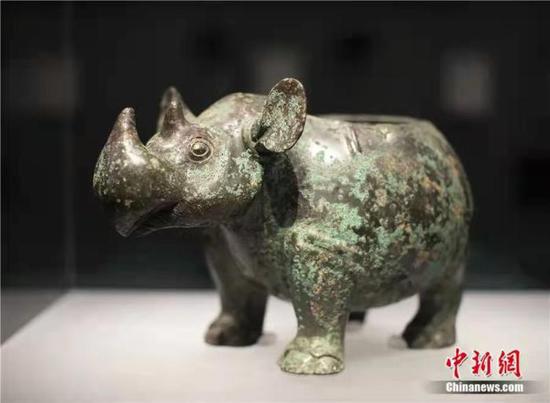
For example, "Ritual Vessel in the Shape of a Rhinoceros" is the most popular exhibit in our museum and our mascot, too. We have initiated an online vote to look for a nickname for this relic, and we even find a Spanish name for it: Reina, meaning for "queen." As an expert on bronzes, I am quite familiar with this ritual object, but I have not yet figured out its sex because the ancient artisan did not add any sex features to it. The voting shows that the public believes it is a female and even a noble queen. And this is an excellent story.
China News Service: How can we tell the story of Asia, especially China, in the western context?
Xu Jie: The key to telling the story of Asian and Chinese culture in the Western context is "communication" and "connection." Be sure to find a point of entry familiar to Western audience and lead them into unfamiliar cultures.
The first point is to connect the ancient with the modern.
We once held an exhibition where half of the exhibits were ancient artifacts from our collection and the other half were works by contemporary artists. Putting them together allows the audience to see how contemporary artists were inspired by ancient art. At the same time, such exhibitions can also shed light on ancient art from the perspective of contemporary art and thus exploit the vitality of ancient art.
The second is to connect Asia with the world.
A few years ago, we organized an exhibition called "China in the Middle of the World," with world maps as the theme. Among the maps displayed to the audience, two are the "Kunyu Wangu Quantu" from the late Ming Dynasty and the "Kunyu Quantu" from the early Qing Dynasty. Both maps were customized for the Chinese emperors by Western missionaries working together with Chinese technicians, hence both placed China in the center of the world. Maps are an important means for people to understand the world, and with them as a medium, this exhibition reflected China's position in the world as well as the exchange between China and the other countries at that time.
And the third is to connect art with life.
This connection is particularly important. All of our exhibitions need to have something to do with American life today, and in 2013, the Asian Art Museum in San Francisco organized an exhibition on the Terracotta Warriors and Horses under the theme of "Immortality." We suggested all visitors take the perspective of "immortality" during their visit. In fact, everyone is capable of immortality. For example, if a teacher has cultivated good students, a community volunteer has helped the elderly, or a scientist has come up with an important scientific theory, they have achieved immortality. And this pursuit is universal. Inspired by the theme of "immortality", the audience will understand why Qin Shi Huang made so many terracotta warriors and horses and left so many wonderful relics.
China News Service: What experiences can Chinese and Western Museum professionals learn from each other?
Xu Jie: In the United States, for example, each museum holds the autonomy over their development, and museums around the country have distinct features. This is a strength that Chinese museums can draw lessons from. It is especially true considering the rapid development of China's museums in the past 20 years. The architecture of museums around China is not all the same, but most museums are still quite similar regarding the means, forms and even the content of their exhibitions, with the exception of a few leading museums. Each region still has much room of improvement in further highlighting its uniqueness.
One major dilemma for Western museums is operation, which is particularly acute in after the outbreak of the pandemic. Their major source of fund is not admission fees, but donations from individuals, associations, and corporations, which imposes considerable fundraising pressure on the curators. In contrast, the Chinese government provides museums with much support in terms of operating funds. I hope the U.S. government can learn from this and offer more support to cultural endeavors.
China News Service: There are differences among different countries, nationalities and cultures, so what is the role of museums in cross-cultural exchanges?
Xu Jie: People have different interests and hobbies, even those from the same cultural background. Therefore, there are greater differences between different cultures. If the political systems of two countries are different as well, then the discrepancies will be larger. How to achieve cultural exchanges that go beyond the limitations of politics? We need to find the greatest common interest between countries. Transcending the political level, museums emphasize the people-to-people and cross-cultural communication.
When celebrating friendly relations between countries, cultural and sports activities are held, showing the role of cultural exchanges as "icing on the cake." When serious contradictions exist between countries, cultural activities are conducted to deal with the crisis, which can be seen as "offering fuel in snowy weather." For example, by making cultural exchanges stepping stones, China and the United States successfully established diplomatic relations. Hence, regardless of the state of political relations between countries, cultural communication must not be interrupted. Especially for countries undergoing poor political relations, cultural exchanges turn out to be more important.