



China steps up efforts to drive green finance







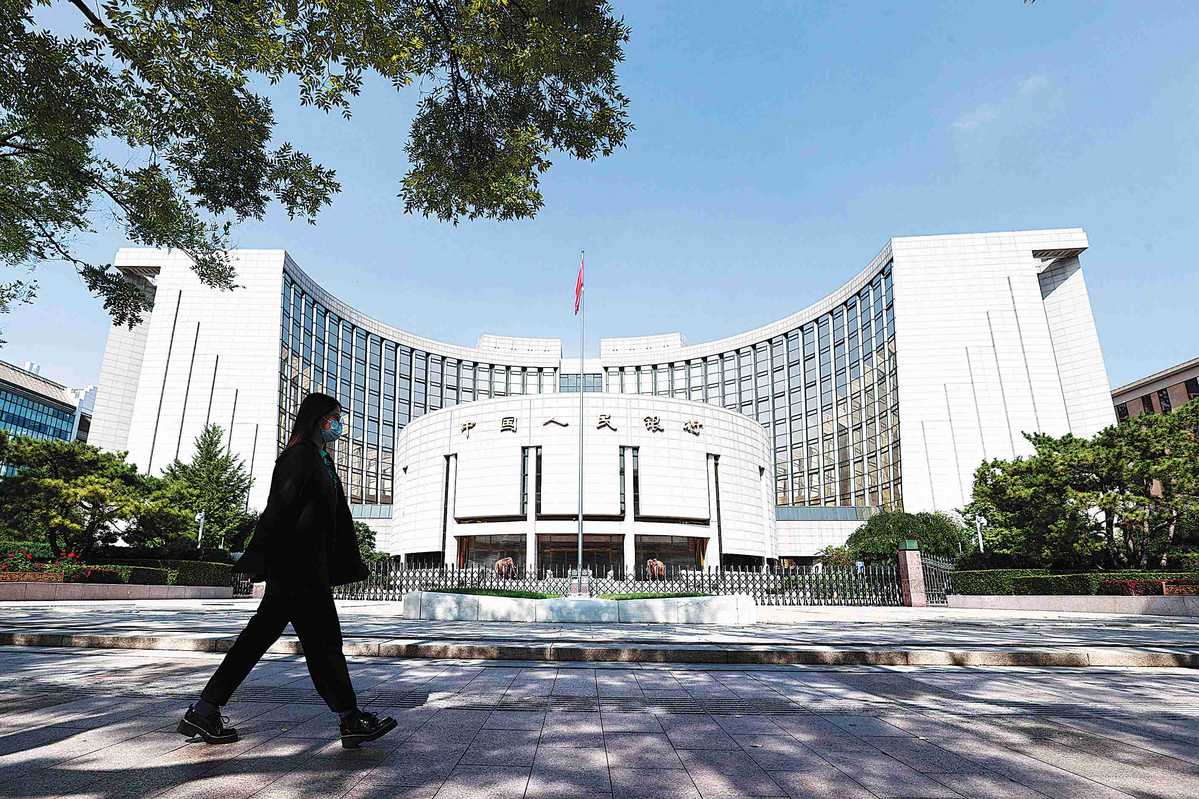
Central bank's carbon cut tool will spur big lenders to back 2,817 companies as more than $13 billion comes into play
China has seen booming growth of green finance, backed by policies and regulations, as the country accelerates its green transition and economic restructuring to achieve high-quality and sustainable development.
The People's Bank of China launched a carbon emissions reduction facility in November to offer low-interest loans to financial institutions that help firms cut emissions. Using the new monetary policy instrument, the central bank will provide 60 percent of loan principal made by financial institutions for carbon emissions reductions at a one-year lending rate of 1.75 percent.
The PBOC has issued the first batch of funds worth 85.5 billion yuan ($13.42 billion) via the facility in support of financial institutions' issuances of carbon emissions reduction loans totaling 142.5 billion yuan. It is estimated that the loans will help 2,817 companies cut carbon emissions by about 28.76 million metric tons, said Sun Guofeng, head of the monetary policy department at the PBOC, at a news conference on Dec 30.
The central bank released a new set of assessment measures last year for financial institutions' performance in developing and promoting green finance. It will further improve the practice of assessing financial institutions' green finance performance through substantial efforts, such as exploring the establishment of open, transparent, authoritative and unified institutions for green finance data statistics, enlarging the scope of green financial products included in the evaluation system and enriching usage scenarios for such products, said Wang Xin, director-general of the research bureau of the PBOC.
As China's financial system relies mainly on indirect finance, green loans-the most important green finance instrument-still account for 90 percent of green financial products in total. By the end of the third quarter, the outstanding balance of China's green loans reached nearly 15 trillion yuan, Wang said.
Last year, the central bank established clearer standards for green finance, offered more comprehensive incentives and launched more monetary policy instruments, he added.
The PBOC released the Green Bond Endorsed Projects Catalogue (2021 Edition) in April, together with the National Development and Reform Commission and the China Securities Regulatory Commission, signifying the unification of domestic standards for green bonds.
Updating previous guidelines, the new document adopts more scientific and precise definitions on green projects. Carbon-intensive projects such as cleaner use of coal and other fossil fuels are no longer supported, said Moody's Analytics, a provider of financial intelligence and analytical tools.
By aligning with international standards, the catalogue will boost the confidence of international investors in Chinese green bonds and increase their willingness to buy such bonds, said SynTao Green Finance, a consultancy providing services in green finance and responsible investment in China.
The new guidelines encourage green bond issuances in the country. As of the end of the third quarter, the outstanding balance of domestic green bonds was 1.02 trillion yuan, up 24.7 percent year-on-year. The growth rate was 5.8 percentage points higher than that by the end of the previous quarter, said Wang with the PBOC.
Building a system of green finance standards is a crucial link in a top-level design for green finance and an important foundation to achieve leapfrog development in this area, said Liu Jin, president of Bank of China Ltd.
"With continuous expansion of green finance globally, the unification of standards for green loans and green bonds is imminent. My suggestion is that China should create domestically unified standards for green loans and green bonds that are geared to international standards, clear and executable. Based on the above situation, China should further establish standards for other green financial instruments to guide green finance heading in the right direction and to help increase regulatory efficiency of all countries," Liu said.
The ongoing global green transition requires huge funding. Therefore, financial institutions must set a more progressive target for green lending to provide strong support to the industries focusing on energy conservation and environmental protection, clean energy, cleaner production and green upgrading of infrastructure, he said.
In the meantime, financial institutions should also provide diversified financing channels and adopt a full life cycle service model for green industries according to their growth potential and risk probability, accelerate the development of financial products such as green bonds, funds, insurance and equity investments, and deepen innovation of financial products associated with carbon trading, he added.
Lyu Jiajin, chairman of Industrial Bank Co Ltd, a national joint-stock commercial bank based in Fuzhou, Fujian province, also encouraged financial institutions to fully utilize indirect and direct financing instruments to boost business expansion, promote structural optimization and create their own green asset-balance sheets.
"Financial institutions must clearly identify the general trends of our nation and actively shoulder the responsibility of a low-carbon transition of the Chinese economy by giving full play to their unique functions of financing, price discovery and risk management," Lyu said.
"They should ramp up efforts to push for a green transformation of traditional industries and the development of clean energy, green construction and green transportation, strongly support industrialization of digital technologies and digitalization of various industries, and promote all activities which will help improve operational efficiency of society and reduce carbon emissions."
Lyu urged financial institutions to make full use of their advantages in account management, payments and settlements, investment transactions and information technologies to help all kinds of market entities manage carbon assets, activate carbon pricing and help create a larger carbon trading market.
Industrial Bank aims to double its outstanding green financing balance during China's 14th Five-Year Plan period (2021-25). As of the end of September, the balance was 1.31 trillion yuan, up about 13 percent from the beginning of last year, covering 33,000 corporate clients.
While China is striving to peak carbon emissions by 2030 and achieve carbon neutrality by 2060, tremendous investment and financing demand associated with green manufacturing and green consumption will create huge growth opportunities for China's banking and insurance sectors, said Zhou Liang, vice-chairman of the China Banking and Insurance Regulatory Commission.
"During the process of green and low-carbon development, China's financial sector will keep improving its environmental and climate-related risk management capability. As a result, the overall financial system will become more resilient, safer and more sustainable," Zhou said.
China will gradually improve the institutional framework for low-carbon development and green finance, establish a green finance statistical monitoring and evaluation system, and set standards for green finance information disclosure, he said.
Financial services professionals suggest the government accelerate efforts to promote the corporate disclosure of environmental information.
The work of promoting forced disclosure of environmental information could be first conducted by listed companies or in the country's green finance pilot zones, so that financial institutions will be provided with necessary information to realize green financial product innovation and to identify climate-related risks, said Zhang Weiwu, senior executive vice-president of Industrial and Commercial Bank of China Ltd.




















