Planting the seeds of prosperity







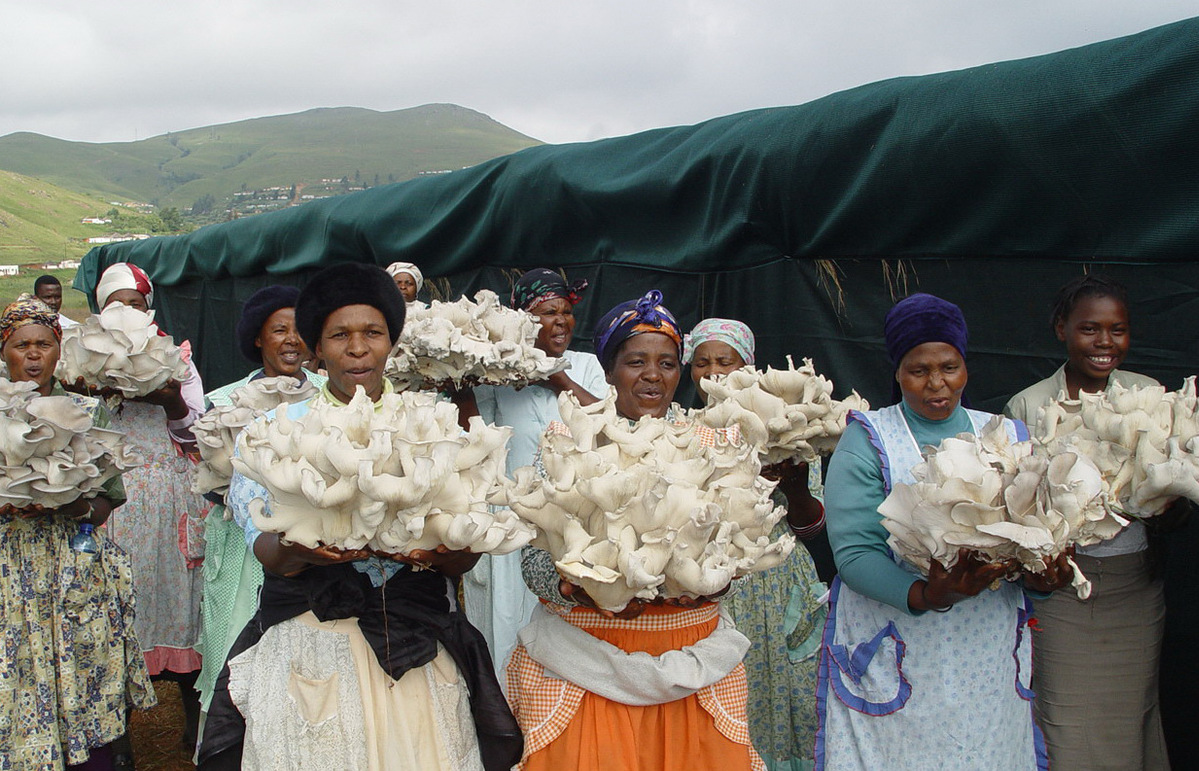
Incomes swell with Chinese expertise on growing mushrooms with grass
In Papua New Guinea, some farming communities call a type of introduced plant "China grass". It also goes by another name, "prosperity grass"-a moniker given in recognition of the way its cultivation has improved people's lives.
The technique to grow the grass, called Juncao in China, was invented by Lin Zhanxi, a professor from Fujian province. The cultivation method enables edible fungi to grow on grass instead of felled trees, sparing precious forests.
Outside China, farmers in Papua New Guinea are not the only ones benefiting from the prosperity grass. Their peers in Africa also are taking to the Juncao technique and reaping the benefits under Chinese assistance programs.
For Papua New Guinea, the journey began in 2001, when a Juncao demonstration base was established. So began the international cooperation that has helped farming communities in far-flung countries.
Two decades on, more than 700 rural households in Papua New Guinea's Eastern Highlands Province are growing mushrooms with the Juncao technique.
In 2006 it was Rwanda's turn. Chinese specialists took their expertise to the East African country for the start of a cooperation project aimed at spreading knowhow on the method. The process involves using the chopped grass as substrate for growing the edible and medicinal mushrooms.
By the end of last year, about 47 training courses for the Juncao technique had been conducted, with more than 1,800 agricultural technicians and farmers learning the method. The program has supported more than 50 Rwandan enterprises, cooperatives, and farmers to produce edible fungus bags. More than 3,700 farmers across Rwanda have used the Juncao technique to cultivate edible fungi.
"Given China's experience of poverty alleviation and agricultural development, the country is uniquely positioned to engage in development exchanges with countries of the Global South," said Carlos Watson, the representative of the UN Food and Agriculture Organization in China and the Democratic People's Republic of Korea.
"Development solutions have been offered, covering things such as good and best practices, technologies, experiences, innovations, legislations, policies, capacity development, knowledge sharing and, many more," he said. "China is on the frontline of supporting developing countries to achieve their own development goals."
Under projects in which Chinese agricultural experts have been sent to Africa, more than 50,000 Africans have been trained and 23 agricultural demonstration centers have been built, according to a white paper on Sino-African cooperation issued recently.
China also works with international organizations, such as the FAO, to better strengthen regional cooperation that could integrate diverse resources to support the agricultural development of African countries.
Strategic engagement
The FAO-China South-South Cooperation Programme, a flagship South-South and Triangular Cooperation Programme devised under a strategic engagement between the UN agency and China, has achieved impressive results in recent years.
In Madagascar, Chinese experts worked closely with their local counterparts to transfer knowledge and technologies on hybrid rice production and livestock management at project sites in Mahitsy, Zhaka and Diego.
Under the program, the two sides have boosted rice yields from 2.8 tons per hectare with local varieties to at least 8 to 10 tons per hectare with the use of hybrid rice at the demonstration sites, according to the FAO.
In Uganda, rice production was increased fourfold, from 2.5 tons per hectare to 10 tons, with a threefold rise in milk production. The incomes of more than 3,000 farmers have been greatly improved thanks to the South-South Cooperation project in the country.
China has established agricultural cooperation mechanisms with 23 African countries and regional organizations, and signed 72 bilateral and multilateral agreements on agricultural collaboration.
"China is a strong advocate of South-South technical exchanges and knowledge-sharing initiatives," Watson said. "This is not only China's success, but also a great contribution to the world."