



How some US media got China's history resolution - and everything else - wrong







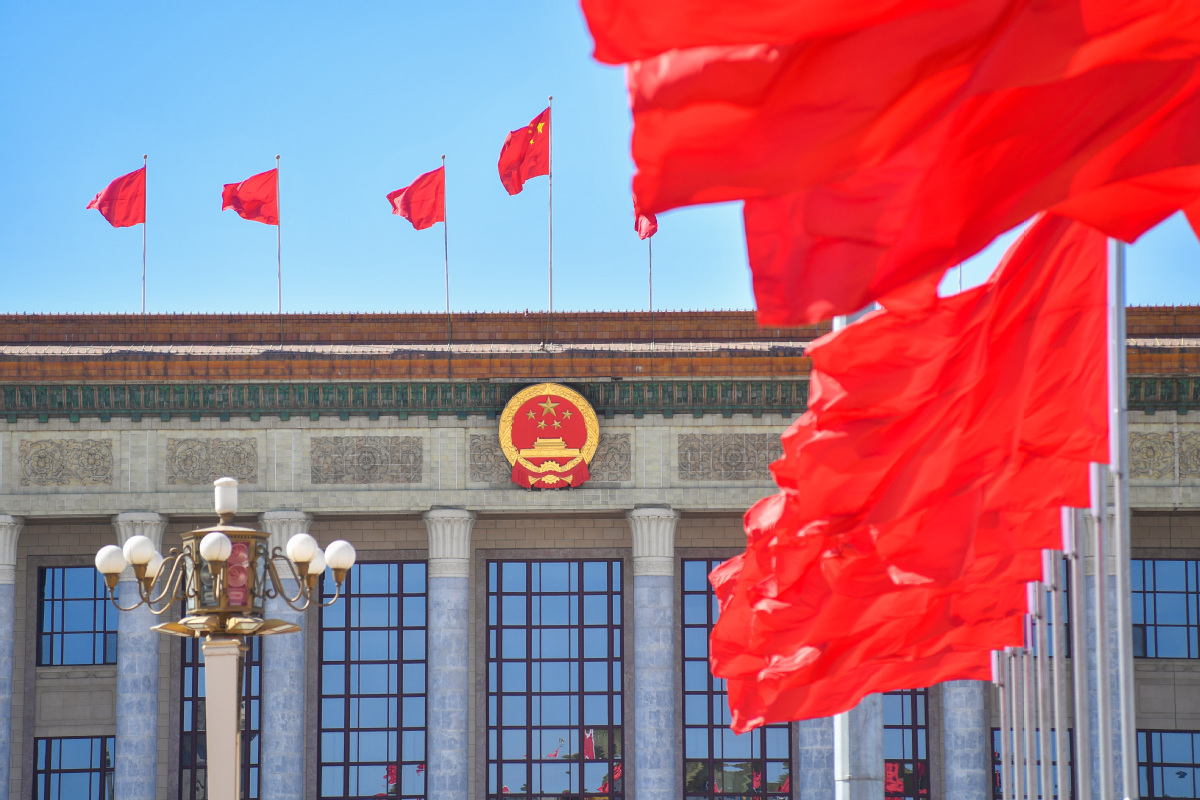
Even before the Sixth Plenary Session of the Communist Party of China's 19th Central Committee had begun, some media outlets in the US had their takes at the ready.
Headlines blared with pronouncements about the historical resolution that would be discussed at the session. This, they declared, would be the moment in which President Xi Jinping cemented his leadership by enshrining himself into the country's history.
Such elementary analysis was to be expected from commentators who didn't even wait for the session to finish — much less the publication of the full resolution — before broadcasting their ad hoc reckonings far and wide.
Now that the 70-page document is available for all to read, we can draw our own conclusions without those self-proclaimed "experts" butting in, determined as they always are to force an interpretation based on their preconceived notions.
These readings, like their other reporting about China, are the product of decades of informal ideological conditioning. But dismissing them as miscreants with agendas, while accurate, is inadequate. In truth, we should pity them for lacking the theoretical literacy to properly grasp the resolution and what it represents: a survey of Chinese history through the lens of historical materialism.
That's a complicated phrase, one which may confuse the New York Times and Wall Street Journals of the world. As space is limited, I'll do my best to walk them through it. In his Eighteenth Brumaire of Louis Napoleon, Karl Marx succinctly laid out the relationship between leaders and history: "Men make their own history, but they do not make it as they please; they do not make it under self-selected circumstances, but under circumstances existing already, given and transmitted from the past."
Historical materialists recognize this relationship not as a mantle of destiny, cast down from the sky by divine right, but a product of the times, which carry with them their own challenges and contradictions. Xi himself summarized this concept well in a speech from 2013: "Revolutionary leaders are not gods, but human beings…Historical figures should be analyzed based on the conditions of the time and society they live in. We cannot simply attribute success in good times to individuals, nor can we attribute setbacks to individuals in times of adversity." The study of history, then, cannot be condensed to an "elect" of supernaturally appointed individuals; a broader, more scientific outlook must be deployed.
This is the difference between the Marxist conception of history — which treats history as the movement of and relations between social and economic forces — and individualistic notions of history as a succession of "great men". Though both models were formulated in the 19th century, it is the materialist conception of history which remains worthwhile for those who wish to actually understand the world around them. The bourgeois idealist conception of history, a blunt instrument designed to dilute complexity and attribute world-changing events to the whims of a few superior beings, was rightly tossed in the dustbin long ago.
So it was within a real historical framework, not the outdated methodology the Western media clings to, that this new resolution was written and approved during the most recent plenary session. The CPC knows the importance of periodically evaluating its own history and that of the country since its founding in 1921; this resolution is the third of its kind, following ones passed at the seventh plenary session of the Sixth Central Committee in 1945 and the sixth plenary session of the 11th Central Committee in 1981. Each has come at a key juncture in the CPC's 100-year journey — the first, during the period of the new-democratic revolution; the second, the period of reform and opening-up; and the third in the "new era" designated by Xi at the 19th CPC National Congress in 2017.
Both earlier resolutions were written to address certain historical questions and clarify the Party's history as of the point of their drafting. Then as now, the capitalist press reduced them to a set of personality clashes; they were treated as nothing more than attempts by a CPC leader to justify their hold on power. Few if any took them at face value, as documents providing a blueprint for studying the Party's past to better inform its present and future. Although these resolutions announced their intentions openly, commentators were hell-bent on blundering their way into a "truer" reading as they combed through the text for hidden messages, like a magic eye painting or a Beatles record. To no one's great surprise, their readings inevitably conformed to the opinions they already held. Again, we must forgive them their trespasses. They lash out at phantoms because they are blind — or blinded. But Marxists are not.
We know the mark of a good theory or historical framework is, above all, its usefulness in addressing real-world problems. "Any ideology is ineffective unless it is linked with objective realities, meets objectively existing needs and has been grasped by the masses of the people," Mao Zedong said in 1949. "We are historical materialists, opposed to historical idealism." Quite right. There is no better laboratory for a philosophy, or indeed a leader, than the material world.
In the case of Marxism, it's safe to say the experiment was a success. The working class's victory in the October Revolution vindicated Marxism as the prevailing theory and method for scientific socialists. Its salvoes were a clarion call that reverberated throughout the world, China included. If it was revolutionary practice that served as the crucible for Marxism-Leninism in the Soviet Union, the same can be said for Mao Zedong Thought in its adaptation of Marxism-Leninism to the practical conditions of China. And if the course of the Chinese revolution proved Mao was the right leader for the right time, then the same standard can and should be applied to all leaders of Marxist parties.
As Marx said in The German Ideology, "Circumstances make men just as much as men make circumstances." Xi's place in the Party's survey of history is less about a man singlehandedly creating his own circumstances than it is the demands of the era making a leader like Xi necessary. In his time, China has eradicated absolute poverty, set ambitious goals in the fight against climate change, beaten back a once-in-a-lifetime pandemic and stood up to the hegemony of the United States. Recent years have presented uniquely challenging circumstances, and Xi, the CPC and the Chinese people have proven themselves up to the task.
After 100 years of arduous struggle, it is only right to look back and take stock. "If we do not clarify the history of the Party and the path it has taken in history," Mao said in 1942, "we will not be able to do things better." That's the purpose of the resolution — to access, analyze and move forward with renewed vigor.
Unfortunately, that's also something cynics a world away can't possibly comprehend. But don't blame them. It's not their fault no one gave them the tools for the job.
The author is a US writer with China Daily. The opinions expressed here are those of the writer and do not represent the views of China Daily and China Daily website.
If you have a specific expertise and would like to contribute to China Daily, please contact us at opinion@chinadaily.com.cn , and comment@chinadaily.com.cn





