Whatever happened to the G20?
Unlike the global financial crisis when it came to the fore, the group has been missing in action during the pandemic and on climate change








Last weekend's G20 came and went. Sadly, as have so many in recent years. Admittedly, it was inevitably going to be overshadowed by the COP 26 gathering in Glasgow, but in the days of old, the G20 leaders-most of whom travelled on to Glasgow-would have attempted to proactively set the tone to try and solve global warming.
Indeed, comparing and contrasting the influence of G20 since the onset of COVID-19 in 2020 with its response to the 2007-08 financial crisis is shocking. Back in 2008, then US President George W. Bush elevated the group above the G7 to be the premier policymaking body to deal with global shocks. Not only did the 2008-09 policy response deliver collective shock and awe, such that it helped ensure the risks of a sustained global economic meltdown would be minimized, but the nature and spirit of the G20 itself injected confidence into the global system. Of course, central to this was the inclusion of China, the other BRIC countries, Brazil, Russia and India, and other large emerging economies. It meant that the G20 represented at least 80 percent of the global GDP, and therefore, had true validity in terms of representative legitimacy. In turn, this laid the groundwork for subsequent shifts in the voting rights of the International Monetary Fund as well as the proportionate share of the key currencies in the Special Drawing Rights, the IMF's accounting currency.
In addition, from those early annual G20 meetings, the foundations for the Financial Stability Board, a key body that ensures there is sufficient capital in the world's financial system, came into existence, as the Financial Stability Forum was born. In my view, these have been the only progressive changes in global governance in the near 20 years since I came up with the BRIC acronym.
The 2020-21 economic fallout from the novel coronavirus outbreak is estimated by the IMF to be at least three times as big as that in 2008-09 and yet this G20 summit did not really achieve anything to help instill confidence that either the health crisis would be brought to an end soon, nor the fallout minimized. And coming ahead of the COP 26, it did little to set a collective tone for the Glasgow meeting.
Why? An optimistic view might be that the G20 has essentially concluded that it is more important to get on with details and not seek to blow up big headlines with no substance. I shall return to this idea below.
A less charitable view would be that the G20, while notionally more legitimate, has found out it is too large to be an effective group for fruitful decision-making about big complex challenges, especially as the group doesn't share the same philosophies or societal structures, nor have similar levels of wealth. Certainly in the middle of all of this, the crucial role of the United States and China is much more fraught today than it was in 2008. And if the US and China can't agree on big issues, there is virtually no chance that the G20 can.
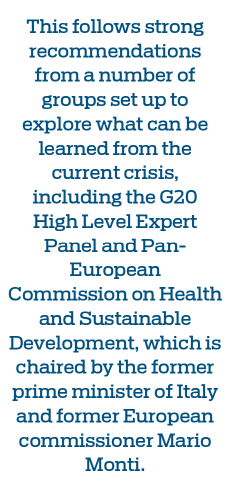
In this regard, it is rather interesting that the G7 appears to have made a revival of sorts, with a number of initiatives arising from this year's United Kingdom hosting. A great deal of this appears to be born out of frustration with the G20. But of course, given the continued relative decline of the G7 as a representative group, even if they sentimentally feel good, it is hardly helpful for the complex world we live in today. Moreover, the BRICS political leaders have not achieved much either. A cynic might point to the G20 and BRICS, both of which now seem to achieve little, are groups that include China and the other large emerging nations. And in this regard, it might well be that China, as the largest developing country and the world's second-largest economy, has to think differently as to how it is participating in and engaging with these groups. Given very little media attention, perhaps one of the most interesting aspects of the G20 communiqué was the agreement to set up a Joint Finance-Health Task Force, to explore ways to mitigate future health pandemics (and presumably other health crises). This follows strong recommendations from a number of groups set up to explore what can be learned from the current crisis, including the G20 High Level Expert Panel and Pan-European Commission on Health and Sustainable Development, which is chaired by the former prime minister of Italy and former European commissioner Mario Monti.
I am an active member of this commission. One of our biggest proposals, following the lead of the G20 in its response to the 2008-09 financial crisis and the establishment of the Financial Stability Board, was to introduce a global finance and health board under the G20. It is clear to us, having finance ministries play an earlier and more central role in global health is desperately needed.
The author is former chief economist at Goldman Sachs. The author contributed this article to China Watch, a think tank powered by China Daily. The views do not necessarily reflect those of China Daily.
Contact the editor at editor@chinawatch.cn