



Self-defeating habit
It is time the US put an end to the trade war it launched against China as it is not doing itself any good







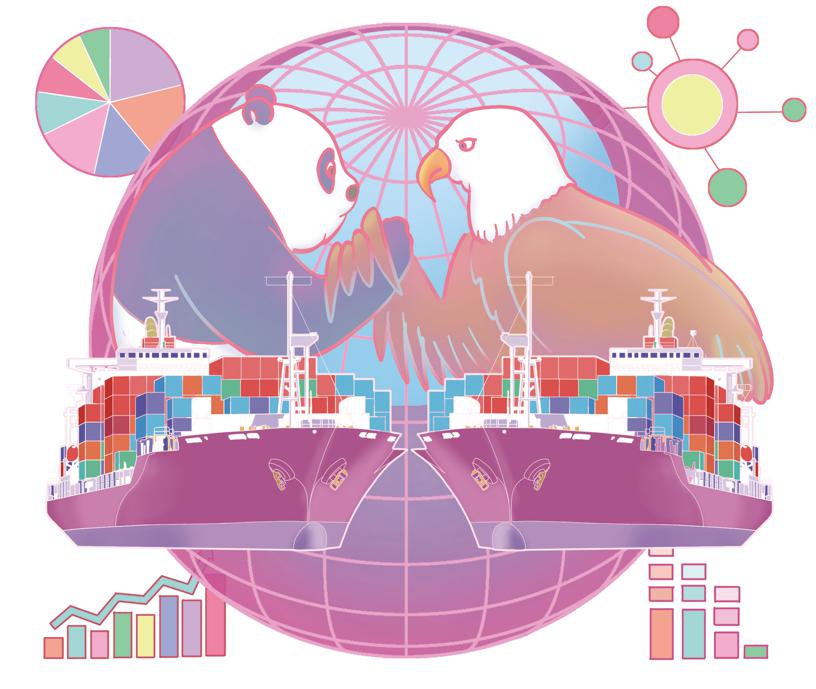
In June 2018, the United States initiated a trade war against China. Although the two sides struck a Phase One trade deal in January 2020, the trade war is far from over.
Unfortunately, due to the pandemic, the purchase commitments of China in the Phase One trade deal with the US are unlikely to be accomplished. Chinese purchases fell short by 40 percent in 2020 and it will be very difficult to reach the goals this year as well. The future for the US-China trade relationship remains gloomy.
But as most observers agree, the trade war is a lose-lose game anyway. While Chinese exports have lost some of their market in the US, the US has not remained unscathed. It has suffered from the trade war too. According to an estimate by Oxford Economics, a British-based think tank, the trade war with China will cause a peak loss of 245,000 jobs in the US, but a gradual scaling back of tariffs on both sides would boost growth and lead to an additional 145,000 jobs by 2025.
Indeed, the facts speak for themselves. According to the US Bureau of Economic Analysis, from 2017 to 2020, US exports to China decreased from $132 billion to $125 billion and imports from China dropped from $506 billion to $435 billion. As a result, the US trade deficit with China decreased from $374 billion in 2017 to $310 billion in 2020. From that it would seem that the trade war somewhat balanced China-US trade. However, part of the US deficit with China has simply been transferred to other countries. And the global US trade deficit shows that it has failed to achieve its objective of reducing the US global trade imbalance, which increased from $799 billion to $916 billion last year.
The trade data have ample implications. First of all, the trade war hasn't brought back the jobs the US lost. Although a small fraction of the US demand for goods and services has been removed from China, it is not produced at home. Instead, the demand has shifted to third countries. That is to say, the jobs (for producing those goods and services) are not flowing back to the US. In fact, the micro data is also in line with the macroeconomic indication. According to a survey conducted by the US Chamber of Commerce in Shanghai between June 15 and July 15 in 2021, among its 338 member companies over 70 percent of the surveyed manufacturers had no plans to move their supply chains out of China, while only about 4 percent said they might move some production back to the US.
Second, the decoupling desired by some US politicians has not really occurred either. For some US politicians, it is fine if the supply chain does not reshore so long as it moves out of China, as all they want to achieve is a decoupling between these two largest economies in the world. Yet the trade war has not decoupled the two economies in any significant way. Instead, the push for decoupling has been costly. For instance, the chaos in the global semiconductor supply chain is at least partly attributable to the US decoupling policies.
Another major argument for the US government supporting the trade war was that it wanted to force China to liberalize market entry, reduce subsidies, and accelerate reform of State-owned enterprises. Admittedly, China, as a developing country, has not met the high standards set by Western developed countries. Hence, reforms are necessary. However, there are two caveats to be made. First, China's liberalization reforms have been ongoing even without the pressure of the trade war. For instance, China implemented the "negative list" for foreign investors in January 2018. It now covers all the 1,047 industries and only consists of 48 clauses of restrictions to foreign investors. As a comparison, in 2013 when China started to pilot the negative list in the Shanghai Free Trade Zone, the list had 190 clauses. Second, the Phase One trade deal does not have a neutral dispute settlement mechanism like other trade agreements and the World Trade Organization do. According to a survey conducted by the US-China Business Council in 2020, only about 16 percent of the respondents said they might use the poorly designed dispute mechanism in the trade deal, while more than 39 percent said they were not likely to use it. High-quality multilateral free trade agreements, such as the Regional Comprehensive Economic Partnership and the Comprehensive and Progressive Agreement for Trans-Pacific Partnership, are believed to be much better solutions for US concerns.
Regardless of the uncertain "effectiveness" of the trade war, it is already certain that the US consumers have become the victims. The penalty tariffs imposed by the US government are either directly passed on to US consumers if the Chinese imports are not substitutable or indirectly if US consumers have to choose more expensive alternatives from other countries. Janet Yellen, the US secretary of the treasury, confessed in August that the trade war has already cost US consumers a lot.
In sum, the economic and business facts demonstrate that the trade war has not helped solve US concerns. It is political obstacles in the US that are now the major reason for this ongoing lose-lose trade war. The US administration should put a stop to the highly costly trade war and work with Beijing to find constructive ways to build up a new trade relationship between the world's two largest economies.
The author is a professor at Huazhong University of Science and Technology and the director of the Optical Valley Institute for Free Trade. The author contributed this article to China Watch, a think tank powered by China Daily. The views do not necessarily reflect those of China Daily.

















