The Philippines ignorant to back AUKUS deal, harming ASEAN







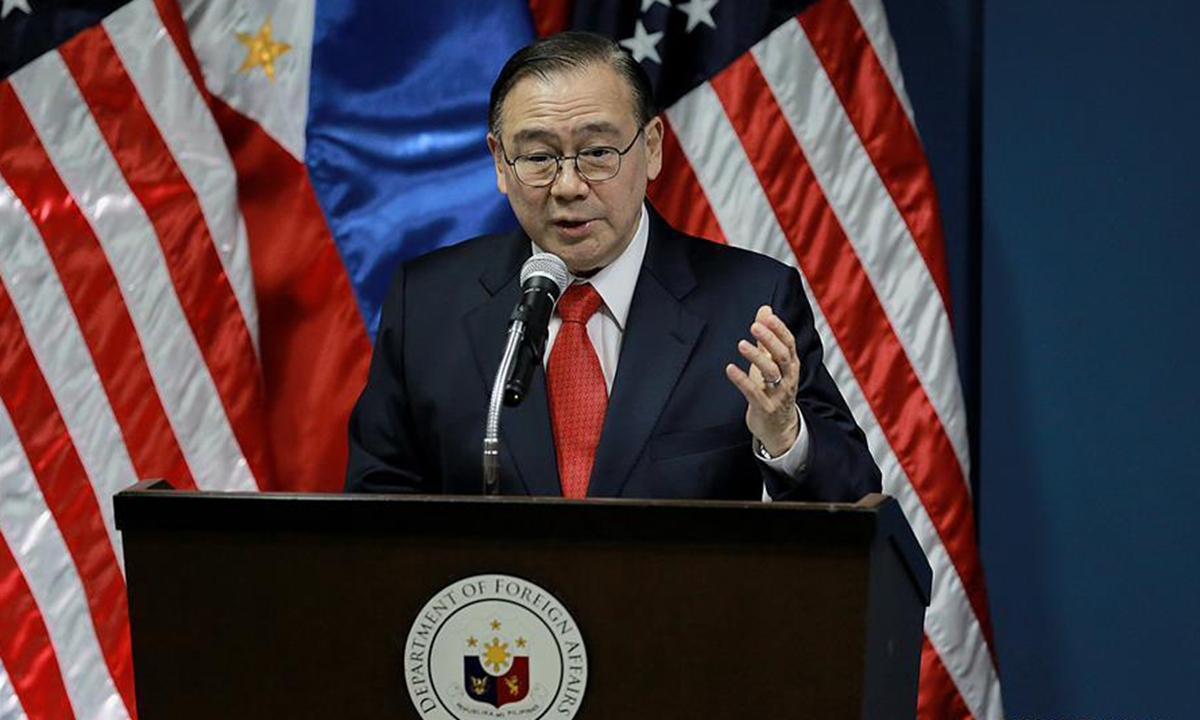
The Philippines has openly backed the nuclear submarine deal reached among the US, UK and Australia, known as AUKUS, in sharp contrast with its ASEAN counterparts such as Malaysia and Indonesia who sounded the alarm amid a growing superpower rivalry in Southeast Asia.
With the AUKUS agreement, Australia will be provided with the technology to build nuclear-powered submarines. Worries are mounting among ASEAN countries over a regional arms race. But Philippines' Secretary of Foreign Affairs Teodoro Locsin said in a statement in Tuesday that "The enhancement of a near-abroad ally's ability to project power should restore and keep the balance rather than destabilize it."
As a decades-long ally of the US, the Philippines is dependent on the latter in terms of overall national security. From this perspective, Manila is willing to see Washington strengthen its military presence in the Southeast Asia through whatever means. Compared with Indonesia and Malaysia, the Philippines is more involved in the South China Sea disputes. It thus has a stronger desire to check China by taking advantage of extra-regional countries. For Manila, at least quite a number of Filipinos, the AUKUS submarine deal will enhance military constraints on China. They believe this may help counter China in the region and defend the Philippines' interests.
However, such a judgment and the Philippines' support for the AUKUS deal are extremely wrong. Will the deal really "restore and keep the balance" in the region as Locsin said? The answer is apparently "no". The balance of power between China and the US in the Indo-Pacific region is unbalanced. As a power outside the region, the US still has occupied a great advantage. Providing Australia with the nuclear-powered submarine capability is not about "restoring" the balance. It is about further aggravating the existing imbalance by enhancing the military superiority of the US and its allies in the region.
The deal is a trilateral decision. But it will likely have a direct impact on the Southeast Asian countries. Whereas it's believed that Australia's nuclear-powered submarines will mainly be used to strengthen confrontation or rivalry with China in the Southeast Asian region, there are worries that the region will potentially become a battlefield for a new round of major power competition.
This will have a disastrous impact on Southeast Asian countries. When elephants fight, it's the grass that suffers. Southeast Asia will further become "the grass" and bear the brunt of intensifying competition among major powers.
AUKUS deal risks pushing Southeast Asian countries into great power rivalry. These fears are growing. It's completely justified for countries such as Malaysia and Indonesia to voice concerns and objection. By contrast, the support Manila threw to the deal reflects the Philippines' shortsightedness and ignorance of regional situation and major power competition.
Philippine President Rodrigo Duterte's term is drawing to a close in 2022. In recent years, especially after Duterte assumed office, the Philippines has adopted relatively friendly policies toward China. But Duterte is still subject to domestic public opinion, the Philippine opposition groups, and the country's diplomatic traditions that used to give more weight to the alliance with the US. With the presidential election in sight, Duterte has to take into consideration domestic voices and sentiments that are calling for a tough stance against China. Especially over the South China Sea issue.
It's very likely that in the foreseeable future around the election time, the Philippines will return to diplomatic traditions.
In July, the Philippines reversed course and fully restored the Visiting Forces Agreement base deal that allows US forces to operate from the Philippines. This move saw the old alliance with the US refreshed. This is, to a certain extent, a compromise by Duterte to return to the traditional diplomatic stances of the Philippines.
With regard to China, including the South China Sea issue, the mentality of the Philippines to rely on the US to counter China is unrealistic and sensational. With election politics, the Philippines could easily see political polarization. This means foreign policies could easily be twisted under such a context.
Some US media outlets are sensationalizing news that Manila is now returning back to its old ally, hyping that tilting toward China has not done the Philippines much good. Truth is Duterte's China-friendly policy is a win to the Philippines. Through deepening relations with China, the Philippines has gained many tangible benefits in terms of developing trade, attracting foreign investment, and receiving aids. Now, out of domestic political considerations, the Philippines is likely to make certain policy adjustments. This is a pity. It's hoped the Philippine government could sustain a rational and pragmatic attitude toward China during and after the election periods.
The author is research fellow and deputy director at the Institute of International Relations of the Shanghai Academy of Social Sciences.