Theme parks silver lining amid outbreak







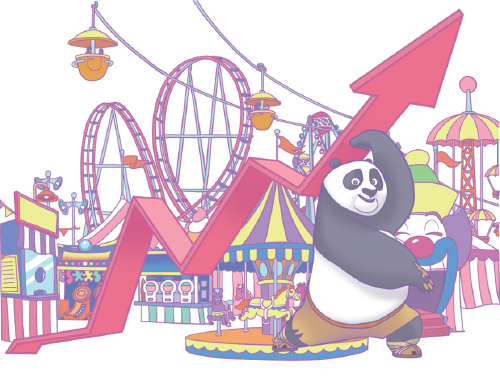
Universal Beijing Resort, the largest of its kind in the world, will start its trial run on Wednesday and formal operation on Sept 20. The theme resort signals the entry of another international chain into China's thriving theme park industry.
From 2008 to 2017, theme park attendance in China increased on average 13 percent a year. Today there are more than 200 theme parks on the Chinese mainland and their numbers continue to increase. In these times of misguided global divisions, the impressive rise of theme parks in China shows the brighter side of foreign investment and Sino-US cooperation.
In the beginning, theme parks were concentrated in the coastal regions of China, which boast greater economic prosperity, advanced development, megacities with 10-20 million people, and relatively mild climate. At the time, every third major theme park was still in eastern China. In these early parks, service offerings were still relatively undifferentiated. These big-city parks relied mainly on international intellectual properties, according to infrastructure advisory AECOM.
The period was marked by the first expansion wave of international theme parks, which reached its peak with the opening of the Shanghai Disney Resort in June 2016. It was the dream of incumbent Disney Chairman (then CEO) Bob Iger who invested $5.5 billion and 17 years into the project.
During its first year of operation, the Shanghai Park was already fueling a good chunk of Disney's earnings growth. With more than 11 million visitors, about half of which came from outside Shanghai, it was on way to becoming the most profitable Disney Park globally.
Disney's impressive performance was carefully scrutinized by other international giants eager to partake in China's theme park economy, including the US-based Universal City Studios, and the UK-based Merlin Entertainments that is famous for its Legoland Parks.
We are witnessing the second wave of theme park expansion today, and capital investment in theme park projects in the first half of the 2020s could reach $20 billion.
"Chinese people are confident in the country," Tom Mehrmann, president of the Universal Beijing Resort said a year ago. Given China's strong domestic tourism industry, Universal saw a great business opportunity in the country despite the COVID-19 pandemic. The Universal Beijing Resort will be the company's fifth park in the world. As for Merlin, its Legoland Shanghai is scheduled to open in early 2024, followed by Legoland Beijing.
These multi-billion-dollar investments show foreign investors' rising confidence in China's business environment, its success in largely containing the pandemic and, most importantly, the expansion of China's middle-income group.
Internationally, Shanghai Disneyland enjoys great brand recognition. Yet it had less than 6 percent of the market in 2018. The three dominant Chinese operators-OCT, Fantawild Holdings and Chimelong-had a combined 58 percent share of the market, according to Tianfeng Securities in March.
Last year, as in previous years, 12 new theme parks were launched in China despite COVID-19, construction disruptions and pandemic-prevention and control measures. Also, the theme-park economy is spreading from the megacities in the coastal regions to cities like Nanjing in Jiangsu province and Zhengzhou in Henan province, which have population of 8-10 million.
As competition intensifies, local brands tend to be more popular in smaller cities with increased use of storytelling and a focus on local conditions, history and legends.
Although China's theme park attendance could reach 70-80 percent of pre-pandemic levels this year, analysts say it will take another two years before the number of park visitors returns to the 2019 levels.
In the global theme park industry, the long-term trend is clear. While the parks are stagnating in the high-income Western countries, the quest for new markets is pivoting to emerging Asia. Before the pandemic, North American parks were advancing at a modest 1.0 percent. Europe was relatively flat, and so were Latin American parks. While Asia's top parks expanded at roughly 2.0 percent, China's performance was far stronger, with OCT, Chimelong, and Fantawild reporting high single-digit, if not double-digit, increases.
In China, per capita attendance in theme parks was 0.13 in 2017 and projected to rise to 0.16 by 2020. In the US, per capita attendance is an estimated 0.65. While the level is higher in high-income economies, the difference suggests the mainland market is far from saturated.
Early this year, President Xi Jinping declared the completion of the goal of building China into "a moderately prosperous society in all respects". As China's middle-income group continues to expand and transportation systems improve, rising disposable incomes will ensure that the demand for leisure and theme parks continues to grow.
The views don't necessarily reflect those of China Daily.
The author is the founder of Difference Group and has served at the India, China and America Institute (USA), Shanghai Institutes for International Studies (China) and the EU Centre (Singapore).
If you have a specific expertise, or would like to share your thought about our stories, then send us your writings at opinion@chinadaily.com.cn, and comment@chinadaily.com.cn.