Mission impossible
United States will find it hard to build a trilateral US-Japan-ROK coalition accordant with its policy mandates on China







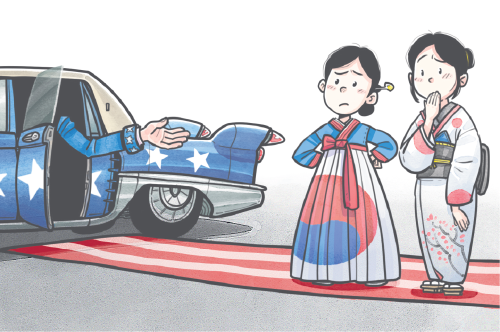
The US-Japan and US-Republic of Korea alliances are of particular importance to the Joe Biden administration's strategy of "outcompeting" China. Therefore, President Biden has made an extraordinary effort to make Japan and the ROK stand on the same page with the United States in its competition with China.
However, this effort has yet to be materialized.
Obviously, the US has keenly realized that there are substantial divergences in the three countries' respective approaches toward China. The Chicago Council on Global Affairs recently released a task force report: Cooperating, Competing, Confronting: US-Japan-South Korea Trilateral Cooperation as China Rises. The report points out the root cause of the problems in strengthening trilateral cooperation vis-a-vis China-the "persistent doubts" about the US' commitment to and leadership in the region, which involve doubts not only about Washington's political will and competence, but the economic feasibility of US leadership as well. Such doubts about the US have substantially undermined strategic mutual trust between the trilateral allies, resulting in Japan and the ROK's serious reconsideration of their security options. The report also points out that the three countries have "distinct needs and interests" in their relations with China. Thus, to build up a US-Japan-ROK trilateral alliance vis-à-vis China remains a formidable challenge.
To overcome the challenge, the report makes some recommendations. First, the three countries should develop institutional arrangements and mechanisms for formulating consistent policy measures in competition against China, including temporary tariff reductions and other forms of support for targeted industries and companies. The report also suggests the three countries take the lead in reform of the World Trade Organization to make it an important venue for the trilateral partnership against China. To that end, the report urges the Biden administration to reverse the freeze in appointing new appellate body members.
Second, the US needs to better understand the positions of Japan and the ROK in their relations with China. Their economic and security interests mean, at times, that their respective approaches toward China differ from that of the US. In order to develop more convergence, the report suggests that the three "create opportunities for cooperation that are not focused on China" in addition to "restating alliance values and principles and reinforcing them whenever possible". After all, there are ample opportunities for the three allies to cooperate in areas such as health, education and other development projects.
According to the report, building a trilateral coalition overtly focused on China will further the narrative that the goal of the US and its allies is to destroy China. That will ultimately be counterproductive, encouraging China to harden its positions rather than seeking cooperation when possible.
The report is clear-eyed and objective, and its policy recommendations are rational and reasonable. However, that the three allies are unable to exert their alliance advantage in competition against China is because of more deep-seated problems and structure-oriented barriers.
Essentially, the inequality between the US and its allies in the US-led alliance system has determined that the alliance is primarily to serve the interests of the US rather that the US' allies, and this is especially so in the US-Japan-ROK alliance, where Japan remains an "unnormal state" while the ROK has its own difficulties. During the Cold War and in a unipolar world after the collapse of the Soviet Union, it served Japan and the ROK's fundamental interests to follow the US' lead. However, as the world is moving into multipolarity with irrevocable economic interdependence, a US-Japan-ROK alliance that primarily serves US interests is hardly sustainable. It is simply unrealistic to demand Japan and the ROK to be at the US disposal in its endeavor to "outcompete "China. The two US allies' "persistent doubts" about US commitment to and leadership in the region are not necessarily because of the perceived decline of the US presence vis-à-vis China in the region, but because the two are increasingly reluctant to serve the US just for the US' benefit at the expense of their own interests.
Moreover, the US-China competition initiated by Washington has further revealed and intensified substantial divergences in the three allies' respective policies toward China, especially the insurmountable gap between their security interests and economic ones. The US strategy of "outcompeting" China is essentially security oriented-the US needs to defend its primacy in the world, which is challenged by China's rise. However, the US and China are irreversibly intertwined economically-"decoupling "essentially presents a political will but an economic pseudo-proposition. The trade between the US and China, for example, has actually increased despite the increased tariffs imposed by the US on Chinese goods and the "trade war" launched by the Trump administration in 2018. Bilateral trade between China and the US rebounded to $586.72 billion in 2020, surging 8.3 percent year-on-year, following a hiccup in 2018 to 2019.
Japan and the ROK would confront an even more acute contradiction between their security interests and economic ones should they follow the US' lead on US-China competition. China has long become the biggest trading partner for Japan and the ROK. The trade volume between China and Japan reached $317.5 billion in 2020 with an increase of 0.8 percent year-on-year. In comparison, US-Japan trade plunged from $218.3 billion in 2019 to $183.6 billion in 2020, just 57.82 percent of the China-Japan trade. As for the ROK, its trade volume with China once again exceeded $300 billion in 2020, while its trade with the US decreased by 2.7 percent to $131.6 billion in 2020, only 43.87 percent of its trade with China during the same period.
It is ironically revealing that the US, which has frequently imposed "economic sanctions" against others, urges Japan and the ROK to join with the US to oppose "China's economic coercion" that is barely existent in China's economic exchanges with the two countries. Indeed, there is little that the US can compensate Japan and the ROK economically should they throw themselves into the US arms for the US goal of "outcompeting "China at their own expenses.
The author is a professor of the Institute of International and Regional Studies of Beijing Language and Culture University. The author contributed this article to China Watch, a think tank powered by China Daily. The views do not necessarily reflect those of China Daily.