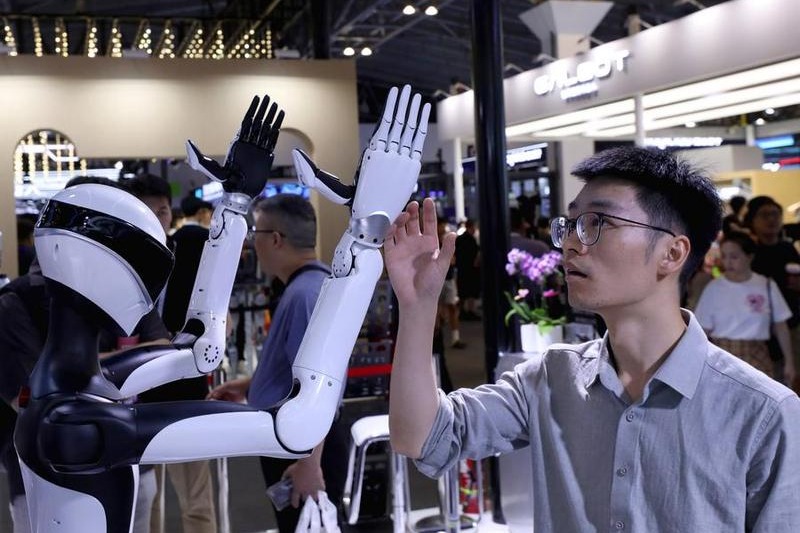
Robotic guide dogs show potential to assist lives of blind people worldwide








Robotic guide dog prototypes unveiled over the last few months have an exciting history and emerged from humble beginnings. Introduced as a prototype at the 2018 Intel Cup Undergraduate technology competition in Shanghai, the concept presented potential for blind people around the world to secure their independence.
Approximately 17 million blind and visually impaired people reside in China, according to a 2018 report funded by Tencent and the Information Accessibility Research Association. The nation does not have the same history of using guide dogs as exists in other countries.
Skipping expensive animal training to raise a loyal and reliable companion and moving straight to a robotic artificial intelligence solution could play to the country's strengths in empowering the visually impaired.
The first guide dogs were used in 1916, and many countries have a rich culture of collaborating with man's best friend to help the visually impaired. The cost of specialist training to produce such a reliable animal can rack up to tens, if not hundreds, of thousands of US dollars. Dogs also have physical limitations, for example being color blind, causing allergies or sadly having a limited lifespan.
This month, a team led by Zhongyu Li, at the University of Berkeley California, unveiled a modern prototype, building on the progress of what was pitched several years ago in Shanghai. The new four legged model is designed to guide people with a lead, and is able to navigate obstacles and narrow corridors safely. Laser ranging systems recreate a virtual map of the robot's surroundings and enable it to guide itself and the person through the environment.
The type of coding needed for the robot to understand its relative position in space, and to account for hazards in a dynamic environment, will not be easy or cheap to roll out, especially in a population as large as China.
It may still be far-fetched to imagine robots navigating the bustling streets of Shanghai and Beijing, at busy junctions and traffic lights. As AI improves, along with the performance of robots, economies of scale may come into place to make this a realizable dream. Coding can be directly copied and manufactured into mass produced units, with hardware also becoming cheaper by the year.
A major component of this new type of technology will be its integration into the Internet of Things. Robotic guide dogs of the future will need to calculate routes in real time, accounting for variables such as traffic density, weather conditions and pedestrian footfall. Fast interconnected 5G networks with low latency and widespread coverage will be vital to facilitate this, meaning that China would be well positioned to adopt this technology nationwide.
The blind in China still have a lust for life and a drive to be fully immersed in society as valuable workers. Many have traditionally worked as masseuses, or piano tuners, utilizing other more tactile senses which have developed in place of sight. Others turn to voice acting and media broadcasting.
The blind and visually impaired are a significant minority of the population with much talent to offer, and for many the chance to lead an independent and normal life is often a stepping stone to greater and innovative contributions within China's economy. Robotics can expand horizons for disabled people and allow them to feel more included in society.
China has more than 17 million people who are blind or visually-impaired.
Barry He is a London-based columnist for China Daily.