Outlook for the year ahead







China is expected to lead the global economic recovery and further promote post-pandemic cooperation
The direct impact of the novel coronavirus crisis on global political and economic security is expected to diminish in 2021. However, the indirect impacts cannot be ignored. There are likely to be some important trends in 2021.
First, the world economy will see a rebound in growth, admittedly from a relatively low base following the downturn caused by the pandemic. The International Monetary Fund has forecast that in 2021 the GDP growth of the global economy will be 5.5 percent, 9 percentage points higher than in 2020.Specifically, emerging and developing economies are estimated to grow by 6.3 percent in real terms in 2021, compared with a decline of 2.4 percent in 2020, while developed economies will expand by 4.3 percent in 2021, compared with a contraction of 4.9 percent in 2020. On the whole, the emerging and developing economies will continue to have a growth rate 2 percentage points higher than that of developed economies.
Emerging and developing economies will see their proportion of the global economy rebound to 40.7 percent in 2021, 0.1 percentage points higher than in 2020 when these countries were hit harder due to their weaker resilience and fragility. The IMF predicts the rate will further expand to 43.7 percent by 2025.Factors that will strengthen the economic recovery include the restoration of supply chains thanks to the wide use of vaccines, the release of pent-up or pended consumption demand and stimulative macroeconomic policies.
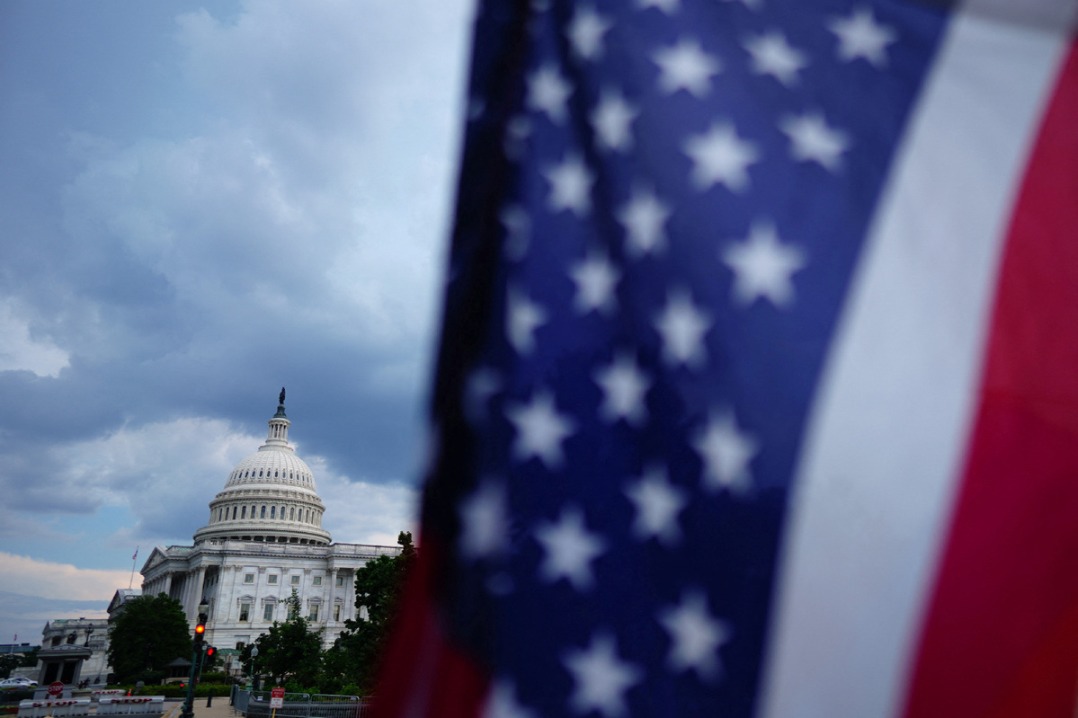
Second, the gap between the Chinese economy and the US economy will further narrow. Among the G20 economies, China was the only one to register positive growth in 2020. According to IMF estimates made in 2019, China's GDP was expected to be 68.4 percent of that of the United States in 2020. After the pandemic broke out, the IMF revised the figure upward to 73.2 percent.
It also estimated that, by 2025, China's GDP will be 90 percent that of the US. In terms of purchasing power parity, China overtook the US as the world's largest economy in 2014. Even in their heydays, the Soviet Union and Japan still lagged far behind the US in economic size. Measured by the average value calculated based on market exchange rate and PPP, China's GDP will be 99.4 percent of that of the US by 2021, and reach 102.4 percent by 2022. The rapidly narrowing gap between the two countries will continue to complicate the China-US relationship.
Third, a multi-polar world will further take shape. After Brexit, the European Union became more cohesive and coordinated. It is expected to play a key role in the multipolar world that is emerging. Russia is another important player in the global political arena, considering its strong military, big geopolitical influence in areas such as Central Asia and Middle East and cyber capabilities, as well as it being a permanent member of the United Nations Security Council.
Meanwhile, Japan plays a key role in the Asia-Pacific region and has huge influence via the Asian Development Bank and its leading role in the Comprehensive and Progressive Agreement for Trans-Pacific Partnership after the exit of the US from the CPTPP's proposed forerunner, the Trans-Pacific Partnership, as well as being a party to the newly-signed Regional Comprehensive Economic Partnership. Likewise, India and Australia have a great deal of influence in South Asia and the South Pacific region respectively.
It is foreseeable that the trend toward a multipolar world will accelerate in 2021, and that China, the US, the EU, Russia, Japan, India and Australia will compete and cooperate with each other in various areas.
Fourth, political polarization and social divisions will be exacerbated in some countries. In Europe, there are growing tensions between supporters and opponents of Brexit, between people who welcome and reject migrants, between environmentalists and farmers, and between the extreme right and the extreme left. In the US, although Donald Trump is no longer president, Trumpism will still be prevalent and influential for a long time. In India, the pandemic has worsened the social stratification. In November, farmers who were angry about Prime Minister Narendra Modi's agricultural reforms launched large-scale protests in New Delhi, which quickly spread to railways, businesses, streets, and factories across the country, with tensions escalating after a crackdown by the military police.
Political polarization is mirrored in acute economic and social divisions. The COVID-19 pandemic has aggravated the inequalities and social fragility in many countries. For instance, the US has seen a marked increase in unemployment among lower-wage workers in the service sector, while the 50 richest US citizens possess a total wealth of nearly $2 trillion, which is almost the combined wealth of the poorest 50 percent of the population-about 165 million people. The data also reveal that the white people hold 83.9 percent of the nation's wealth while black families own 4.1 percent, and there have been disproportionately high novel coronavirus infection rates and COVID-19 death rates among non-whites.
The deadly and devastating pandemic has made people rediscover the idea of a community with a shared future for all mankind. The ship of human civilization has not been capsized or halted amid the huge waves and fierce storms. In 2021, the world will start to recover from deep recession, although the speed and size of recovery will be up to the evolving pandemic, relationships among major countries and other uncertainties.
An objective and reasonable evaluation of the changes in the global landscape is of great significance for China which is set to embark on a new journey toward the goal of fully building a modern socialist country. By sticking to the new dual circulation development paradigm, China is expected to lead the world in economic recovery, and make more contributions to cementing the bottom line for world security and improving global governance and cooperation in 2021.
The author is director of the Institute of World Economics and Politics at the Chinese Academy of Social Sciences and the leading expert of the National Institute for Global Strategy.