



Not all gloom and doom







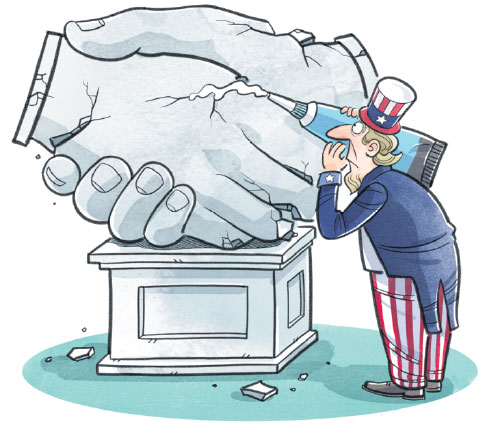
The outlook for China-US economic and trade relations may not be as pessimistic as it seems
The foreign economic policies of the former US administration did not prove effective in reducing the US trade deficit or boosting its manufacturing industries. The inauguration of President Joe Biden may bring some changes, but the policy priorities of the United States relating to economic growth, manufacturing industries and employment may not change in the short term. The US may continue to view China as a strategic competitor.
The appointment of Kurt Campbell as the coordinator for the Indo-Pacific at the White House National Security Council and Katherine Tai as the US trade representative indicates that China-US relations will in all likelihood become more complicated and are unlikely to thaw any time soon. However, new policies that have been adopted by the Biden administration can still help stabilize China-US economic and trade relations.
The immediate reversal of the Donald Trump administration's heavy leaning on the unilateral approach may not happen, but the new US administration will adopt a more multilateral stance than its predecessor. The Biden administration may wish to reconsider the measures taken by the Trump administration in blocking the appointment of new judges to the World Trade Organization appellate body, which has paralyzed the WTO dispute settlement mechanism. It may also wish to review the tariffs on steel and aluminum imported from its allies such as the European Union.
The Biden administration has clearly signaled it wants to improve relations between the US and its traditional allies, including the EU, Japan and the Republic of Korea.
The Biden administration may feel sort of torn on the issue to rejoin the Comprehensive and Progressive Trans-Pacific Partnership Agreement (CPTPP) whose predecessor Trans-Pacific Partnership Agreement (TPP) was a major policy pursuit by the Barack Obama administration in which Biden served as the vice-president. Biden perhaps favors making the bid again, but this choice is constrained by the dividing opinion in the arena of domestic politics in which the trade agreement skepticism is quite influential. But the pressure both domestically and from the US' allied countries to urge it to rejoin is likely to grow after Biden assumed power. As a result, the possibility for the Biden administration to kick off the renegotiation on its membership in the CPTPP this year may still exist.
The Biden administration may continue the recent policy reorientation to give more emphasis on the factor of currency undervaluation in controlling the US trade deficits. The legal revision on the rules of antidumping and countervailing duties by the US Department of Commerce in February last year integrated the policies against the so-called currency manipulation with the countervailing measures that have been traditionally in different areas. In summer last year, the US Department of Commerce launched the countervailing duty investigations (CVDs) against Vietnam's import of vehicle tires and China's imports of twist ties in which exchange rate undervaluation was for the first time used as one of the factors to support CVDs. Later, the Office of the US Trade Representative took a very unusual action in launching a 301 investigation into the alleged currency manipulation case of the Vietnamese government. Taking a tougher line in the so-called foreign currency manipulation in the US foreign economic policy has been a persistent opinion in various think tanks in the US, the trend to transmit these suggestion into unilateral action may continue in the Biden administration.
How to handle US-China economic and trade relations will remain the top issue for the foreign economic and trade policies of the Biden administration.
First, the Biden administration is expected to continue to implement the China-US phase one trade agreement despite the questionable items. Data show that China's imports of US goods rose by a large margin over the past months although still lower than planned due to the epidemic, which shows that China has been steadily implementing the agreement.
Second, the Biden administration will focus more on new negotiations to address structural issues such as State-owned enterprises, government subsidies and transparency, attaching importance to China-US bilateral dialogues and negotiations on multilateral and regional institutional rules.
Third, the Biden administration may seek cooperation with China on new rules for the digital economy, anti-pandemic efforts and exchange rates and external balance.
Although the policy adjustments of the Biden administration may bring new challenges to China, positive changes in China-US relations can be expected.
China will continue to follow its fundamental principles on national sovereignty and its economic system. In the short term, China may ask the US to cancel additional tariffs imposed by the Trump administration, lift sanctions against Chinese high-tech companies, and stop export controls that harm the interests of both sides.
China can also make a joint proposal with the United States and Italy which has assumed the G20 2021 Presidency to hold another G20 special summit early this year to improve China-US relations. The summit can promote in-depth dialogues on solutions to urgent issues such as combating the pandemic, promoting economic recovery, and raising more funds for international institutions to help countries with fragile financial and fiscal systems.
In 2020, several countries including China signed the Regional Comprehensive Economic Partnership and the negotiations on the China-EU Comprehensive Agreement on Investments were concluded. The negotiations involved many measures on lowering the so-called behind the border barriers and institutional opening-up, which can help promote dialogue between China and the US on institutional rules.
Given the likely shift of policy priority to give more emphasis on the so-called currency issue, there may be more controversies on exchange rate between the two countries in future. On the other hand, in view of the possible changes in the renminbi's exchange rate and China's international balance of payments, the room for China and the US to address the problems through dialogue and cooperation has also expanded.
Although there will continue to be competition between China and the US, stable joint efforts can still be expected to manage various differences and promote more stable relations between the two countries.
The author is a professor with the National School of Development at Peking University. The author contributed this article to China Watch, a think tank powered by China Daily. The views do not necessarily reflect those of China Daily.





