



Welfare regime reforms needed to enhance HK residents' well-being







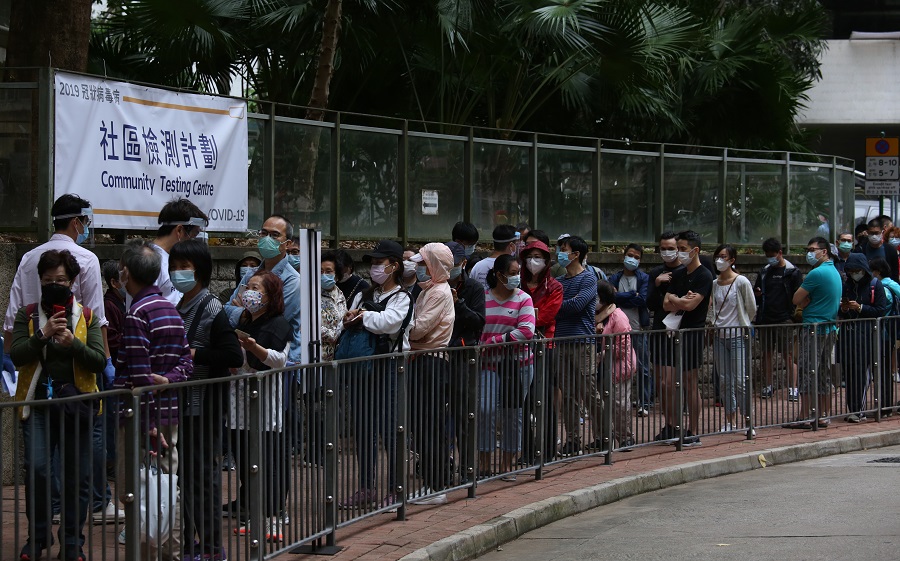
A new year comes with a new goal. Hong Kong's primary goal this year for sure is to contain the COVID-19 pandemic with an aim to achieve zero infections, a crucial factor in revitalizing the economy and the normalization of life. Thereafter, we might as well need to, with clear objectives in mind, think about how to rebuild the society and resolve some of the deep-seated problems that have been besetting Hong Kong.
In the past year, everyone was focused on the employment situation under the impact of COVID-19. Since the second quarter last year, the unemployment rate and underemployment rate in Hong Kong have exceeded 6 percent and 3 percent, respectively. Large-scale layoffs have not only triggered public concerns about subsistence on a personal level, but also misgivings about an issue ingrained in Hong Kong’s social structure — its welfare regime.
Hong Kong's welfare system is classified as the "productivist welfare regime", which means that social and welfare policies are centered on areas such as education, health, etc. that can enhance human capital. Social policies are designed for enhancing economic development, with less consideration for and commitment to public welfare. This type of welfare regime is established on the premise of a sound employment situation, which ensures people's livelihoods and helps reduce their reliance on public welfare. In other words, when the employment situation worsens, the entire welfare regime will become insufficient, creating general anxiety in the community. Now the SAR government is relying on the Employment Support Scheme to allay public concerns amid the crippling pandemic, but its effectiveness will be severely challenged in the long run.
We should set a more ambitious goal this year, which should be beyond winning the battle against the pandemic; we should strive to enhance the well-being of the whole society so that everyone will benefit more equally
The current serious unemployment problem has no doubt alerted us to the structural flaw of our welfare regime. But Hong Kong's deep-seated problems are far more than that. For instance, the long-standing income inequality in Hong Kong has created a huge wealth gap between the rich and the poor. The city has a narrow economic base that is heavily skewed toward the finance-related sectors, perpetuating the unequal distribution of wealth among members of the society. As a result, the majority of people are not able to reap the fruits of economic development. The lopsided industrial structure has generated a crowding out effect that makes it difficult for other industries to flourish. Job options are limited and only a few people can benefit from the limited highly-paid jobs available only in a few sectors. Take the financial services sector as an example, it created a net value of HK$532.8 billion ($69 billion) in 2018, accounting for 19.7 percent of the GDP, but there were only 263,000 people employed in this sector, accounting for only 6.8 percent of total employment. In comparison, the consumer services sectors such as retail, catering and hotel accommodate a large number of low- and middle-income employees, whose salaries have remained meagre, although these sectors have benefited from the Individual Visit Scheme, which has created numerous jobs over the last few decades. Unfortunately, employees in these sectors currently bear the brunt of the economic downturn caused by the COVID-19 pandemic.
Disparity does not only exist in salary income but also in asset income, which is usually generated from the stock market and property market. Over the period between 1997 and 2019, the Hang Seng Index has grown by 162.9 percent, and the house price index has climbed by 134.8 percent, both exceeding the 50 percent increase in the average salary in Hong Kong by far. In other words, the real incomes of citizens who have financial assets and real estate have far outpaced those who don’t have any. For the grassroots community, their low wages and negligible asset incomes are important factors contributing to their wealth gap with those well to do. Hong Kong’s welfare regime has also failed to deal with disparity in asset incomes.
We should set a more ambitious goal this year, which should be beyond winning the battle against the pandemic; we should strive to enhance the well-being of the whole society so that everyone will benefit more equally. To this end, we must first set a clear target for reforming our welfare regime. The well-being of the general public should be prioritized to garner stronger public support and trust for the government. By doing so, Hong Kong will have more power and competence to rejuvenate in the post-epidemic era.
The author is senior research officer of the One Country Two Systems Research Institute.
The views do not necessarily reflect those of China Daily.





