



Racism a complication of US systematic maladies







It's a mysterious fact that the world's "most democratic" country is also the most racist. Throughout its history, self-claimed democracy and a persistent headache of racial disparity have coexisted on American soil.
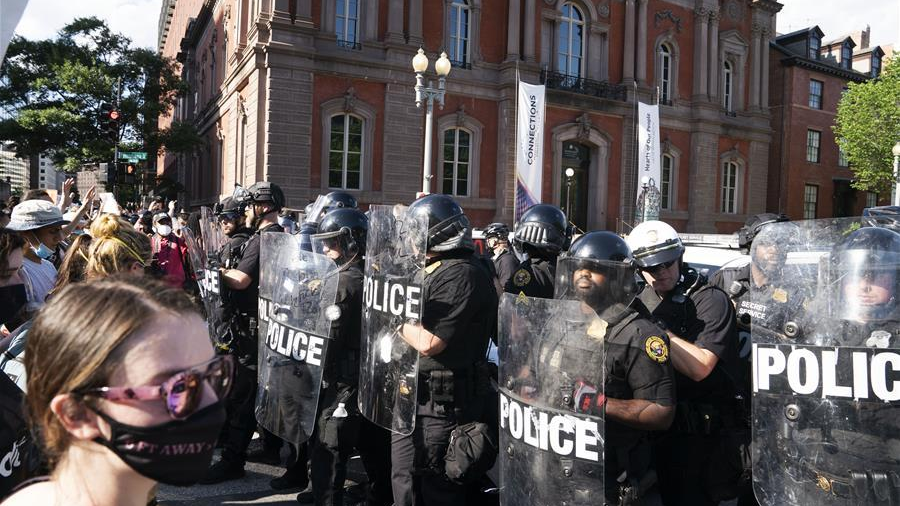
Racism-triggered protests soared during Donald Trump's term in office. In the wake of several white-on-Black police shootings, the scale of coast-to-coast demonstrations rivaled those of the Vietnam War era. Trump, widely known for racially-charged remarks, is often the first to be blamed for encouraging white supremacist sentiments. But the decades-long headache is merely a symptom of maladies in the United States' cultural and societal mechanisms. Attributing an intertwined issue entirely to Trump does not help understand it.
To comprehend the deep-rooted racism, it is worth revisiting the country's history. The ancestors of white Americans, Anglo Saxons, were once outsiders to American soil. Insisting their pursuit of liberty is incomparable across the world, some Anglo Saxons were obstinate in ethnicity-based prejudices. This may explain why the whites, despite being outsiders, felt superior to indigenous people in the early years of the United States' founding.
It is also in this context that most white Americans saw no problem when 20 enslaved Africans were brought to America against their will in 1619 and plantation owners reaped colossal profits from the slave trade throughout the 17th and 18th centuries.
But self-claimed superiority was not enough to rule over other races. Colonizers needed to find a theoretical basis for white supremacy and plant it into the governed. Social Darwinism and the theory of the White Man's Burden took ground in this context. Advocating the Survival of the Fittest, Social Darwinists believed white people were the strongest and thus destined to govern.
Darwinism was initially introduced to explain biological evolution. But when applied in social sciences, it is used to justify the idea that might is right. Under this notion, white Americans have gained access to education, jobs and many other resources at the cost of non-whites. This creates a vicious circle. Better resources have further enhanced the white's competitiveness, and thus reinforced Social Darwinism.
The White Man's Burden is another theory invented to glorify colonization – white colonizers shoulder the responsibility to "care for" the non-white indigenous people. In this way, colonization was varnished as a mission of civilization and a gift for other races, for which indigenous people should feel grateful.
The two theories may explain racist sentiment during the colonial era. Fast forward to modern times, the United States has tried to eradicate racism, with new laws aiming to ensure diversity in American society. But the legal strides do not necessarily lead to the same level of improvement in societal arrangements.
Social Darwinism is history, but the impact of it lingers as a result of racial disparities in societal arrangements. A US Department of Education report indicated that in 2013, Black high school students were half as likely to have Advanced Placement or International Baccalaureate credits. Statistics from Opportunity Insight showed only 15 percent of Black students from less-educated households earned a college degree. That's compared with 24.5 percent of their white counterparts.
Not surprisingly, education inequality makes Black Americans less likely to climb the ladder of social status. According to the Bureau of Labor Statistics, only 31 percent of employed Blacks worked in high-paying occupations, in comparison to 41 percent of the white counterparts in 2018. The US Census Bureau reached a similar conclusion: the average Black employee earned only 62 percent pf that paid to the white in the same year.
No effective mechanism has been introduced so far to ensure Black Americans are treated equally on issues of access to education, and thus high-paying jobs, let alone healthcare, politics and justice. Structural racism has contributed to Black people's lack of competitiveness in American society. This, to an extent, has reinforced stereotypes.
Against this backdrop, white supremacist sentiments were voiced more loudly during Trump's term in office. Apart from the president's racist remarks, rising prejudice is closely connected with the challenges white Americans have faced in recent years.
Economically, the world's largest economy has seen a widening wealth gap in the past decade. According to Pew Research Center, the income gap between the country's rich and poor families more than doubled from 1989 to 2016. In 1989, the richest five percent of American families had 114 times as much wealth at the median. The figure soared to 248 in 2016. Working-class white Americans are one of the most affected groups.
To shirk their responsibilities, political "pundits" resorted to the blame game, accusing globalization of widening the income gap. At their instigation, working-class white Americans attribute their loss of jobs to other ethnic groups that have migrated into the United States.
Economic conundrums are partly behind rising racism in the United States. The changes in the country's demographic structure have furthered intensified tensions. According to the US Census Bureau, all racial minority groups are growing faster than whites. The country is on its way to becoming predominantly non-white. Beyond question, this has raised white Americans' anxiety levels, and thus their hostility against other ethnic groups.
Racism in the United States is a sophisticated issue. Legislation alone is not enough to solve it. Fixing maladies in the country's cultural, societal and economic mechanisms may suggest an answer to this decades-long headache.





