



Division or dialogue, that depends on US







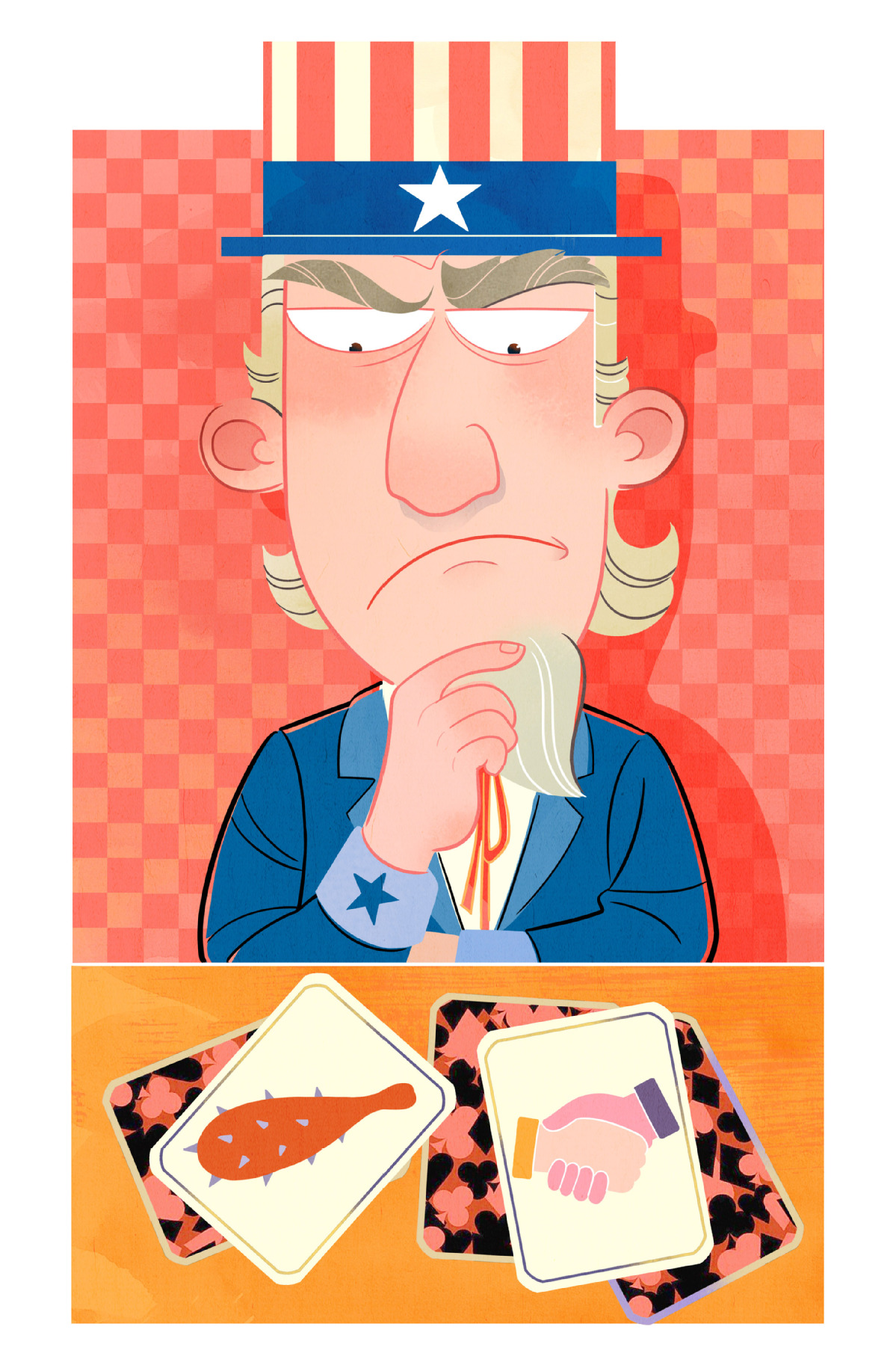
Americans don't agree on much of anything nowadays. Yet they are largely united in their belief that China represents an existential challenge to their country and the world order it has long led. This combination of internal division and external demonization has made the Sino-American rivalry increasingly inescapable-and potentially catastrophic.
In recent years, the United States' internal divisions have been fueled by social media, which, by populating users' feeds with tailored content, create "echo chambers" that reinforce, rather than challenge, their beliefs and values. When alternative ideas do make it into the echo chamber, they are often distorted or smeared. And when someone within the chamber calls into question shared beliefs, they risk being instantly ostracized or, in contemporary parlance, "canceled".
This ultra-reactive demonization of diverging views not only flattens discourse, it also narrows the space between disagreement and conflict. Widespread frustration with leaders' failure to deliver justice, security and opportunity heightens the risks further. The same tendencies can be seen in the US' approach to China. For example, the US State Department's just-released report, "The Elements of the China Challenge" villainizes the Communist Party of China, describing it as "unconstrained by respect for individual liberty and human rights".
The report also stokes fear of China's supposed "authoritarian goals" and "hegemonic ambitions", which imply a desire to infuse the US-led global order with its own social and political model. And it recommends that the US build a united front against China, in order to secure-by military force, if necessary-"freedom" for the world.
None of this has gone unnoticed in China, which has been conducting its own, increasingly unfavorable assessment of the US. It now seems clear to China's leaders, citizens and businesses that, far from a land of freedom and opportunity, the US is a deeply fragmented society, blighted by systemic racism, rising inequality, and a lack of common purpose-ills that have long been obscured by fantasies about the "American Dream".
Moreover, far from being the exemplar of democracy, the US has a highly distorted political system. Its institutions, including the Electoral College, the Senate and the Supreme Court, and practices such as gerrymandering, strategic reduction of polling places, and onerous voter verification rules, mean that the majority does not always rule. Wealthy donors purchase influence, whether by financing campaigns or buying up the media.
As China has shed long-held illusions about the US, its hopes for a constructive bilateral relationship have diminished. To be sure, president-elect Joe Biden is unlikely to sustain the roller-coaster ride of surprise attacks, reversals, disruptions, and near misses that President Donald Trump engineered. But less chaotic does not necessarily mean less confrontational. So, China is preparing for the worst. This may mean a continuation of Trump's trade war or more senseless finger-pointing over the COVID-19 pandemic. It may even mean military tensions involving the Taiwan question, and the South China Sea and China's western border issues.
But that does not mean China is stooping to US-style isolationism and demonization. On the contrary, China has taken important steps to advance global cooperation in key areas of shared concern. For example, on climate change, President Xi Jinping, while addressing the 75th annual session of the United Nations General Assembly, vowed that China's carbon-dioxide emission will peak by 2030 and the country will become carbon neutral by 2060.
On trade, China has signed the Regional Comprehensive Economic Partnership, whose 15 member countries account for 30 percent of the global population. Much to the world's surprise, it has also indicated its willingness to join the Comprehensive and Progressive Agreement for Trans-Pacific Partnership, which emerged after Trump withdrew the US from the original Trans-Pacific Partnership.
The US, which is struggling to control the pandemic, and seems to be headed toward a double-dip recession, would do well to take a similar approach. Trade is the only way it can escape its current economic predicament. That includes trade with China-the first major economy to recover from the pandemic shock, and the only one forecast to register positive growth in 2020.
But this will be impossible if misapprehensions, antagonism and mutual suspicion continue to dominate bilateral relations. As former US secretary of defense Jim Mattis said, the US has two key powers: the power of inspiration and the power of intimidation. In dealing with China-an economic powerhouse with a population of 1.4 billion-intimidation will not work. China will not be cowed into submission on its domestic affairs.
There is still time, however, for Washington to use the power of inspiration to show that the US and China can be equal partners in peace, and work together to overcome shared challenges. For cooperation to work, the US needs to demonstrate its ability to think in terms of "we", rather than "I". There is a moral dimension to this imperative. Many outsiders, including Chinese, cannot comprehend how the world's leading science and technology power could allow over 260,000 people to die from a virus that much poorer countries have combated more successfully with simple measures.
As Rabbi Jonathan Sacks explains: "The world is divided into the people like us and the people not like us, and what is lost is the notion of the common good." China's enduring commitment to multilateralism indicates that it recognizes this. It is time for the US to do the same, and to embrace a direct and honest dialogue on issues that require constructive engagement.
Biden's presidency would provide a golden opportunity to initiate this crucial conversation. But time is of the essence. If Biden begins his term by choosing division over dialogue, changing course will soon become difficult, if not impossible.
Andrew Sheng is a distinguished fellow at Asia Global Institute of the University of Hong Kong and a member of the UNEP Advisory Council on Sustainable Finance. And Xiao Geng, chairman of the Hong Kong Institution for International Finance, is a professor at and director of the Research Institute of Maritime Silk-Road at Peking University HSBC Business School.
Project Syndicate
The views don't necessarily reflect those of China Daily.
If you have a specific expertise and would like to contribute to China Daily, please contact us at opinion@chinadaily.com.cn , and comment@chinadaily.com.cn





