



The death of Diego Maradona







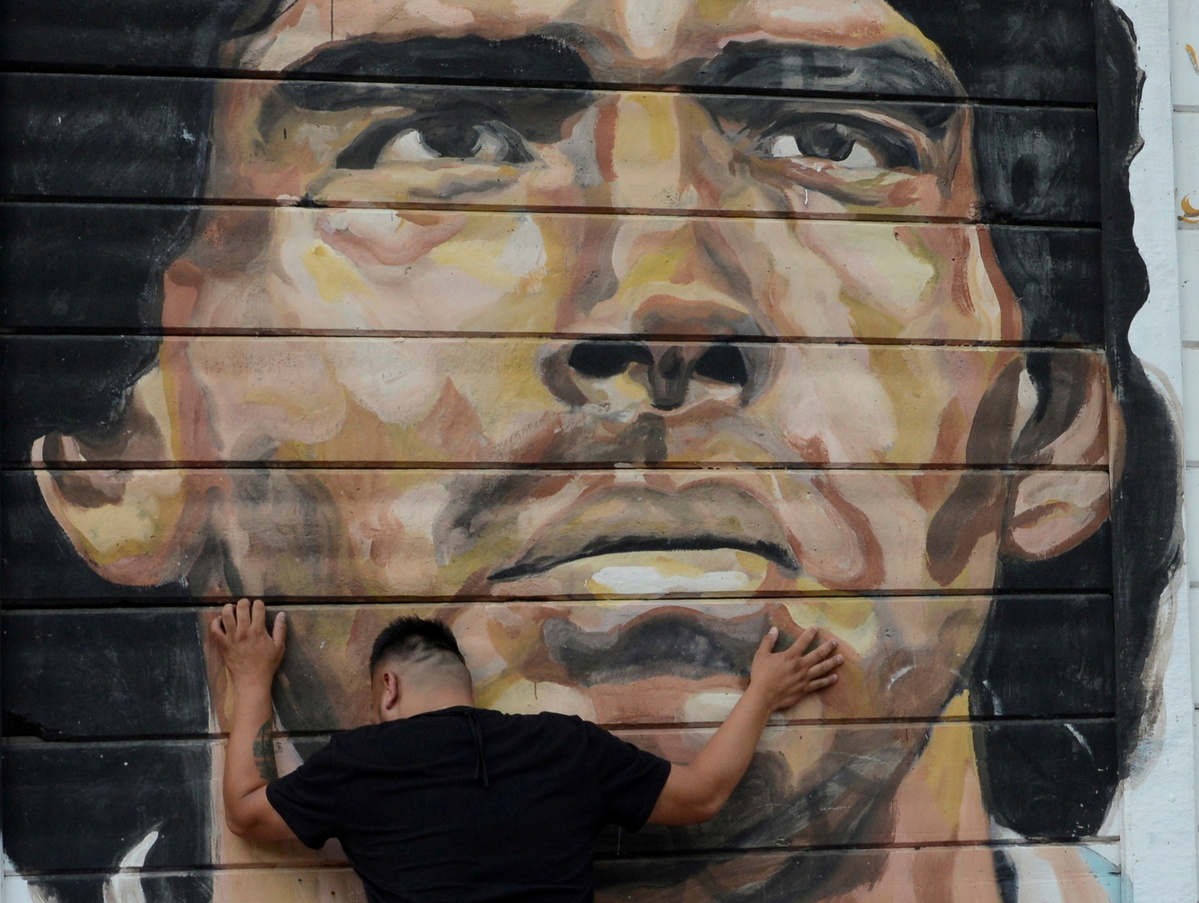
The death of a former athlete might not seem the greatest of tragedies. Sport entertains and diverts us, but it does not have the broader effect of politics, art or science.
But the death of Diego Maradona on Wednesday, at the age of 60, is like the man himself the exception to so much received wisdom.
The Argentinian lived a life that demonstrated that football at its peak can summon passions that move entire nations. His career will be argued over – he does not have the phenomenal statistics of Lionel Messi and Cristiano Ronaldo, though he played in a far more aggressive footballing culture – but beyond the numbers, Maradona was a man who was deified in Argentine and the Italian city of Naples, to both of which he brought glorious redemption after darkness and failure.
To look at Maradona's career now is to see football almost in an embryonic state. This was when stadiums were huge crude concrete bowls with primitive terracing and almost zero amenities, pitches were lumpen and worn, teams were largely domestic, wages were comparable to skilled workers, and when fans still had a direct personal connection with the players, whom they could meet at the training ground or around the city.
The media and corporate possibilities for the sport were nascent at best. Like a magician, Maradona synergized the possibilities; he was the first truly global football superstar, going from Boca Juniors in Buenos Aires to Barcelona to Napoli in Italy, twice breaking the world transfer record.
His arrival in Napoli in 1984 was unexpected – they had finished eleventh out of 16 the previous season, and no team from the south of Italy had ever won the scudetto. But after a disappointing two years, during which he had been kicked into submission in the 1982 World Cup and almost literally kicked out of Spain after brawling with Athletic Bilbao, it was time for a fresh start.
Napoli, like Maradona, had no great lineage. The city was also the victim of vile prejudice, taunted by supporters of the major northern Italian clubs Milan, Inter and Juventus: "Here come the Neapolitans – what a stench! Even the dogs run away!"
So the city took him to its heart – more than that: Maradona was taken as a savior or redeemer, the man to bring back pride and respect to Naples.
And the astonishing thing is that he did exactly that, as the club finished eighth, third and then first, to win the championship for the first time ever in the 1986-87 season. Wild celebrations went on for a week, as a forgotten city asserted itself from the shadows of more successful rivals.
This too was the story of Maradona in the 1986 World Cup.
With Argentina having been defeated in the Falklands War just four years earlier, beating England in the quarter final and then winning the entire tournament was the greatest possible redemption for the nation.
The national team had been in poor form, but Maradona's performances are the best by any single player at any world cup – 1986 will be forever the Maradona World Cup. (His astonishing second goal against England, dribbling 60 yards past four players, was voted goal of the century).
Magician though Maradona may have been – able to conjure possibilities during football matches equal as much as he could drive teammates to incomparable new heights – he was also deeply human, and thus deeply flawed.
He liked to have a good time. He liked women. He liked money and the outwards signs of success.
Naples in particular, through the Camorra mafia, offered him all he wanted. He took, and was taken. He indulged, until he himself was devoured. The pressure on him became too much, and he was looking for an escape, which drugs and self-indulgence offered, though they blunted his mind and mobility.
Napoli however would not allow him a transfer. So he remained a player there when Italy hosted the World Cup in 1990. The pressure on the national team to win was enormous. But when Italy faced Argentina in the semi-final, in a match held in Naples, Maradona urged locals to support him and Argentina rather than the national team, splitting the country.
The game went to penalties and Maradona effectively scored the winner, turning him from saint to devil in Italian eyes. When the next season began, his political protection evaporated, he failed a drugs test, and he was effectively kicked out of Italy.
Afterwards Maradona drifted through clubs and then became a manager of mostly minor teams, never for any great length of time. He put on weight, and had to have gastric bypass surgery in 2005. He took Argentina to the World Cup in 2010, and made the quarter-finals, though they were routed 4-0 by Germany, after which he was effectively sacked. Health problems became routine; his death on Wednesday was a surprise but not a shock.
But El Pibe de Oro ("The Golden Kid") had long been immortalized, his countenance seen on Neapolitan murals and makeshift roadside shrines. In Argentina too he was more than a football player. His former national teammate Jorge Voldano said, "It was a special compensation factor for a country that in a few years lived several military dictatorships and social frustrations of all kinds. Maradona offered to the Argentines a way out of their collective frustration, and that's why people love him. There is a divine figure."
Diego Maradona as a man was a weak vessel, whose fingers were repeatedly burned; but as a symbol and icon he shone brighter than any athlete in the last hundred years. He is immortal.
Mike Cormack is a writer, editor and reviewer mostly focusing on China, where he lived 2007-2014. He edited Agenda Beijing and is a regular book reviewer for South China Morning Post.





