



Officers, their families also have fundamental rights







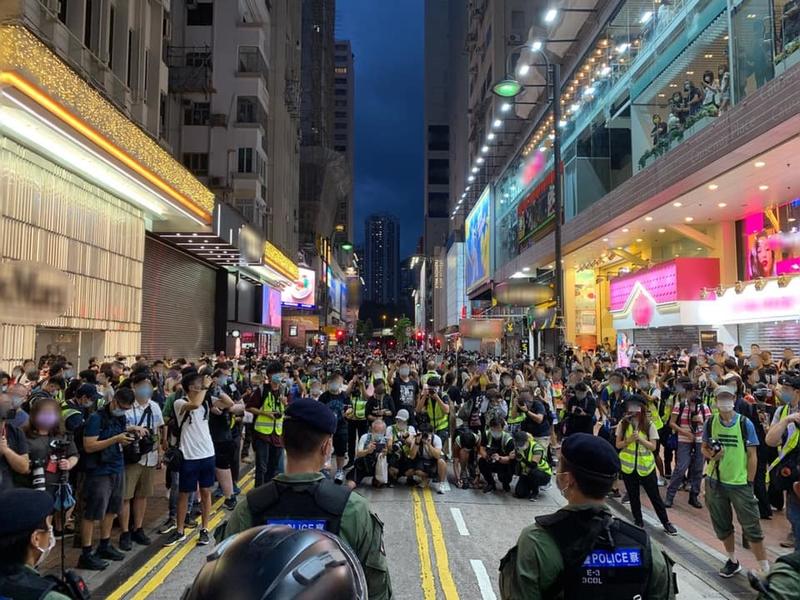
In 2019, after insurgents declared war on society, there was a real danger that they would destroy Hong Kong. Although they did not succeed, they and their allies torched public facilities and private businesses, vandalized banks and restaurants, and brutalized people who came from other parts of China or held different opinions. They acquired funds, assembled arsenals and turned universities into bomb-making factories. They reduced parts of the city into little more than war zones, even attacking trains, buses and traffic lights.
Their insurrection, however, failed, and this was entirely due to the heroism of the Hong Kong Police Force. When confronted by frenzied mobs attacking them with petrol bombs and other lethal weapons, its young officers bravely held their ground and restored order. They responded to the violent attacks with minimum force and, through sheer professionalism, they were able not only to defend the city, but also to avoid any fatalities.
Once they realized that the police force had its measure, the protest movement changed tack. As the force had successfully countered its armed wing on the streets, it adopted an alternative tactic of disinformation, designed to undermine its credibility. They claimed, for example, that the police were sexually assaulting female protesters in detention, and their foreign backers eagerly recycled this fallacy, which was ultimately exposed. On Nov 3, Poon Yung-wai was convicted of falsely spreading online rumors of sexual abuse on a Facebook group of over 50,000 members, and trying to incite an attack on the San Uk Holding Centre, which housed arrested protesters.
Having been thwarted, the protest movement, in frustration, also decided to harm police morale, by mounting an alternative campaign against officers and their families. This involved the release of personal details online, vilification on social media, and the intimidation of their children. Their strategy proceeded in tandem with late-night attacks by black-clad thugs on the police married quarters, in Wong Tai Sin and elsewhere, designed to terrify the officers’ families.
The protesters’ doxxing campaign was, moreover, well organized and systematic, and large numbers of officers were targeted. The Commissioner of Police, Chris Tang Ping-keung, has revealed that over 3,000 officers and their families were threatened in this way, and it was clearly incumbent on him to protect his officers. Since the display by officers of their unique identity numbers was exposing them to huge risks, an alternative identification system obviously had to be deployed. Resort was had, therefore, to the operational Call-Sign, with Alpha ID’s being used by the Special Tactical Contingent (“the Raptors”).
As Tang has explained, a Call-Sign is unique to an individual officer, and provides him or her with a measure of protection. While shielding frontline officers from identification by those intent on harm, the Call-Sign and the Alpha ID still enable the police to identify particular individuals who are alleged to have misbehaved.
However, after several individuals, including protesters, challenged the use of the Call-Sign and the Alpha ID in a judicial review, the Court of First Instance decided that the absence of personal identity numbers on the officers’ uniforms violated human rights (HCAL 1747-2703//2019). In particular, Justice Anderson Chow Ka-ming declared that the failure of the Commissioner of Police to ensure that every officer deployed in non-covert duties “wears and prominently displays an identification number which is unique to that officer violates Art.3 of the Hong Kong Bill of Rights”. Art.3 provides that nobody shall be subjected “to torture or to cruel, inhuman or degrading treatment or punishment”, and Chow concluded that this right was unenforceable if the officer allegedly responsible for a violation during public disorder could not readily be identified for complaint purposes. He also pointed to occasions where there had been abuse, as where the same Call-Sign was displayed by multiple officers on the same occasion, or where it was covered up, although the force has explained that any such practice can result in disciplinary action.
Although Chow said he was “fully alive” to police concerns over the “rampant doxxing campaigns against them”, he concluded that the requirement that officers should display a unique identity number “would greatly facilitate a complaint of police ill-treatment by the victim and any subsequent investigation of such complaint”. However, although the Call-sign and the Alpha ID were being used in highly unusual circumstances, not only to protect police officers, but also to uphold their rights and those of their families, this appears to have been largely overlooked, which is a concern. Although the Hong Kong Bill of Rights does not bind the protest movement and its armed wing in the same way as it does the government and its agencies, police officers are nonetheless entitled to full protection from what Art.3 describes as “cruel, inhuman or degrading treatment”, which includes doxxing and the terrorizing of their family members.
Shortly after the Hong Kong Bill of Rights Ordinance was enacted in 1991, the Judicial Committee of the Privy Council, as the predecessor of the Hong Kong Court of Final Appeal, was required to consider its ambit in a criminal case in 1993 (Att.Gen. of Hong Kong v Lee Kwong-kut). Lord Woolf, who subsequently served as a Non-Permanent Judge of the Hong Kong Court of Final Appeal from 2003 to 2012, provided invaluable guidance to the courts in Hong Kong as to how they should approach human rights issues arising under the new Ordinance. He said that, although the judges should be zealous in upholding an individual’s rights, it was also necessary that disputes over the effect of the Ordinance should not be allowed to get out of hand. In order to maintain the balance between the rights of the individual and the public interest, Lord Woolf emphasized that rigid and inflexible standards should not be imposed on attempts to resolve the difficult and intransigent problems which society faces when dealing with serious crime.
In other words, Lord Woolf believed that a realistic approach is required in approaching human rights issues under the Ordinance, rather than one which is blinkered, and that the exigencies of particular situations should be borne in mind by the courts.
On Nov 21, Tang announced that there is to be an appeal against Chow’s ruling, and the wider issue of police rights must now assume center stage. If, as is sometimes said, the Hong Kong Bill of Rights is a living document, then it has within itself the flexibility necessary to respond to changing circumstances. Although basic principles must always be respected, rigidity for its own sake has nothing to commend it, and an appropriate balance must now be struck. If this is done, it will ensure that the safety of frontline police officers is not compromised simply because one means of identification is being used rather than another, for objectively justifiable reasons.
The police have put in place a system for identifying officers, with alphanumeric identification, and this should satisfy everyone. If they are to maintain the peace in times of violent protest, officers must be able to concentrate on the task in hand. They cannot be distracted by fears that, if they do their job, they and their families will face reprisals. Their rights, like those of others, should be upheld, and the courts must not lose touch with reality.
The author is a senior counsel, law professor and criminal justice analyst, and was previously the director of public prosecutions of the Hong Kong SAR. The views do not necessarily reflect those of China Daily.





