



Defending the deal







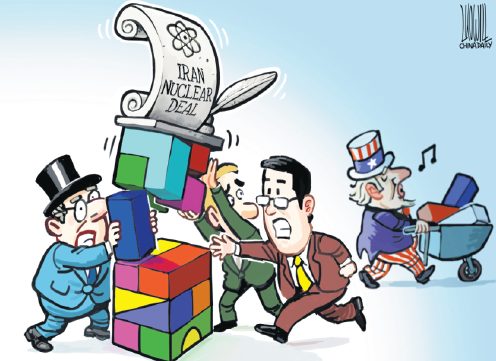
Concerted efforts required to keep the Joint Comprehensive Plan of Action in place in the face of US attempts to sabotage it
United Nations Security Council Resolution 2231 (2015), stipulating arms sale restrictions and limits on Iranian nuclear activities, expired on Oct 18, meaning Iran can now engage in normal arms trade with other countries. However, the United States, whose proposal to permanently extend the arms embargo on Iran was rejected by the UN Security Council in August, will impose more political, security and economic pressure on Iran, and even oppose countries having normal economic ties and engaging in arms sales with Iran.
Such actions will have significant ramifications on the Iran nuclear issue and international relations. A right understanding of the Joint Comprehensive Plan of Action, commonly known as the Iran nuclear deal, requires an understanding of the history and the nature of the Iran nuclear issue.
The JCPOA has effectively served the purpose of nonproliferation and addressed the major concerns of countries that are not friendly with Iran, such as the US and Israel. Under the nuclear deal, Iran is allowed a maximum 300 kilogram stock of 3.67 percent enriched uranium; its stock of heavy water cannot exceed 130 metric tons; it can only enrich uranium at the Natanz facility, with only 5,060 IR-1 centrifuges (with an additional 1,044 centrifuges allowed for research but not enrichment purposes); and it is also prohibited from reprocessing spent fuel and engaging in related research activities.
Iran and the P5+1 talks, involving the five permanent members of the UN Security Council-China, France, Russia, the United Kingdom and the US-plus Germany (and the high representative of the European Union for Foreign Affairs and Security Policy), concluded with the deal aimed at ensuring Iran cannot produce enough nuclear materials needed for one nuclear weapon within a year. If Iran produces more nuclear materials than allowed, the UN Security Council will have enough time to take forceful measures to safeguard nonproliferation.
Before the JCPOA, the US and Iran had been sparring over the nuclear issue for over a decade. While the US and its allies, particularly Israel, insisted that Iran cannot have the right to enrich uranium, a key technology for nuclear weapon programs, Iran insisted that as a member of the Treaty on the Non-Proliferation of Nuclear Weapons, it would never give up its legitimate right to benefit from peaceful uses of nuclear energy.
A key turning point came during former US president Barack Obama's second term, when he decided to make the Iran nuclear deal part of his political and diplomatic legacy. His administration no longer insisted that Iran give up its right to enrich uranium-despite strong sentiments in Israel-but rather, it focused on restricting Iran's enrichment capabilities. Iran accepted the restrictions, as it managed to keep the enrichment rights it had been fighting for. Therefore, the JCPOA is a compromise between the US and Iran, not a zero-sum game in which one side wins over the other.
Before the Iran nuclear issue, there were mainly two ways to resolve nuclear issues: by force or by the will of the host country. The US and Israel used air raids to destroy nuclear facilities in Iraq and Syria. Ukraine, South Africa and Libya voluntarily gave up their nuclear weapons following major shifts in their regions and in the world. The JCPOA is a stellar example of resolving nuclear issues peacefully.
Apart from Iran, the nuclear issue of the Democratic People's Republic of Korea stands out as one relevant to the security of the region and the world. The JCPOA offers hope for resolving it peacefully. Therefore, it is particularly important to keep the Iran nuclear deal alive.
In May 2018, the US announced that it would walk away from the JCPOA. Sanctions were re-imposed on Iran and on countries and businesses maintaining normal economic and trade ties with it. The US has also been leading the efforts to permanently extend the arms embargo on Iran at the UN Security Council, but in vain.
Why does the US want to challenge the Iran nuclear deal anyway? The US believes that following the nuclear deal, the international community has been gradually lifting sanctions on Iran, leading to its development, something not conducive to the US' geopolitical interests in the Middle East. By exiting the JCPOA, announcing the so-called snapback sanctions on Iran and cutting off the country's economic ties with other countries, the US aims to destroy Iran's economy, thereby weakening the country, and triggering a humanitarian crisis to exacerbate social instability, overthrow the regime and ultimately serve its geopolitical and strategic interests in the Middle East.
With the US reneging on the deal, the Iran nuclear issue, which was in remission, has reappeared. So what is the path forward? The results of the ongoing US presidential election will be pertinent to this question. If the US re-embraces Obama's policy direction, the JCPOA is likely to make a comeback. Of course we cannot exclude the possibility of the US basing JCPOA's return on the addition of new content to it. This will require new compromises being made by both sides.
But if the US continues its current policy of challenging the Iran nuclear deal, the international community needs to strengthen collaboration and explore ways to keep the deal in place despite the US' unilateral actions.
The European Union has now established the Instrument for Supporting Trade Exchanges, or the INSTEX, which lays the groundwork to bypass US sanctions and maintain trade relations with Iran. This system should be upgraded and expanded to more areas such as energy and finance, so that it can play its role in protecting trade with Iran and keep the deal with Iran functioning. This is an effective way to respond to unilateralism, and for this to happen, it will require agreement, collaboration and responsibility from other major countries.
The author is deputy-director of the Institute of World Economics and Politics at the Chinese Academy of Social Sciences. The author contributed this article to China Watch, a think tank powered by China Daily. The views do not necessarily reflect those of China Daily.





