



We ignore the gray rhino at our peril







Climate change presents grave risks for China but also big opportunities if it determines what effective actions to take
The recent historic flooding in Southwest China was a grim reminder of the risks of extreme weather events. It is in China's interest to act to mitigate climate change, whether independently or in coalition with others. This self interest lies in the acute national security risk inherent in runaway climate change coupled with the cost effectiveness of taking immediate action.
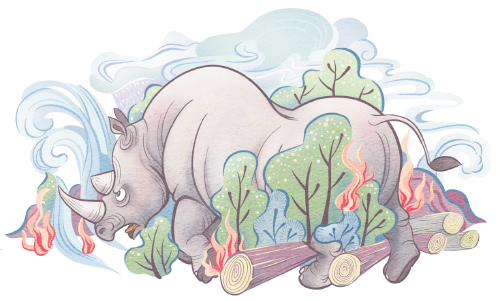
The national security impact is reflected in what President Xi Jinping said is the gray rhino risk-the evidence of a growing calamity is clear, but the solution is not automatic and needs concerted action. The melting of glaciers in the Qinghai-Tibetan Plateau threatens the Yangtze and Yellow River deltas which sustain about 64 percent of the Chinese economy and the livelihoods of 600 million people.
What is more, climate change accounted for a 40-percent reduction in river runoff in the Yellow River watershed, 15 percent in the Haihe River watershed and 18 percent in the Liaohe River watershed. According to government reports, extreme flooding in the Pearl River basin increased significantly during 1981-2015. Shanghai is sinking and cities in the coastal regions are highly vulnerable to rising sea levels and super typhoons. Tianjin, Beijing, Zhejiang province and Shanghai with power, transport, telecommunications, water and finance concentrations, are vulnerable to disruptions from climate change. Droughts have increased since the 1980s with 23 provinces and autonomous regions experiencing "severe" droughts, with five regions experiencing a severe drought for the first time. Prolonged droughts in rural areas would likely lead to a second wave of mass migration to cities, which would be unable to provide enough jobs and social services, increasing the risk of social unrest. China's food security is also at heightened risk. From 1961 to 2010, the size of farms affected by diseases increased eight times and those ravaged by pests increased nearly six times. Climate induced pandemics are not far away.
But there is good news. It is increasingly clear that climate-smart growth can encourage more efficient modes of production, promote energy efficiency, create millions of new jobs, generate new revenue sources, and provide environmental and health benefits. In the last 15 years, China has shown the capacity to transition to a climate-smart model. This can be seen in the efficiency improvements and productivity gains of State-owned enterprises, energy use, transportation, agriculture, and heavy industries and digital transformation. But more needs to be done to accelerate this transition in the post-pandemic world. China's role is more important than ever because major economies are distracted by domestic political, economic and COVID-19 concerns.
Here is a game plan. First, China should accelerate the adoption of domestic carbon taxes and trading. The pilot projects have been successful and it is time now to roll them out aggressively, nationwide. Second, China should use its global monopsony power (power of a large buyer in international trade) to impose a transnational carbon tariff. Third, China should use its powers-monopsony, diplomatic and financial-to build a climate coalition with its Asian trading partners via the Regional Comprehensive Economic Partnership, especially with the Southeast Asian nations, Japan and Australia to adopt a regime of carbon prices and impose a transnational carbon tariff to encourage non-members to join.
In support of this three-part approach, the Asian Infrastructure Investment Bank, the Belt and Road Initiative and the Asian Development Bank could promote climate resilient infrastructure investment, move away from carbon projects, promote carbon capture and energy efficiency investments and eschew traditional infrastructure lending.
The gains to China could be enormous. Based on pilot experiments, the initial price of carbon could start at $40 per metric ton. At this price, China could generate an estimated 14 percent of additional revenues to help its local governments finance the shift toward a climate smart growth model and alleviate an already tight fiscal space. This new growth and financing model will help the country overcome the middle-income trap and remain on track to achieve a prosperous society and an ecological civilization by 2049.
The current global regime of climate mitigation has failed, and the gray rhino risk is growing. Other major economies are too distracted by the pandemic. This is an opportunity for China to take unilateral action to accelerate climate change mitigation while inviting others to join the fight.
Eduardo Araral is an associate professor and director and Vinod Thomas is a visiting professor at the Lee Kuan Yew School of Public Policy at National University of Singapore. The authors contributed this article to China Watch, a think tank powered by China Daily. The views do not necessarily reflect those of China Daily.
If you have a specific expertise and would like to contribute to China Daily, please contact us at opinion@chinadaily.com.cn , and comment@chinadaily.com.cn





