Rivalry with China a no-win strategy for US







As governments worldwide confront the terrible choice between saving lives from COVID-19 and protecting people's livelihoods, economic indicators highlight the intensity of the dilemma. Unemployment has skyrocketed, trade has plunged, and the global economy is facing its worst downturn since the Great Depression. There is only one way to limit the novel coronavirus pandemic's economic fallout: Sino-US cooperation.
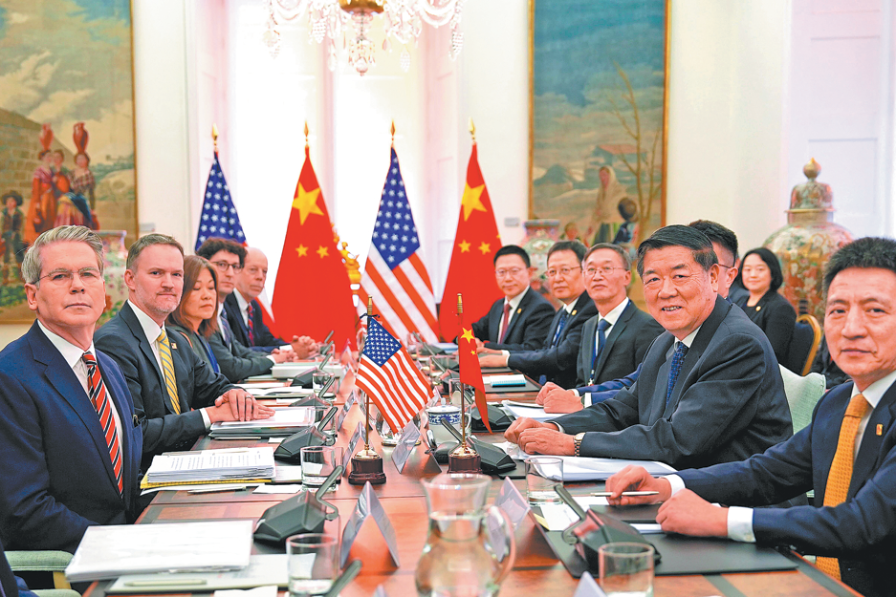
But China and the United States have been at odds lately. Since 2017, the US administration has pursued an aggressive containment strategy, wielding trade barriers as its favorite weapon.
US has become more antagonistic
Far from spurring a change of heart, the COVID-19 crisis seems to have deepened the US administration's commitment to antagonism to the point that blaming China for the outbreak appears to have taken precedence over protecting American lives. In its latest document "Strategic Approach to the People's Republic of China", the US administration has reiterated its reasoning: a supposedly "clear-eyed" assessment has confirmed China as a strategic competitor in economic, ideological and national-security terms.
The US does not, the document claims, "seek to contain China's development", and "welcomes cooperation by China to expand and work toward shared objectives". But US engagement with China will be "selective and results-oriented", always advancing US national interests.
As the COVID-19 death toll in the US has crossed the 110,000 mark, Washington has no greater interest than containing the coronavirus. And with more than 38 million unemployment claims having been filed in just nine weeks, limiting the pandemic's economic costs must also be worthy of cooperation.
Make no mistake, neither confronting a threat that doesn't respect borders nor safeguarding an economy that is deeply integrated with the rest of the world can be done alone. Yet it is far from clear that the US will subordinate geopolitical rivalry to these vital objectives.
On the contrary, just in the last month, the US Commerce Department introduced new technology restrictions targeting Chinese telecommunications giant Huawei, and the Senate passed a bill that could de-list some Chinese enterprises from trading on US stock exchanges. And, while acknowledging the "wide scientific consensus that the virus was not manmade or genetically modified", US Secretary of State Mike Pompeo recently declared that there is "enormous evidence" to show that it originated in a laboratory in China.
Amid acute emotional and economic trauma, the desire to identify and punish a culprit can certainly be tempting. For the US president, it has emerged as a central feature of his re-election campaign-and a useful way to avoid blame for his administration's failures in containing the pandemic. But history shows the folly of such an approach: policies intended to punish the losers of World War I set the stage for the Great Depression and eventually led to another world war.
Pandemic has given rise to dangerous political trends
The stakes are just as high today. The pandemic has turbocharged dangerous political and economic trends, from nationalism to a digital divide among workers and businesses. Rising unemployment, together with climate change-related natural disasters and disease outbreaks, will only exacerbate discontent.
Many governments hope that large-scale monetary and fiscal stimulus will be enough to save their economies. The International Monetary Fund estimates that developed countries have already committed to providing $9 trillion worth of fiscal support, with the US and Europe in the lead. In the US, the Congressional Budget Office projects a fiscal deficit of $3.7 trillion-17.9 percent of GDP-in 2020.
China, too, is relying on fiscal stimulus, though to a much lesser extent. Its efforts-centered on over 2.5 trillion yuan ($350 billion) in cuts to taxes and fees faced by businesses and households-would raise its fiscal deficit only slightly, to 3.6 percent of GDP.
But while the US Federal Reserve has unleashed unprecedented monetary loosening-expanding its balance sheet by nearly $3 trillion as of mid-May-the People's Bank of China has not followed suit, preferring to press commercial banks to issue credit to businesses and local governments. In the first four months of this year, total yuan-denominated loans rose by 10.7 percent year-on-year. The sale of coronavirus bonds worth 1 trillion yuan should help to sustain local governments' budgets.
Despite these massive stimulus measures, the US' real GDP is expected to decline by 39.6 percent in the second quarter of 2020, and 5.6 percent for the whole year. This reflects an inconvenient truth: most monetary and fiscal policies address only temporary cash-flow issues. What the world needs is to re-tool the business and employment models for the post-pandemic era-and that will require massive investments at local, national and global levels.
Unlike the US, China seems to recognize this. At the opening of the recently concluded third session of the 13th National People's Congress, Premier Li Keqiang set no GDP target for the year, indicating the government will uphold its people-first approach. Li also vowed to work with the US to implement the "phase one" trade deal that was signed in January.
The US needs to recognize that its escalating geopolitical rivalry with China makes little strategic sense. The last several decades have shown that global cooperation-especially on trade-is a viable win-win strategy, while trade wars and zero-sum geopolitical competition undermine prosperity for all.
Beyond the bilateral strategic game, the US-as a longtime global leader-has a moral obligation to help the rest of the world avoid a pandemic-induced depression trap, which would be more dangerous than the so-called Thucydides' trap. Judging by recent signals, we should not hold our breath.
Andrew Sheng is a distinguished Fellow of the Asia Global Institute at the University of Hong Kong and a member of the UNEP Advisory Council on Sustainable Finance. And Xiao Geng, president of the Hong Kong Institution for International Finance, is a professor at and director of the Research Institute of Maritime Silk-Road at Peking University HSBC Business School.
Project Syndicate
The views don't necessarily reflect those of China Daily.