



Change for the better







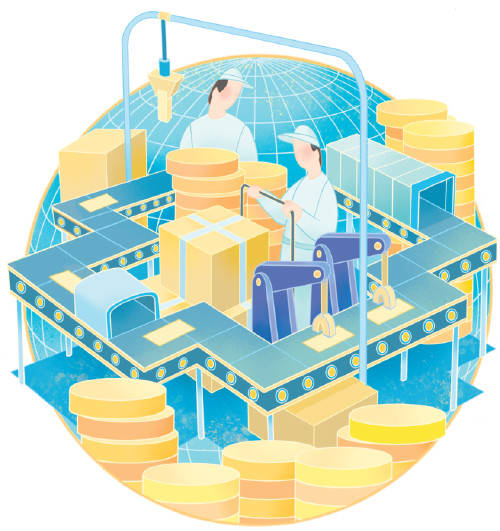
To consolidate the status of China's supply chains it is essential that it accelerate the formation of industry clusters
This pandemic will probably disrupt China's long-term global value chain ecosystem that was established under the export-oriented strategy. This in addition to some other trends will change the environment for China's manufacturing sector.
According to the World Bank's World Development Indicators, China's industrial added value only accounted for 6.8 percent across the globe in 2003, and then it climbed up to 23.9 percent in 2017. China became the largest trading partner of over 120 economies in 2018. According to the World Integrated Trade Solution data provided by the World Bank, which allows users to query several international trade databases, nearly 200 economies worldwide import goods from China, among which, the intermediate goods imported from China accounted, on average, for 21.7 percent (the median) in all their imports.
The intermediate goods for export from China are out of stock, which has already had a serious impact on the automobile supply chain in South Korea, Japan, Serbia, and other countries.
This disorder throughout the global supply chain will in turn influence normal economic operations in China.
In view of the impact on the industrial chain in the developed nations during the pandemic and the principles proposed recently by governments in the United States, Japan and Europe for restructuring their industrial chains, China must be prepared for the global supply chain restructuring.
The United States has, for instance, three objectives in restructuring its industrial chain: First, to facilitate the reshoring of manufacturing; second, to promote near-shore outsourcing, for example, the country of origin principle in the US-Mexico-Canada Agreement is one of the means to meet this objective; third, boost diversification of supply chains away from China to relocate some value chain links to other Asian regions. Under the influence of the trade war the US launched against China and the global pandemic, this process will accelerate. Multinational corporations will probably alter their principles from pursuit of the lowest production costs to the pursuit of the lowest social cost, which means with economic efficiency taken into account, controllability of industrial security will be an important criterion for configuration in production chains, sections and processing areas. Therefore some key industries will probably return to their homelands, move close to their own borders, or diversify their configurations.
Although a counter-globalization trend has emerged and the global industrial chain is being loosened, China now maintains a more open attitude and it has reduced its negative list for foreign investment access and is promulgating its negative list of cross-border trade in services to embrace more foreign investment to enter China and promote industrial chain clusters. China will have to accelerate the formation of strategically emerging industrial chain clusters in the Guangdong-Hong Kong-Macao Greater Bay Area, the Beijing-Tianjin-Hebei Region, the Yangtze River Delta and the Chengdu-Chongqing Region, in order to develop world-class clusters of advanced manufacturing and sharpen its international competitive edge.
To this end, it is recommended that efforts should be made in the following directions after the pandemic:
First, to build stronger industrial clusters, China should intensify its research and development to make breakthroughs at the core nodes along industrial chains. Most of the sectors mired in low value-added industrial clusters in China rely on low prices to squeeze into the global industrial competition, however, the high-end technology-intensive sectors are mostly located in the developed world. The most essential factor in consolidating the status of China's supply chains is to upgrade the technology and productivity of Chinese enterprises and to hold the critical parts in our own hands to create an independent and controllable landscape for industrial development.
Second, to achieve high-level openness of the economy, China should rely more on domestic demand. As the Chinese economy scales up to 100 trillion yuan ($14 trillion), the ultra large market in China is gradually coming into being, when the mode of China's participation in economic globalization may alter as it utilizes its own market to gradually replace the export-oriented one. This means to enable the domestic economic cycle to become a strong factor propelling the development of global industrial chain clusters, by enhancing the economic interactions and cycles between coastal areas, inland areas and northeastern China and strengthening the connections and interactions between economic development zones along the Yangtze River and the Belt and Road routes.
Third, concerted actions should be taken within the clusters in the future. Many of the global industrial chain clusters in China, in terms of their organizational characteristics, appear to be decentralized and uncorrelated. The reason is that these clusters usually do not evolve naturally, but instead governments use preferential policies to attract foreign businesses and investment. Usually these enterprises are only geographically close to one another, instead of coupling and integration according to upstream and downstream relevance in industrial chains. This means China's global industrial chain clusters lack synergy. We should encourage competition among clusters, for example, restructuring the assets or regrouping the business of enterprises along the same industrial chain in a cluster on a large scale; introducing enterprises to form clusters of different ownership systems, different scales, from different regions or countries, to compete against and learn from one another. This will help optimize cluster development.
The author is an economics professor and director of the Yangtze Institute of Industrial Economy at the Nanjing University. The author contributed this article to China Watch, a think tank powered by China Daily. The views do not necessarily reflect those of China Daily.





