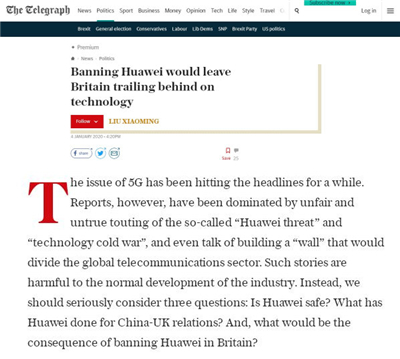
Banning Huawei would leave Britain trailing behind on technology: Ambassador to UK







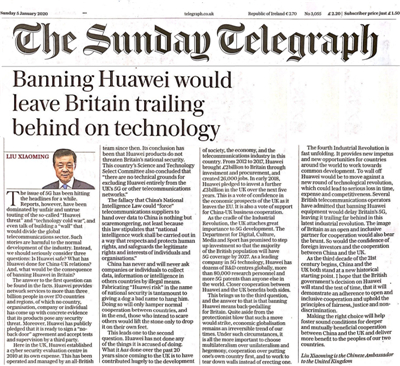
Editor's note: Chinese Ambassador to UK Liu Xiaoming contributes an article to The Sunday Telegraph entitled Banning Huawei would leave Britain trailing behind on technology. Here's the full text.
On 5 January 2019, The Sunday Telegraph carried an article by Ambassador Liu Xiaoming entitled Banning Huawei would leave Britain trailing behind on technology. The full text is as follows:
The issue of 5G has been hitting the headlines for a while. Reports, however, have been dominated by unfair and untrue touting of the so-called "Huawei threat" and "technology cold war", and even talk of building a "wall" that would divide the global telecommunications sector. Such stories are harmful to the normal development of the industry. Instead, we should seriously consider three questions: Is Huawei safe? What has Huawei done for China-UK relations? And, what would be the consequence of banning Huawei in Britain?
The answer to the first question can be found in the facts. Huawei provides network services to more than three billion people in over 170 countries and regions, of which no country, organisation, company or individual has come up with concrete evidence that its products pose any security threat. Moreover, Huawei has publicly pledged that it is ready to sign a "no-back door" agreement and accept tests and supervision by a third party.
Here in the UK, Huawei established a cyber security evaluation centre in 2010 at its own expense. This has been operated and managed by an all-British team since then. Its conclusion has been that Huawei products do not threaten Britain's national security. This country's Science and Technology Select Committee also concluded that "there are no technical grounds for excluding Huawei entirely from the UK's 5G or other telecommunications networks."
The fallacy that China's National Intelligence Law could "force" telecommunications suppliers to hand over data to China is nothing but scaremongering, not least because this law stipulates that "national intelligence work shall be carried out in a way that respects and protects human rights, and safeguards the legitimate rights and interests of individuals and organisations."
China has never and will never ask companies or individuals to collect data, information or intelligence in others countries by illegal means. Fabricating "Huawei risk" in the name of national security is tantamount to giving a dog a bad name to hang him. Doing so will only hamper normal cooperation between countries, and in the end, those who intend to scare others would lift the stone only to drop it on their own feet.
This leads one to the second question. Huawei has not done any of the things it is accused of doing. What it has done over the past 20 years since coming to the UK is to have contributed hugely to the development of society, the economy, and the telecommunications industry in this country. From 2012 to 2017, Huawei brought £2 billion to Britain through investment and procurement, and created 26,000 jobs. In early 2018, Huawei pledged to invest a further £3 billion in the UK over the next five years. This is a vote of confidence in the economic prospects of the UK as it leaves the EU. It is also a vote of support for China-UK business cooperation.
As the cradle of the Industrial Revolution, the UK attaches great importance to 5G development. The Department for Digital, Culture, Media and Sport has promised to step up investment so that the majority of the British population will have 5G coverage by 2027. As a leading company in 5G technology, Huawei has dozens of R&D centres globally, more than 80,000 research personnel and more 5G patents than anyone else in the world. Closer cooperation between Huawei and the UK benefits both sides.
This brings us to the third question, and the answer to that is that banning Huawei means back-pedalling for Britain. Quite aside from the protectionist blow that such a move would strike, economic globalisation remains an irreversible trend of our times. Under such circumstances, it is all the more important to choose multilateralism over unilateralism and hegemony, cooperation over putting one's own country first, and to work to tear down walls instead of erecting one.
The fourth Industrial Revolution is fast unfolding. It provides new impetus and new opportunities for countries around the world to work towards common development. To wall off Huawei would be to move against a new round of technological revolution, which could lead to serious loss in time, expense and competitiveness. Several British telecommunications operators have admitted that banning Huawei equipment would delay Britain's 5G, leaving it trailing far behind in this latest industrial revolution. The image of Britain as an open and inclusive partner for cooperation would also bear the brunt. So would the confidence of foreign investors and the cooperation between China and the UK.
As the third decade of the 21st century begins, China and the UK both stand at a new historical starting point. I hope that the British government's decision on Huawei will stand the test of time, that it will demonstrate an adherence to open and inclusive cooperation and uphold the principles of fairness, justice and non-discrimination.
Making the right choice will help foster sound conditions for deeper and mutually beneficial cooperation between China and the UK and deliver more benefit to the peoples of our two countries.