America's stalemate versus China's competitiveness







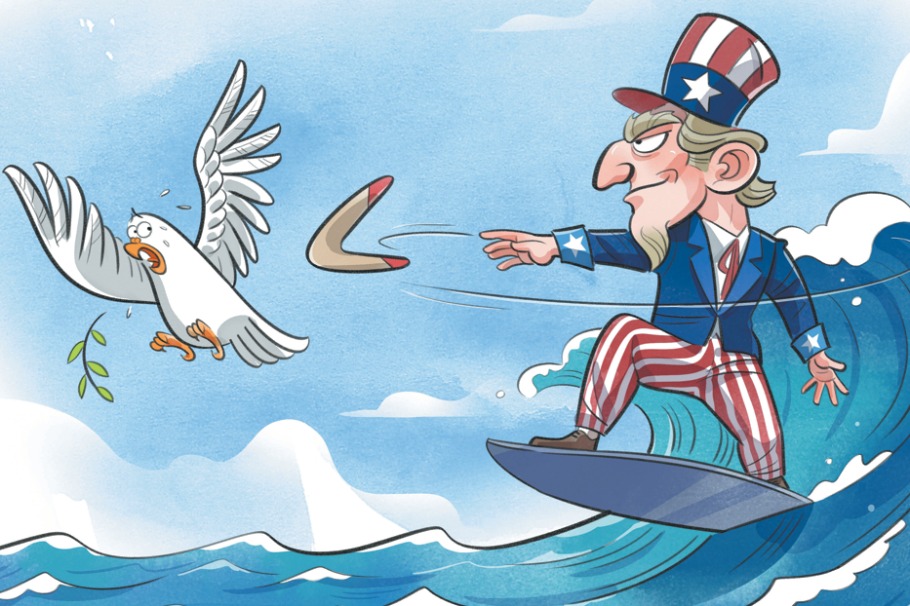
The end of 2019 saw, according to Washington rhetoric, a "deal" on Sino-American trade. Is this true? The US administration has not dropped any of the taxes that have been erected so far, it has simply not added to them. This little propaganda aimed at the average Trump voter who is unaware of the real functioning of the economy draws three realities: the US economy gains nothing from the maneuvering and China accelerates its own policy of rebalancing; the "allies" of the United States are rediscovering that the American DNA is not historically free trade, and that this American unilateralism could become structural regardless of the current poor intellectual quality of the debate.
Let’s take a closer look at the “deal”? The 25 percent tariffs on 250 billion US imports of Chinese products previously put in place have not been cancelled; there is no peace or even truce, just a stop before the US unilateral bidding that envisaged taxing an additional 360 billion at 15 percent. For most of these imports, the US economy is not capable of producing them competitively and only a small part is substitutable by imports from other countries; the result is an additional cost for US equipment manufacturers and assemblers in several industries, for food chains and therefore for consumers; these taxes, which are an affront to world stability and which remain after the December agreement because of Washington's own actions, are therefore detrimental first and foremost to the American people. Its president thinks he has brought back a "deal" to his electorate, the people will decide.
If he speaks of a deal, it is because China has committed to an additional $200 billion in purchases of American products and services, notably in energy and agri-food goods. This additional demand will support the prices of these sectors, which are concentrated oligopolistically in the hands of the friends of the billionaire president and not really in the hands of the base of his electorate; on who understands the economy between the president and his electorate the least will depend the appreciation of the unequal internal American character of the "deal". Finally, the volume of demand and even less employment will be only slightly pulled upwards: at constant production, the withdrawal of these volumes from the domestic market or from sales to other export markets will see a correlative decrease in the trade surpluses of the United States with other countries; almost zero impact on the overall trade balance of the country, zero impact on employment and wages but not on profits nor the propaganda of the bilateral trade relationship isolated from its context. And in the end, there is no gain in competitiveness for the US economy, which will not invest but will seek an annuity.
Does China lose to the "deal"? Not at all; the economy is not a zero-sum game; the country is rebalancing its overall foreign trade and part of this increase in imports corresponds to purchases that would have taken place anyway, and for another part will be readjusted by a slower growth of imports of the same goods from its other partners. The Chinese ship continues in its wake and it is in fact the other trading partners of these two giants that are affected; they now clearly know that the origin of the disorders lies in the White House in Washington and this will leave a lasting scar in the image of America, which we now remember has been alternately isolationist and Wilsonist. Today it may be that it is politically isolationist and economically interventionist, i.e. illiberal.
More and more steps are indeed being taken toward this illiberalism.
The foundation of American illiberalism is the plutocracy. Donald Trump's latest "outing" to date was to lament the fact that China had become "strong" thanks to Chinese investment. Apart from the fact that "strength" has no meaning in economics - it is competitiveness that has one and the reality is that the competitiveness of the American territory is weak -, if China is competitive, it owes it like any other country first of all to its work and its local macro-economic conditions. As for the minority investment by American companies, what have they done with their profits? They have not reinvested them in the American economy, nor in the training of American workers, but in dividends to shareholders; the debate in the United States on inequality is very strong, and inequality is the result of this selfish American national behavior. The trade treaties inspired by the United States aimed in their clauses at inequality, as the American Nobel Prize winner Joseph Stiglitz confirms
On the other hand, Chinese companies have reinvested their profits partly in international investment - including to the United States where they create jobs - but mainly in research, technical improvement and employee training in China; the Chinese state has invested its own budget in education, which is not the choice America has made. Same contrast to eradicate poverty. In short, China's competitiveness is largely due to the Chinese national strategy and the efforts of its people; if there is "strength", it is moral strength, and the American public debate precisely today questions the morality of the "elites" in New York and Washington. We can give this definition of the American plutocracy: America is enriched by trade with China but has decided to enrich only a minority of Americans. America has not "strengthened" China but has morally weakened itself; by looking for scapegoats in China and Europe, the billionaire-president has elected the real, internal American debate.
It is to avoid this real debate that today the White House intervenes in trade, in technological relations that prohibit American companies from using this or that supplier - American industrialists are the first to complain about this - and intervening in cross-border investments. The fact that these interventionisms are ineffective does not make them any less interventionist, and America is today on the way to becoming one of the countries that is accelerating most towards illiberalism.
What about the post-Trump era, whether it is near or far? From Joe Biden to Elizabeth Warren to Bernie Sanders, everyone thinks that tariffs are a good way to negotiate. This debate that has haunted the United States since its foundation when they were victims of English taxes and then taxed trade themselves in order not to tax their citizens, this old 18th century debate of a then emerging country, should it be imposed on the world of the 21st century after two centuries of progress on free trade and the regulation of plutocracies? The so-called "deal" should open our eyes.
Jo?l Ruet, president of the Bridge Tank, expert in emerging economy