



HK ban on face masks not new, analysts say







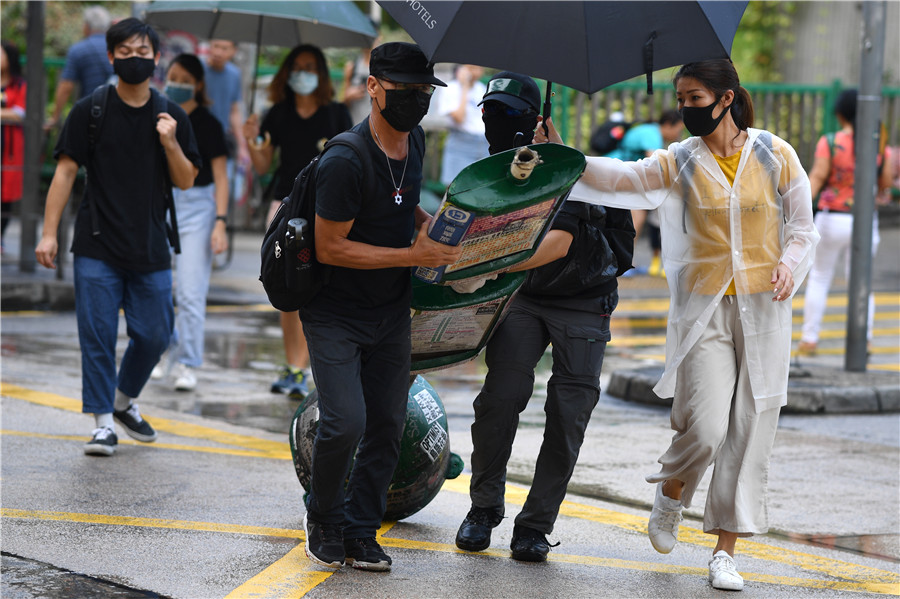
Items used in demonstrations considered illegal in many countries
The Hong Kong Special Administrative Region's ban on face masks in public assemblies starting Oct 5 is not new in the global context, according to analysts.
In dozens of countries, the wearing of face masks, especially during street protests and demonstrations, is against the law, they said.
"You can see why the authorities ban them (face masks), and you can see why people wear them," said Murray Lee, professor of criminology at The University of Sydney.
"Police want to see who they are up against, and the people on the streets don't want to be seen - not with facial recognition technology and social media.
"So they cover their faces. This frustrates the authorities trying to figure out who the leaders are," Lee said.
"Obviously if you are confronting thousands of people wearing masks it would be next to impossible to arrest them all, so you arrest a couple and make examples out of them, hoping no one else will follow ... that is the theory."
Hong Kong's ban on face masks is not unique and such laws have existed in many countries around the world, Lee said.
Earlier this year, at the height of the gilets jaunes (yellow vest) movement in France, the government banned the wearing of masks, including penalties of 15,000 euros ($16,500) and a year in jail. But the ban did not stop people from taking to the streets.
As early as 1723, the United Kingdom passed the Black Act, criminalizing having one's face blackened or being disguised. That law was not repealed until 1823.
Wearing masks in public is not illegal in the UK but current laws exist to have them removed under Section 60 of the Criminal Justice and Public Order Act if authorities feel public order is at risk.
A spokesperson for London's Metropolitan Police said the law exists not just for protests or demonstrations but to maintain public order.
"There needs to be sufficient justification, however, for it to be put in place and only for a predefined time period," the spokesperson said.
In the United States, which prides itself on its civil liberties, many states have laws dating back to the 1800s banning the wearing of face masks. New York, for example, banned face masks in 1845 as a public safety issue following riots between landlords and tenants. The law was updated a few years ago during the Occupy Movement, where activists began wearing Guy Fawkes masks. The mask is a depiction of Guy Fawkes, a member of the Gunpowder Plot, which was a bid to blow up the House of Lords in London in 1605.
In the 20th century, various US states and municipalities passed laws to stop members of the Ku Klux Klan white supremacist organization from hiding their identities by wearing white hoods, but it had little effect.
These laws have been challenged on the grounds that they violate the guarantees of the First Amendment to the US Constitution to free speech and free association. Some courts have weighed freedom of speech against the public safety interest and upheld such laws.
Face masks worn in political protests are also banned in many European countries. Canada banned the wearing of face masks in 2013 by those involved in riots and unlawful assemblies.
In Australia, various states have tried to ban the wearing of face masks in public but have failed for numerous reasons.
The Hong Kong authorities have imposed a ban on all "facial coverings" by those taking part in public meetings and processions, as well as on those involved in unlawful assemblies and riots.
The exception will be for those wearing masks for health reasons or if required by their profession. The new law carries a penalty of one year in jail and a fine of about $3,000. Disobeying a police order to remove a mask carries an additional six-month penalty and fine.
Hannah Robert, lecturer at La Trobe University's Law School in Melbourne, said she did not think such bans were very effective.
"By invoking emergency powers not used for 50 years, the authorities have turned the international focus back on Hong Kong," she said.
Professor Janet Ransley, director of the Griffith Criminology Institute at Griffith University in Queensland, agreed, saying, "You have to ask yourself what these bans are trying to achieve - increasing arrests, or reducing the incentive of people wanting to take part."
"There is no data, as far as I know, to suggest (such bans) are effective. Perhaps they act as a deterrent, but it all depends on the issue or issues that have led to the demonstrations ... ," Ransley said.
Protesters wearing masks is an issue of concern in both China and the US. Authorities in Portland, Oregon, are considering outlawing the wearing of masks by protesters as the US city has experienced violent clashes between right and leftwing groups, with some members wearing masks.
"Wearing a mask ... does remove some of the barriers to bad behavior, because you know you will less likely be detected," said Kevin Sali, a criminal law specialist in Portland.
"The law should be narrowly tailored to the specific harm you try to address," Sali said. "There always will be constitutional obstacles at both the federal level and at the state level when US state and cities want to pass anti-mask laws, which will often put limits on the law."
In July, a spokesperson for Portland Mayor Ted Wheeler told The Wall Street Journal that the city was considering a mask ban.
On June 29, a march by the rightwing Proud Boys group and counterprotests in the city led to violence that was seen online around the world. A conservative writer named Andy Ngo said he was assaulted by many mask-wearing, far-left-leaning militant antifascist members.
Following the incident, Portland Police Chief Danielle Outlaw called for a ban on masked protests.
"A lot of people are emboldened because they know they can't be identified," Outlaw said during a news conference.
Many supporters voiced support on the social media page where the move was announced, but also expressed concerns about the time needed to make the law a reality.
"I fully support the First Amendment rights to free speech, but we cannot continue to allow people to use the guise of free speech to commit crime," Outlaw said to local media KATU News.
In Massachusetts, Senator Dean Tran and Boston City Councilman Tim McCarthy proposed a ban against face masks after protests at the Aug 31 "Straight Pride Parade" in Boston. Many protesters wore masks. Four police officers were injured and 36 protesters arrested.
On Sept 2, Tran tweeted in favor of prohibiting protesters from covering their faces in public.
"It is time federal, state and local (authorities) make it illegal to cover your faces in public events and demonstrations. A danger to public safety and our police officers. No one or group is above the law."
In Hong Kong, two people, an 18-year-old male university student and a 38-year-old woman, were charged on Oct 7 with violations after the ban on face masks took effect. They were charged with one count of unlawful assembly. The duo were granted bail 10 minutes after the court heard the charges. Their cases were postponed to Nov 18.


- First nighttime high-speed departs from Guangzhou for Wuhan
- Chongqing, Hunan, Guizhou host cross-province Spring Festival celebration
- Foreign diplomats join Chongqing's New Year market event
- Researchers discover natural hydrogen trapped in Qinghai-Tibet Plateau
- Yunnan researchers reveal Cambrian vertebrates may have had 'four eyes'
- Scientists uncover response mechanisms of alpine plants phenology to climate change












