


Subsidies help soybean farmers grow their business







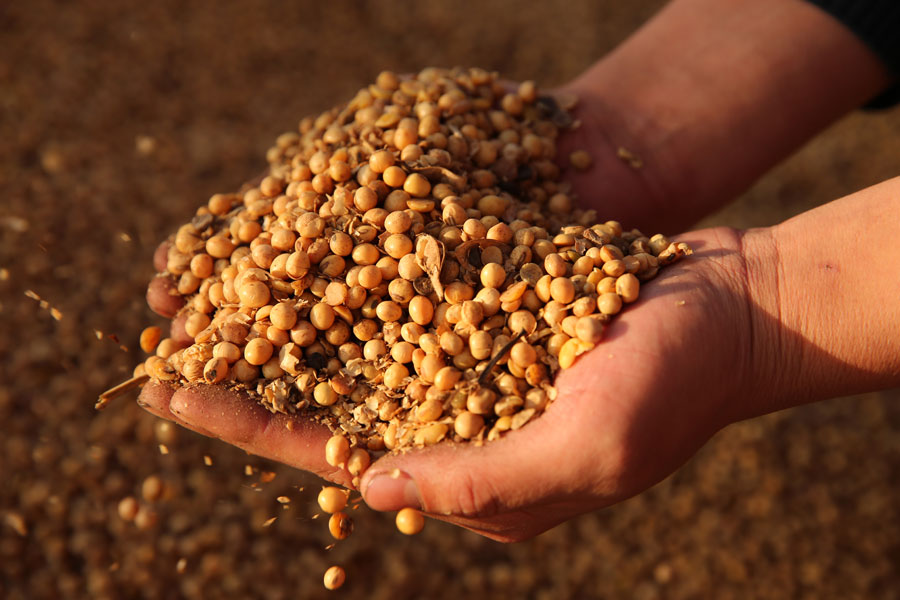
More government support encourages planting of the crop
Sun Anfu, a farmer in an area of Heilongjiang province known for its high-quality soybeans, now devotes all his land to the crop, having increased the proportion continually in recent years.
In 2017, of his 100 hectares of land in Haiwang village in Hailun, one-third was sown with soybeans and the rest with corn.
Last year, the subsidy for planting soybeans increased from a year earlier.
In response, Sun expanded his soybean planting and now it is the only commodity he grows.
"Soybean prices have continued to rise since last year, and with the subsidies, profits from growing soybeans are now higher than from growing corn," he said. "Of all 600 households in the village, more than 500 have increased soybean planting."
Last year, with subsidies from the local government included, Sun said he earned about 5,000 yuan for each hectare of soybean crops compared with 1,500 yuan for each hectare of corn.
"Soybeans grown here in Hailun are high-quality and sell well, and most of those I harvest go to big food processing factories nearby," he said. "I can sell the soybeans for about 4 yuan a kilogram, compared with 3.6 yuan last year."
Although Sun wanted to rent more land from farmers in nearby villages to expand his soybean harvest this year, many of them were unwilling to do so, or had increased their rents, so Sun said he gave up.
In Hailun, a national pilot area for high-efficiency production of green and high-quality soybeans, more than 133,000 hectares of farmland have been planted with the crop since 2000, according to Yang Dayong, director of the Green Food Development Office, which is responsible to the city's agricultural and rural affairs bureau.
With higher profits from soybean farming and policies to encourage the growth of such crops adopted by the local government, the amount of land used for soybean planting in the city is expected to rise to 193,000 hectares this year, a year-on-year expansion of 45 percent, accounting for more than half the farmland in Hailun.
The city will also try to take more measures to help farmers to improve soybean productivity and quality, including introducing superior species and promoting new fertilizing technologies to enable the crop to play a more important role in the local economy, Yang said.
Soybean planting has increased nationwide this year, following a national plan proposed by the central government to rejuvenate production of the crop.
The total area of farmland planted with soybeans this year may exceed 8.6 million hectares, a year-on-year rise of more than 667,000 hectares, which would be the fourth consecutive year of growth, according to Pan Wenbo, planting administration head at the Ministry of Agriculture and Rural Affairs.
This year, the central government has provided more support to encourage soybean planting, including continuing to provide subsidies to farmers in the northeast, a major production area for the crop, promoting rotation farming of corn and soybeans, and increasing financial support for major soybean production counties, Pan said.
According to a plan released by the ministry earlier this year to increase domestic soybean production, authorities will introduce more policies to encourage planting of the crop. The policies will include increasing subsidies to farmers and developing new soybean species over the next few years to raise domestic production.
According to the plan, the amount of land used for growing soybeans is expected to rise to 9.3 million hectares by the end of next year and to 10 million hectares by 2022, with per-hectare production and quality also being boosted.
With consumption of soybeans in recent years increasing for their protein and edible oil, the gap between supply and demand has been widening, resulting in China relying on imports, with more than 80 percent of such produce coming from countries such as Brazil and the United States.
In comparison, China is almost self-sufficient in rice, wheat and corn - the nation's three major crops - with domestic production meeting more than 98 percent of total demand.





