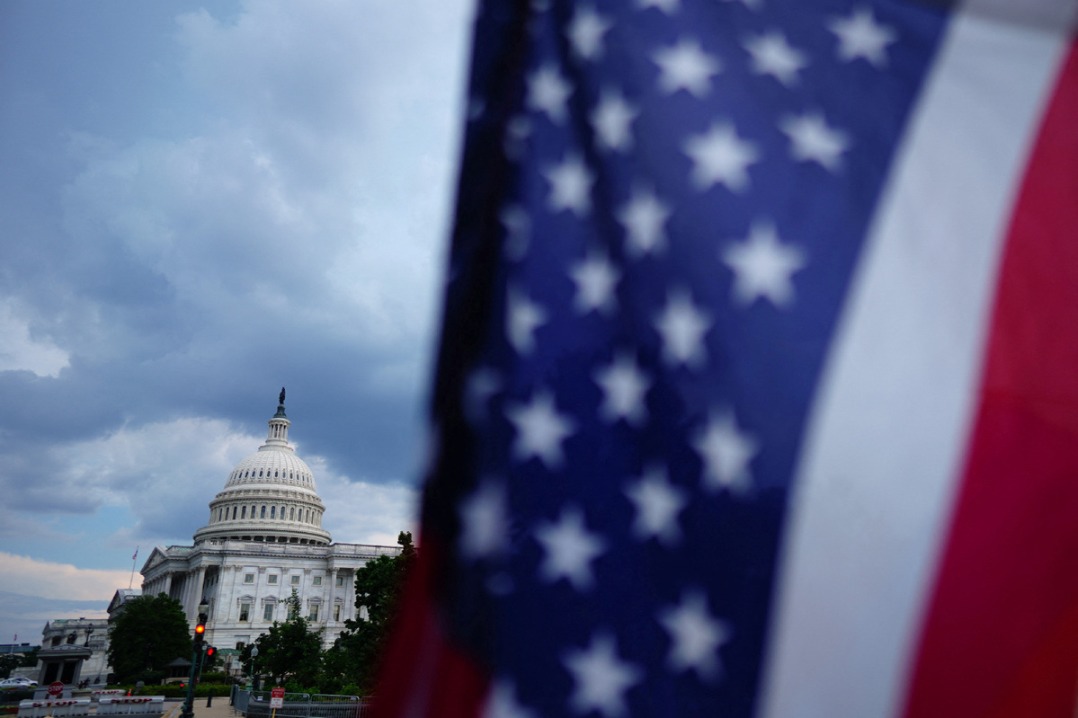
Space exploration should fly the flag for the entire human race







The 2019 space race momentum continues

The start of this year was a good week for fans of international space exploration.
United States space agency NASA managed to send the space probe New Horizons past the Kuiper Belt beyond Neptune, a ring of asteroid particles and cold icy matter.
It also sent another probe into the orbit of the asteroid Bennu, a task that took the equivalent accuracy of shooting a projectile from Los Angeles and landing it on a flying mosquito's wing in New York.
The Chinese National Space Administration, or CNSA, also achieved a first for humanity that made headlines worldwide, when a craft was landed on the far side of the moon, thanks to sophisticated hazard perception technology.
The Chang'e rover, as it was named after the Chinese moon goddess, also sent back stunning never-before-seen images of the surface of the far side of the moon, and confirmed many scientific hunches about the theoretical history of this mysterious part of our celestial backyard.
Six months on from those events, and the wheels of progress and determination are still going round.
While some of us may feel that July has crept up on us worryingly quickly, the world's space organizations are still hard at work racing toward the stars—but this is not a straightforward linear progression.
To quote the words of former US president John F Kennedy, the so-called Moon President, we do not do these things because they are easy, but because they are hard. Earlier this month on July 15, India was forced to delay the launch of the Chandrayaan-2 mission to the moon's south pole, due to technical difficulties and safety concerns.
Despite this, 2019 continues to be a year where the spirit of space endeavor seems to be recapturing imaginations across the world. The potential benefits and subsequent far reaching plans are nothing short of extraordinary.
China's success in landing on the far side of the moon means it will now look to send manned missions there.
The far side of the moon is shielded from electromagnetic radiation emitting from Earth, and therefore provides the perfect site to build an observation point looking into deep space and the furthest reaches of the cosmos without interference. Who knows what wonders may be uncovered by lifting this veil.
This manned operation is scheduled to take place in the mid 2030s, and the European Space Agency, known as ESA, has expressed interest in working with China to make this a reality.
NASA, on the other hand, has its sights set on a manned mission to Mars. This would be a huge step for human beings to set foot on another planet, and could have huge implications for the survival of our species and our destiny as an interplanetary, and then maybe interstellar, civilization.
These could be the first steps toward establishing the next chapter of human existence. The question of whether Mars was once capable of supporting life could be a step closer to being answered.
Earlier this month, however, NASA administrator Jim Bridenstine stated that humans would be on Mars right now, had it not been for hesitancy over the cost.
It has been now almost 50 years since the last human being set foot on the moon, in 1972. We should be excited that we now live in a time where plans have seemingly turned into action, and the wheel of progress is once again turning.
Potential collaborations such as between the ESA and CNSA can only further accelerate such projects, and share the benefits across the globe.
US President Donald Trump has stated that putting an American flag on Mars would mean a great deal for his citizens. As much as this is true, working together may make the journey both sweeter and shorter.