Trade talks no reason to drop guard







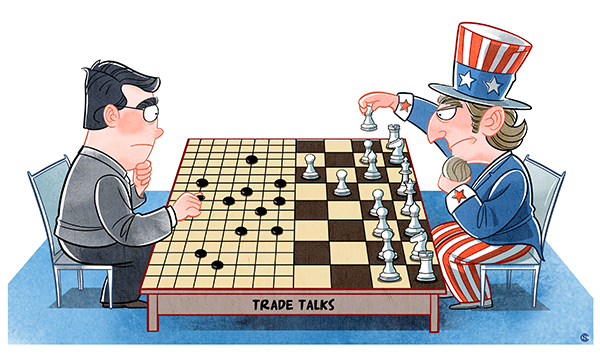
President Xi Jinping and his US counterpart Donald Trump may have agreed at the G20 summit in Osaka to resume trade negotiations, but the path to ending the trade war remains far from clear. After all, the two leaders had reached a similar agreement at the G20 summit in Buenos Aires in December 2018 and that agreement ultimately failed, not least because the United States administration mistook China's conciliatory attitude for weakness.
Whether the US administration makes the same mistake this time remains to be seen. In any case, it is worth considering how the trade war might unfold over the coming months and years - and what China can do to protect itself.
US has not withdrawn tariffs it imposed earlier
Import tariffs may, for the foreseeable future, remain steady - neither escalating nor being rolled back. The agreement in Osaka kept the US administration from following through on its threat to impose additional tariffs on $300 billion worth of Chinese goods. But it did nothing to reverse past measures, such as the 15-percentage-point tariff hike, to 25 percent on $200 billion worth of Chinese products that the US implemented after the 11th round of talks broke down in May.
While these tariffs have not yet had serious consequences for China's economy, their effects are likely to deepen over time. But China may succeed in persuading the US to remove them - or, at least, not raise them further - if it refrains from retaliating with tariffs of its own on US goods. Instead, China should focus on reducing its bilateral trade surplus with the US on its own terms. It is increasingly clear that the US tariffs have done more damage to American businesses and consumers than to China's.
Already, opposition to the Washington-triggered trade war is intensifying within the US. For example, the US Chamber of Commerce - one of the country's most powerful business lobbies - has called for the reversal of all tariffs imposed over the past two years.
The effects of the trade war have already spread to cross-border investment. In recent years, rising Chinese production costs have driven many foreign enterprises - and, increasingly, even Chinese enterprises - to relocate their operations to lower-cost countries such as Vietnam and Thailand. The trade war is accelerating this process. According to the Vietnamese government, inward foreign direct investment increased by nearly 70 percent year-on-year in the first five months of 2019, the highest such increase since 2015. Meanwhile, the growth of US investment in China is slowing.
Essential to improve investment environment
The US administration wants American companies to leave China. It is up to China to persuade them to stay. That means improving the local investment environment, including responding to foreign companies' justifiable complaints - say, by strengthening intellectual property rights protection - and, more broadly, better adhering to World Trade Organization rules.
But the pressure on China does not end there. The US is also eager to exclude the country's high-tech companies from global value chains. Trump recently announced that he would allow US companies to continue to sell to Chinese high-tech giant Huawei, after a months-long campaign against the company. But it remains highly unlikely that the US administration - which reversed a similarly aggressive policy toward smartphone company ZTE last year - will abandon its efforts to strangle China's high-tech industries.
China has three options. First, it could accede to US pressure to disengage from global value chains. Second, it could remain committed to integration, hoping that, thanks to existing interconnections, sanctions on Chinese high-tech companies will also hurt their US counterparts (such as Qualcomm) enough for the US administration to back down. The third option is to focus on supporting domestic high-tech companies' efforts to strengthen their own positions within global value chains and develop contingency plans.
US will try to subdue China by all means
China's prospects for coping with financial sanctions - which the US administration is likely to use more often - are not so bright. Last month, a US judge found three large Chinese banks in contempt of court for refusing to produce evidence for an investigation into violations of sanctions against the Democratic People's Republic of Korea. The ruling ignores the fact that, according to Chinese law, any request for banking records should be handled in accordance with the US-China mutual legal assistance agreement.
Chinese financial institutions thus need to prepare for more troubles, including the risk of being blacklisted - that is, deprived of the right to use the US dollar and important services, such as the Society for Worldwide Interbank Financial Telecommunication financial messaging service and the Clearing House Interbank Payments System. It is a punishment few companies can survive.
Already, one Chinese bank has been included on the Correspondent Account or Payable-Through Account Sanctions list, meaning that it cannot open correspondent or payable-through accounts in the US.
Make more efforts to internationalize yuan
The Chinese government has few options here, but it can step up legislative efforts to protect Chinese banks' interests, while encouraging Chinese financial institutions to treat compliance with US financial regulations with the utmost care. It should also continue working to internationalize the yuan, as there is still a long way to go on this front.
China remains committed to its 40-year-old process of reform and opening-up. Today, that process must focus on redoubling efforts to strengthen intellectual property rights protection, adhering to competitive neutrality and defending multilateralism. But following through on this commitment will require China to find ways to manage escalating tensions with the US and avoid a costly - and potentially devastating - reconfiguration of the global economy.
The author, a former president of the China Society of World Economics and director of the Institute of World Economics and Politics at the Chinese Academy of Social Sciences, served on the Monetary Policy Committee of the People's Bank of China from 2004 to 2006.
Project Syndicate
The views don't necessarily reflect those of China Daily.