US' futile quest for a yuan Plaza Accord







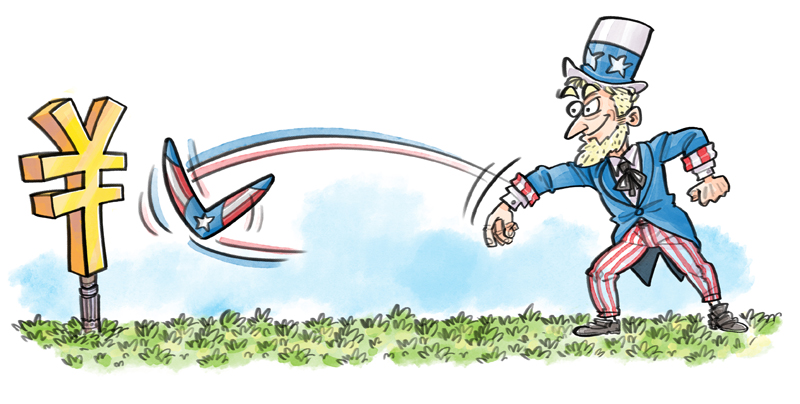
The United States recently raised the tariffs on $200 billion of Chinese goods from 10 percent to 25 percent, while targeting another $300 billion worth of Chinese imports for potential punitive tariffs. As was to be expected, the yuan depreciated from 6.7 toward 6.9 against the US dollar, mainly on renewed trade tensions.
China responded by imposing duties on $60 billion of US goods, starting June 1. In other words, instead of retaliating hard, China chose a mild response that highlights the importance of talks.
The US administration may still be gloating over its misguided tariff stance. Yet the movement of the yuan may not be to the liking of the White House since it is likely to offset the tariff impact.
Tariffs' impact on Chinese and Asian currencies
Until the US' tariff escalation, China's currency was around 6.80 against the US dollar. That, however, was predicated on the expectation that cooler heads would prevail in the White House and a broad-scale trade war was avoidable. But when the US opted for tariff escalation, markets reacted quite expectedly. For now, the Chinese currency has only reversed its appreciation year-to-date.
As the US prepares to raise and broaden tariffs even more, the yuan could depreciate further. But that is the White House's choice, not Beijing's preference. Indeed, the US' tariffs have paced the yuan's fluctuations since the start of the Sino-US trade dispute.
In light of these facts, the claim that China is depreciating the yuan is simply flawed. Depreciation is precisely what China seeks to avoid. When exports shrink, a light depreciation of the currency is of no help. And if the yuan depreciates significantly in a short period of time, it would foster worries about capital flight.
US tariffs to blame for yuan depreciation
That's why the Chinese government has done precisely the reverse: To avoid steeper depreciation and capital outflows, the People's Bank of China (the country's central bank) recently set a stronger-than-expected daily fixing of the exchange rate.
The depreciation of the yuan is in line with that of other emerging-Asia currencies that have taken hits, including the Indonesian rupiah, Singaporean dollar, Malaysian ringgit, the Indian rupee and the exhausted won of the Republic of Korea. By the same token, the US' tariff hike is likely to cause negative spillover effects among the same currencies.
Ironically, those countries that may suffer most of the pain-the ROK and Vietnam-are also targets for the next tariff war. And to think the ROK is a close US ally in Asia. In the future, the US seems intent on targeting Europe, Japan, the ROK and the emerging economies in Southeast Asia.
US will be a collateral damage of its tariff wars
A year ago, Larry Kudlow, director of US National Economic Council, was still gung-ho about US supremacy in the tariff dispute. But recently, he admitted that American consumers would pay for the US' tariff wars. In the US, his reversal is seen as betrayal of American public, and rightly so. As The Washington Post put it, the White House's top economic adviser gives lie to its tariff war rhetoric.
Here are the inconvenient truths: A broad-scale trade war could penalize 0.5 percent to 0.8 percent off real US GDP growth, while earnings growth could be shaved off by 3 percent. Auto sales are a barometer of what's to come. In 2019, Chinese auto sales could decline by 3 percent but in the US by almost 4 percent. In 2020, US sales could remain in the red, but Chinese sales could increase-according to US data.
Unsurprisingly, several US lawmakers are finally slamming the US' tariff hike on Chinese products. In just a year or two, the US administration has committed some of the worst trade policy mistakes in postwar US history. The resulting economic pain will spread in the US as products shipped from China arrive in about three weeks.
US uses yuan as a scapegoat to distract public attention
For a decade or two, Washington has periodically used the yuan as a scapegoat to distract public spotlight away from rising economic challenges in the US. Yet the yuan's value has been largely in line with fundamentals since the mid-2010s, as the International Monetary Fund has affirmed.
However, the US administration has a more intimate interest in currency manipulation. The controversial Plaza Accord of 1985 led the US, France, West Germany, the United Kingdom and Japan to depreciate the US dollar relative to the Japanese yen and Deutsche mark by intervening in the currency markets.
It was that exchange-rate manipulation that played a key role in Japan's subsequent containment, asset bubbles, deflation and secular stagnation. And it is the same dream that seems to fuel the US trade hawks' fantasies about China's containment and stagnation. Yet China is not Japan, dreams are just dreams, and the White House is in for an awakening.
The author is the founder of Difference Group and has served at the India, China and America Institute (US), Shanghai Institute for International Studies (China) and the EU Centre (Singapore).
The views don't necessarily represent those of China Daily.