China, US negotiations should focus on building good long-term relations







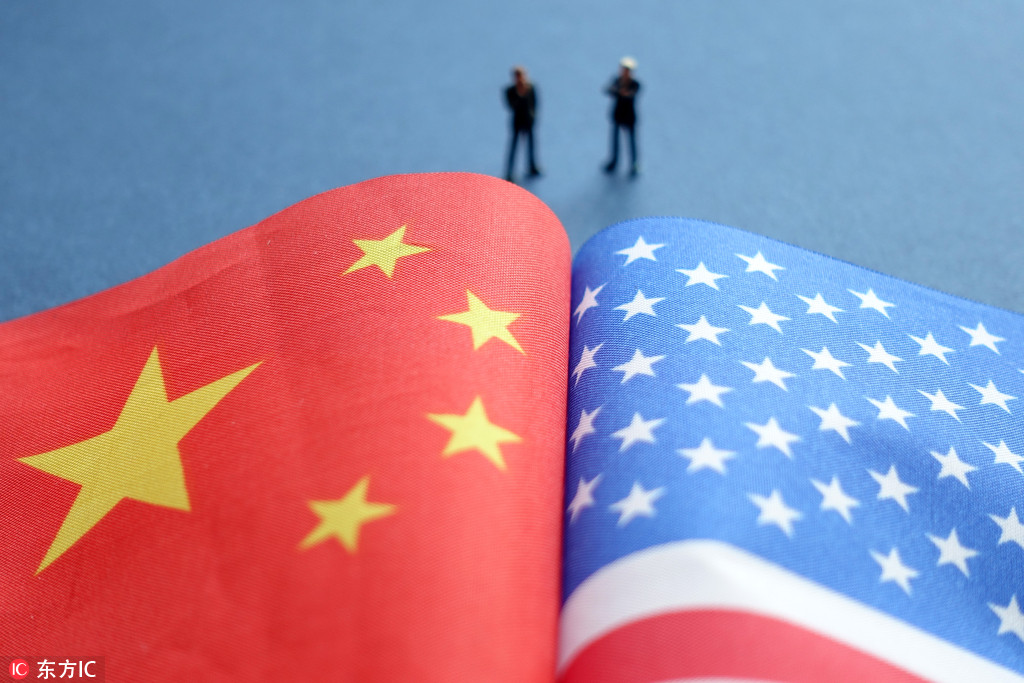
Trade issues pale in importance compared to the need to maintain good economic, political and people-to-people relations between China and the US. Most of the economic concerns are short-term and relatively small, but the China-US relationship will shape the state of the world for decades.
I'm an American living in China and married to a Chinese woman, so I have a strong interest in and love for both countries. The deterioration in economic relations over the last 10 years or so frightens me. Let's look at what is important, and what's not.
According to a recent study by the San Francisco Federal Reserve Bank, imports from China constitute only 1.76 percent of US consumer spending. On the other side, China's trade with the US amounts to less than 5 percent of its GDP. These numbers are not tiny, but they are also not large enough to much affect the lives of most people.
However, limited groups of workers and companies are directly affected.
A principal goal of both governments it to protect lower-skilled industrial workers. The US administration is trying to restore the kinds of factory jobs that once gave working class people a shot at a middle-class lifestyle. And, China is aiming to protect the jobs of factory workers in its export industries.
But, any protection of those low-skilled jobs will have to be short-term and transitional in both countries. US wages have long been too high to allow industries based primarily on low wages to locate there. Only the artificial separation of work forces in India, China, and the former Soviet Union from Western markets allowed those jobs to exist from the 1940s to the 1970s.
In China, incomes and wages have risen sharply, so a business based on low-wage labor will no longer work there, either. The only long-term solution for both countries is to upgrade to higher value-added manufacturing and service jobs. The two countries should be focused on how to manage this transition.
Since WWII, the US has had a history of allowing developing nations easy access to its markets, but then restricted this access when a country became more advanced.
From 1945 until about 1970, Western European countries, especially Germany, had easy access to US markets and the US did not require access to European market. European currencies were strongly undervalued. From the US point of view, this was okay when European producers were small and technologically inferior. But, by 1970, the Europeans had caught up, so the Nixon administration responded by removing the tie between the dollar and gold, effectively devaluing the dollar.
Similarly, the Japanese enjoyed easy, unreciprocated access to US market from the 1950s through the 1970s. The Japanese yen was strongly undervalued at about 300 hundred yen to the dollar, compared to about 100 today. But, by the 1980s Japanese companies had become highly competitive with US companies, so the US insisted on a rapid upward revaluation of the yen and imposed quotas on the imports of Japanese cars into the US.
In some ways, the current US position in the trade negotiations is similar to those it had earlier with its western allies.
Over the last 20 years, the Chinese and American economies have become strongly intertwined. According to the "gravity model" of trade, countries trade primarily with their near neighbors. For example, Canada and Mexico are traditionally major trading partners with the US. It is unusual for two such distant nations as the US and China to be each other's leading trading partners. Part of the transition over the coming decade will be a partial separation of the two economies and a diversification of supply chains. America will re-emphasize trade within North America and China will increase trade with Belt and Road economies.
Americans need to realize that China has to upgrade its productivity and its technology. This is the only way it can escape the middle-income trap over the next 10 years.
This upgrading is driven primarily by Chinese firms competing in China's highly competitive markets. Senior leaders of tech companies tell me that the Chinese tech market is much more competitive than Silicon Valley is. Many Americans stress the roles of State-owned enterprises and government R&D or investment subsidies, but these factors are small compared to the role of China's competitive entrepreneurial firms.
There are definitely some influential people in the current and past US administrations who write a lot about stopping the rise of China as a "peer competitor." In my view, this is just silly. The world is not the same as it was in 1990. The Chinese economy already exceeds the size of the US economy on a purchasing power parity (local price adjusted) basis and will soon exceed it in terms measured GDP. The two countries will always be partly rivals in business and international politics, but they don't have to be hostile rivals.
On Tuesday, President Trump described the trade dispute as "a little squabble" in the midst of a good relationship. In terms of long-term economics, he is right.
But, Winston Churchill said, "History is just one damn thing after another." The only really important goal is to be sure that the relationship between China and the US does not become one of those things. From a hard-headed realist point of view, the disputes between the US and China look small and short-term compared to the real interests we share in common.
The author is an American scholar on economics, and a copy editor with China Daily.
The opinions expressed here are those of the writer and do not necessarily represent the views of China Daily and China Daily website.